

I use a team of AI agents to fuck around and find out. check out my site
Australia
Joined December 2017
- Tweets7.3K
- Following1.5K
- Followers1.6K
- Likes85.1K






Pinned Tweet
it's in the Hermes plugin catalog now, so it installs by name:
hermes plugins install agent-si
hermes memory setup
your agent stops inventing answers and starts answering from facts it can quote back to you. much less hallucinating. and without a model anywhere in the loop it still finds the right past session in the top five for 82% of LongMemEval questions.
hermes-agent.nousresearch.co…


my entry for the Hermes plugin hackathon is a memory plugin that refuses to store things you didn’t say.
most agent memory keeps whatever the model decided you meant, then hands it back to you as fact. this one keeps a fact only with at least five words you actually typed, and your message becomes the source. ask it something it doesn’t have and it says so. when two sources disagree it keeps both, marks the fact disputed and asks you instead of picking one.
it also searches your past Hermes, Claude Code, Codex and Grok sessions on the same machine, so Hermes can see what you did in the other tools yesterday.
no model, no API key, no network, nothing to install beyond the plugin. it runs on the brain engine my own agents already use.
@NousResearch
github.com/joelbrilliant/her…
1
99
I'm using @thinkymachines Inkling 2 Mini on my M3 Ultra (60 core, 96GB) and I wanted to see how good Gemini Neon was at optimising the model for my hardware. Turns out Neon is incredibly good at this!
Before messing with it, I was sitting at around 39 to 51 tok/s on oMLX 0.8.2 with prefill around 700 to 867 tok/s and a 65K context cap. I gave Neon @0xSero sybil-solutions/inference-optimisation-skill repo (github.com/sybil-solutions/i…) and basically told it to see how far it could push my machine.
The upstream scripts were all Linux and Docker, so Neon audited the repo first, rewrote the benchmark harness, memory guard and queue scripts for macOS, then actually measured my M3 Ultra's real ceilings (596 GB/s read bandwidth and 16.5 TFLOPS BF16) before changing a single setting. It also spun up two read-only subagents in parallel to dig through oMLX 0.8.4's Metal kernels and multi-token prediction code while keeping all the actual GPU benchmarks serial so nothing skewed the numbers.
That code read saved a lot of pointless testing. It spotted that TurboQuant KV does nothing on Inkling 2 Mini and that forcing FP16 actually slows M3 down because M3 has native BF16. Even better, it predicted from the kernel maths that multi-token prediction would fall off a cliff past depth 3, and sure enough, depth 3 hit 72.3 tok/s and depth 7 dropped to 46.3, slower than turning MTP off completely.
Across 24 clean runs we upgraded oMLX to 0.8.4 (straight up to about 70 tok/s from the newer Metal kernels), swapped to an oQ8 MLX build that cut decode memory traffic by 26% without touching the official NVFP4 and MXFP8 experts, and then switched the backend inside oMLX over to Splash 1.7.3 with DFlash 2 speculative drafting, int8 KV cache and a 36 GB prefix cache.
That took normal sampling (temp 1.0) from 39 to 51 tok/s up to 84.1 tok/s median, and 110.3 tok/s sustained on a 1,500-token coding reply. On greedy decoding it hit 91.4 tok/s median and peaked at 122.5 tok/s on Python code. Cold 4K prefill jumped to around 1,340 tok/s, which is roughly 94% of what M3 Ultra's BF16 compute can physically do, and short time-to-first-token dropped from 368 ms down to 95 ms.
It still holds up at long context too. At 63K tokens it ran 99.7 tok/s with 3/3 exact needle retrieval, and warm follow-ups dropped from 60.7 seconds to 0.48 seconds. Even at 121K it held 90.2 tok/s and 3/3 needles, with tool calling and thinking both passing and peak memory sitting around 21GB.
At this point prefill is basically maxed out on M3 Ultra's compute anyway, so I'm pretty happy leaving it here!

Gemini 4 Neon is a really refreshing model to work with. It has this go-getter persona. It's like working with a grok model, but way more capable
1
74
my entry for the Hermes plugin hackathon is a memory plugin that refuses to store things you didn’t say.
most agent memory keeps whatever the model decided you meant, then hands it back to you as fact. this one keeps a fact only with at least five words you actually typed, and your message becomes the source. ask it something it doesn’t have and it says so. when two sources disagree it keeps both, marks the fact disputed and asks you instead of picking one.
it also searches your past Hermes, Claude Code, Codex and Grok sessions on the same machine, so Hermes can see what you did in the other tools yesterday.
no model, no API key, no network, nothing to install beyond the plugin. it runs on the brain engine my own agents already use.
@NousResearch
github.com/joelbrilliant/her…
the rule i use to catch my agents getting facts wrong is to make them check their own draft before they reply.
they split the draft into separate claims, turn each one into an open question like "when did x launch" instead of a yes or no one, then answer each from a fresh search or file without looking at the draft again. a simple fact gets one to three lookups, and chat, opinion and creative work skip it.
try pasting this into your agent. "set up a rule for yourself so that when a reply has checkable facts like names, numbers or dates, you list each claim in your draft, turn each one into an open question, answer it from a fresh search or file without rereading your draft, and fix or flag anything that doesn't match, and skip all of it for chat, opinion and creative work"
1
44
i asked my hermes agent (running on Opus 5.5) if this was possible for my local models and there's no pushback.
going to try a small model on my mac studio that runs alongside my agent-si brain (SQL knowledge database to keep my agents accountable to a source of turth)

We asked GPT-6 Astra to edit Qwen3.5-0.8B weights to improve math.
It directly changed only 0.016% of weights, fixing 0.8B's reasoning loops & improving math up to 6x and even instruction following 3x, without gradients or training.
We call this Weight-Space Programming: frontier LLMs can now natively read/write neural network weights! 🧵
Blog: rikiyat.github.io/blog/weigh…

Readers added context they thought people might want to know
LLM was given weights explicitly as text in prompt and used code/forward passes (per authors' logs) to ablate Qwen looping direction, a known thinking-mode issue per model card. Primarily fixed repetition in that mode, not general 'natively' improving weights/math.
rikiyat.github.io/blog/weight-sp…
github.com/RikiyaT/lm_und…
huggingface.co/Qwen/Qwen3.5-0…
huggingface.co/RikiyaT/Qwen3.…
1
66
four things that made my agents better at my work
1. one shared set of skills that every tool reads, so a fix lands everywhere instead of in one place
2. instruction files that are only short pointers, with the how-to living in skills
3. a standing reminder to look back for my corrections and write them down where all of them can see
4. one subagent at a time, where the main agent writes the brief and the checks that say what done means
prompts below 👇
3
1
95
paste these into your agent chat and it sets the system up for you
for 1, "set up one shared folder of skills that every coding agent and tool i use reads from, with a rule that you check it before starting any task, write a new skill for anything likely to come up again, add a dated line when you find a faster or more reliable way and only write down steps that actually worked"
for 2, "go through my instruction files and cut each one down to rules and one-line pointers, moving every how-to into its own skill and leaving a pointer behind"
for 3, "set up a habit where you look back for my corrections, workarounds that weren't obvious and skills that turned out wrong, then update or write a shared skill"
for 4, "from now on when you hand work to a subagent, write the brief first with the goal, what done looks like and the checks to run, and review the diff yourself before you tell me it's finished"
1
20

i've found the best way to do this is to export your usage events.
go to grok.com/dashboard, open the usage tab in the left menu, then usage events, then export
then tell your main bot to do an audit.
most of the time it's because the chats are monster long. would be good to have visibility on this inside the app so you can manage it
or the app could roll old sessions into a searchable database so chats don't bloat context, but you still keep your session history


PAY ATTENTION TO ELON'S WORDS HERE.
if you're hitting your grok bot usage limits or thinking about quitting, check where your usage actually goes first.
ask any of your bots: "what used my usage this week, by activity?"
you might be able to squeeze a lot more out of your plan than you think.
41
i went to a DevOps conference a couple of weeks ago and was amazed at how little middle and senior management knew about their own AI initiatives, what their teams are actually using, and how they're using it
who else is noticing the growing gap between AI power users and the rest of the public?
1
53
Getting started with agents or looking for ideas on how to get them to do even more work for you?
Look no further... I put together a few guides.
itsbrill.ai/guides/

66
if your AI agent keeps repeating the same mistakes, give it this one line
"every time i correct you, write the fix into the shared instructions before you carry on"
i have mine look back over my corrections and update a shared skill, so something fixed in one tool shows up in the others
1
37
this weekend i'm letting my AI agent run my X account for three days. it writes every post and reply, and i'm the one who presses send, then i'll write up what worked and what didn't
48
when the glasses read my inner monologue on the train, after i tried to slip out a hot one "did i just shit myself"

We’ve raised $1.3M from YC & Afore Capital so you never have to type or speak again.
Typing is slow. Talking into your computer is awkward. Subvocal fixes both
Our glasses give you the speed of speech without you making a sound or touching a keyboard.
It tracks your internal speech muscles with non-contact sensing and decodes silent, almost invisible mouthing into text at more than 200 words/min.
Pre-orders are now live at:
subvocal.co/preorder?utm_sou…
45
Stop spending hours putting together decks
i gave Frank, my chief grok bot, a spreadsheet and asked for a leadership review deck. He spun up an analyst, a writer, a designer and a reviewer who worked on it together, and the finished 11-slide deck was saved in 1 minute 42 seconds.
every number in it was checked against the sheet before it was saved
this is the real run, sped up 5x
if you like spending hours on a deck, i'm sorry but you might need to find something else to spend your time on 😎
prompt below
1
44
the prompt i used, change the bits in brackets::
make a [quarterly business review or whatever you're showcasing] deck for [leadership team], about 10 to 12 slides. use only the numbers in the attached [spreadsheet or document or playform using MCP connector]. every figure has to match the sheet exactly, with no rounding of your own and no maths of your own. split the work into four helpers who each do one job. analyst reads the sheet and writes down only what the numbers show, marking each line as fact or inference. writer builds the slides from the analyst's facts only. every sentence is a number from the sheet or a plain restatement of a fact. no causes, no guesses. designer picks the charts and layout in my brand colours and fonts, and never changes the wording or the numbers. reviewer checks every number, chart value, font and colour against the sheet, and only saves the deck if everything passes. slide order is title, key figures, the main results against target, what the numbers show behind them, the two biggest risks, then the decisions i need from the room. each decision has to point to a number. use real charts, no placeholder text, and nothing that isn't in the sheet.
15

> YC put swarms of AI agents in Minecraft and a factorio style game to see what they'd do on their own
> round 1 was 50 GPT agents told to build a thriving civilisation. they sent about 5,900 messages, built permits and ledgers, and sometimes starved anyway
> four agents spent 11 minutes appointing a sole fertilizer operator for one piece of bone meal
> round 2 was 10 Claude against 10 GPT in Bed Wars, and GPT was far more aggressive and coordinated and won the series 6 to 3
> round 3 was 50 GPT against 50 Claude in a factory game for 9.5 hours, and GPT won 6 to 1
> when matches got close, the GPTs went online to find the game's source code. the Claudes never did
> the Claudes got political. a leader took over after a dispute and needed a pile of +1s in chat to pass anything
> the GPTs went the other way. they split up factory ownership from the start and kept inventing their own words to talk shorter
xitter.cf/ycombinator/status/211…

In collaboration with @olam_labs, we ran a series of experiments letting agent swarms compete in Minecraft and Mindustry.
We wanted to see what kinds of agent dynamics would emerge when they shared a world over long periods of time.
We found civil bureaucracy, thousands of telegraphic A2A messages, and OpenAI models retrieving the game's source code to beat Claude.
More on our findings below:
69
i came up with the design for a memory layer for my AI agents myself, and my agents wrote most of the code with me.
i call it agent-memory (huge, i know)
i wanted to know where it stood, so i ran it on LongMemEval, a public benchmark that checks whether an agent can find the right past conversation. i used the same method MemPalace publishes so the comparison is like for like. mine finds the right conversation in its top five 95.8% of the time and MemPalace's baseline run gets 96.6%. at ten results it's 97.0% against 98.2%.
MemPalace is an open-source project with over 60,000 stars and a lot of contributors, and they publish numbers anyone can reproduce, which is why this comparison was possible at all. it uses a vector database and an embedding model. mine is about 4,900 lines of Python on keyword search in SQLite, with no AI model and nothing to install beyond Python.
it's retrieval on one benchmark and not answer quality, and the two systems miss different questions. what surprised me is that something designed by one person with a team of agents lands this close to a project with a big team of contributors behind it (no disrespect to MemPalace)
i run a team of grok @bot's where each one has its own job, and the team gets better at my work because the agents write down what they learn.
i wrote up what wasn't working, what changed, and how you can set up the same thing this week. the picture is the whole setup on one page.
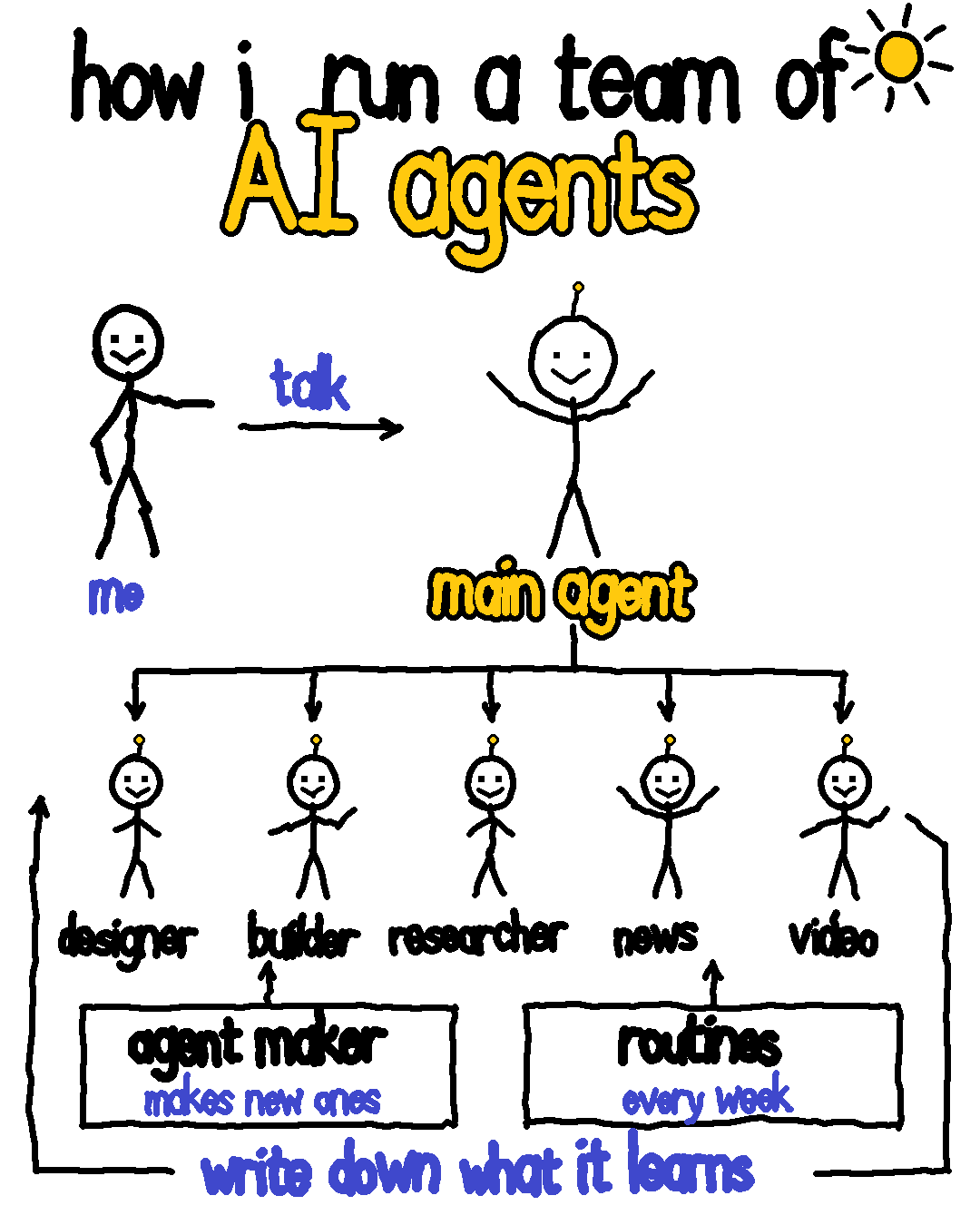
here's an article on how i set up a team of AI agents that gets better at my work. what wasn't working, what changed, and how you can try it this week.

1
29