

Prof., Medical Informatics; AMEE TEL Committee; Ed Boards: Medical Teacher, MedEdPublish. Views are my own.
Austria / Oman
Joined December 2011
- Tweets7.3K
- Following748
- Followers1.7K
- Likes13.6K


Have you ever travelled internationally? Most countries require 8-10 finger prints for visas, and upon entry. USA, EU, and elsewhere, it's standard. I've been printed at least five times in the last 12 months. It's just part of life.


Ken Masters retweeted

This is a big problem for me as GPTs for roleplaying (as a patient) that have been and will be used by hundreds of medical students in our medical school need to be moved to plugins.
Extra workload for me.
Actually we might not need to use ChatGPT if my research project that I'll purchase a powerful GPU device to run local models, but it was rejected. Those who rejected the project are not aware what opportunity for our medical students is missed.
I had to write an irresistable proposal without relying on the idea of "this is sufficient".

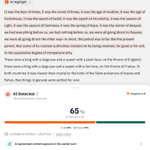
And have you seen that fraud, Charles #Dickens? He also used #AI, as proven by Pangram (Credit: @GolinoHudson). Only 65%, but you can't trust these authors nowadays. No wonder he hasn't published anything since the release of these reliable AI detectors!


Ken Masters retweeted

Almost 100% of the academic text that I write is AI generated and would be flagged as such. It is not a thoughtless text, prompted to be very precise about my thoughts and then carefully edited. It saves me a lot of time and effort and saves the reader from my poor English.
This quoted post is unavailable.

Couldn't agree more. Too often, the "peer" in "peer-review" is forgotten. Sometimes, your peers are just plain wrong. Yes, surprisingly, it happens.:-/

“AI in peer review should be a second reader, not a judge.”
kevinmd.com/2026/09/ai-in-pe…

Ken Masters retweeted

Cat owners have a 30 percent lower risk of dying from a heart attack. A study published in the Journal of Vascular and Interventional Neurology analysed data from 4,435 adults followed over 20 years in the Second National Health and Nutrition Examination Study and found that people who had owned a cat at any point had significantly lower cardiovascular mortality.
The study was led by Adnan Qureshi at the University of Minnesota. He found that cat owners had a 30 percent lower risk of death from myocardial infarction and a lower risk of death from all cardiovascular diseases combined, after adjusting for age, sex, race, blood pressure, cholesterol, diabetes, smoking, BMI, and income. The effect held across every subgroup tested.
The mechanism is likely stress reduction. Cats, unlike dogs, do not need to be walked, which removes the exercise explanation. What they do provide is companionship, tactile contact, and a calming presence that lowers the baseline stress level in the home. Studies on pet interaction have shown that stroking a cat lowers cortisol and blood pressure within minutes, and those small daily reductions compound over years.
The study could not determine whether it was the cat that produced the benefit or whether people who choose to own cats have personality traits that independently protect against heart disease. But the size of the effect, 30 percent, and the length of follow-up, 20 years, made the finding hard to dismiss as coincidence.
A cat does not exercise with you, does not cook for you, and does not remind you to take your medication. It sits on your chest and purrs, and the 20-year data says that is enough. pubmed.ncbi.nlm.nih.gov/2251…

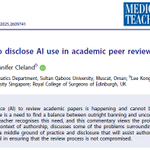
Yes, #AI in peer review has been flagged as an issue for some time. Most publishers, however, simply say "no", which means it happens, but surreptitiously. doi.org/10.1080/0142159X.202… #Meded #HPE


We seriously need to discuss the use of AI in scientific peer review.
Yesterday, we prepared a ~15-page response to a reviewer. We addressed every comment individually and revised the manuscript accordingly.
About 12 hours later, the same reviewer came back with another 2 pages of comments. And these were not simply an assessment of whether we had adequately addressed the original concerns. There were new analyses, new technical details, and new requests that had never been raised in the first round.
Is it humanly possible to carefully read a 15-page response letter, check the revised manuscript and all the changes, critically evaluate them, and then develop an entirely new set of methodological requests within 12 hours?
Perhaps. But it certainly raises questions.
With AI, you can generate an endless list of things authors “could also do”:
“Please perform this subgroup analysis.”
“Add another sensitivity analysis.”
“Repeat the analysis using a different model.”
“Adjust for this additional variable.”
“Validate the findings using another statistical method.”
There is literally no end to this.
And this is not just about whether reviewers use AI. The bigger problem is peer review turning into moving goalposts. Authors address the first-round concerns, only to find that the goalposts have moved and an entirely new set of requests appears in the next round.
Journals need clear rules for AI-assisted peer review. AI use should be disclosed, and unless a genuinely new and critical issue is identified, subsequent review rounds should primarily assess whether the original concerns were adequately addressed.
Otherwise, peer review risks becoming an endless AI prompt loop rather than scientific evaluation.
I fully recognize how difficult it has become for journals to find reviewers, and I am among those who criticize many aspects of the current academic publishing system. But please, if you volunteer to review a paper, don’t make an already exhausting process even more exhausting for authors. Enough is enough.

Request to academic #publishers: when a #reviewer declines & indicates "no time now", that should trigger a removal across all your journals for at least the next two weeks. "No time now" DOES NOT MEAN I'll have the time later today, tomorrow or next week. #HPE #meded
Yes, I think we just have to be patient and wait for publishers to catch up to reality. doi.org/10.1080/0142159X.202… #meded #hpe


Are we creating a double standard around AI in academic publishing?
Authors may increasingly use AI to help prepare a paper, provided they declare its use appropriately.
But reviewers are often told they must not use AI to help review that same paper.
Why is AI assistance acceptable on one side of the publishing process, but not the other?
Is that distinction justified, or do we need to rethink the rules?

"researchers and publishers are exploring how it can support peer review"
Reviewers have been using it for years; editors are trying to introduce it. Publishers are dragging their feet (and, when they finally wake up, will see themselves as forward-thinking). FTFY.
“Ready for the robot reviewers? As AI’s capabilities grow, researchers and publishers are exploring how it can support peer review—and where it still falls short.”
science.org/content/article/…

Publisher sends a review request from a "no-reply" email address, forcing me to go to their site, which gets blocked by my antivirus.
Publisher: Gee, these academics don't even have the courtesy to reply to our review requests.
Ken Masters retweeted
Published last week in @MedTeachJournal:
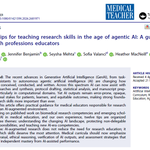
12 tips for educators to support leaner-centered AI integration in #MedEd.
Intrapersonal (individual reflection),
Micro (the immediate educational environment),
Meso (the institution),
Macro (professional organizations),
and Mega (international consortia) levels.


Ken Masters retweeted

Going to see this beautiful tool on detail tonight. What a lovely symposium @itmeded @AMEE_community #AMEE2026


At #AMEE2026, don’t forget to attend this Symposium on Wednesday morning, 26th, 9:00 am. (It won’t be recorded, so the only way to watch it is live, in-person on the day). #AI #hpe #meded @amee_online

Well done! My goodness!

Taking off to Vienna for #AMEE2026 ✈️
This year is extra special as we bring home TWO ASPIRE Awards!
Looking forward to celebrating and exchanging ideas shaping the future of health professions education.
@AMEE_community
#AMEE #MedicalEducation #HealthProfessionsEducation
