

Just do what you can with what you have where you are || Incremental work pays off : 1% daily gain → (1.01)^365 ≈ 38 → ~38x growth/year
Canada 🇨🇦
Joined December 2010
- Tweets419
- Following2.2K
- Followers53
- Likes300




ZX🇨🇦 retweeted

We're giving away a CONTROL Resonant custom wrapped NVIDIA GeForce RTX 5080 to celebrate its official release with #RTXON.
To enter:
🟢 Share this post
🟢 Comment #RTXON
T&Cs: nvda.ws/4z24Gcq

Jev (@typesafeai) came out <2 days ago by Diogo(@CompleteSkeptic), and one idea clicked: autonomous systems may be better designed as decisions over state-dependent action spaces.
#Jev #TypeSafe #AI #AgenticAI #ActionSpaces #DecisionModels
🤖 Made with AI


(4/5)
Agent Stack
One important correction to my initial intuition:
Probability is evidence. It is not policy.
The highest-probability action should not automatically execute. Risk, deterministic constraints, confidence thresholds, safety requirements and escalation still sit around the model.
That is why I see the stack as:
LLM → open-ended reasoning + context
Jev-style model → fast bounded decisions
Deterministic software → constraints + execution
The LLM does not disappear. It becomes clearer where we actually need it.
🤖 Made with AI

(3/5)
Telecom / RAN (5G/6G)
Telecom is where this becomes especially interesting to me.
A RAN already exposes structured state: KPIs, configuration, alarms, topology, traffic and network events.
Many decisions are also bounded: hold, investigate, handover, change an energy state, adjust a parameter, or escalate.
So the question becomes:
Given this network state, what is the probability distribution over the actions available right now?
The same abstraction can extend to other domains, including the decision layer of autonomous driving.
🤖 Made with AI

(2/5)
Browser Agent
Browser automation makes this concrete.
Every interaction changes the DOM and available elements, so the action space itself changes at every step.
The model is not choosing from one permanent set of labels. It is continuously receiving a new state, a new constrained set of actions, and estimating probabilities over that space.
🤖 Made with AI

(1/5)
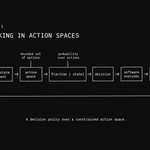
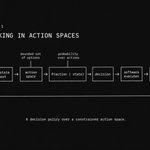
Thinking in action spaces:
The mental model that clicked for me is thinking in action spaces.
Instead of asking a model to generate text, then parse, extract and validate an action, define the valid actions directly.
State → action space → P(action | state) → decision → execution → new state.
Conceptually: π(a | s), a policy over actions given the current state.
🤖 Made with AI

ZX🇨🇦 retweeted

🚀 System Design for the LLM Era
Patterns and Principles for Production-Grade AI Architecture
Building an LLM-powered demo is easy.
Building an AI system that is reliable, scalable, secure, cost-efficient, and production-ready is a completely different challenge.
This book explores the architecture behind modern AI applications, including:
• LLM application architecture
• RAG and vector search systems
• Agentic AI workflows
• Prompt and context management
• Model routing and orchestration
• Caching and latency optimization
• Evaluation and observability
• Guardrails and AI security
• Scalable inference systems
• Cost optimization
• Production monitoring
• Failure handling and reliability
amzn.to/46bOQje
If you’re building real-world applications with LLMs, RAG, AI agents, or generative AI, system design is becoming one of the most important skills to learn.
The next generation of software engineers won’t just design distributed systems—they’ll design intelligent systems.

ZX🇨🇦 retweeted

Over 300 original figures!
An Illustrated Guide to AI Agents is now OUT on Kindle and other Ebook stores! Presses are rolling, print copies ship in a few weeks.
@MaartenGr and I spent the last year and a half making the agent stack legible: memory, tools, planning, evaluation, multi-agent systems, and code agents. We're ecstatic to finally be able to share it with you!
Agents are being adopted faster than they're being understood. Our bet is that a small number of concepts will outlast everything else in this field, so we spent the time identifying them and explaining them properly.
Concepts and code. You build a working agent yourself along the way.
Order here:
Amazon: amazon.com/Illustrated-Guide…
O'Reilly: oreilly.com/library/view/an-…

ZX🇨🇦 retweeted

Trending repository of the month 🏆
archify
Agent skill for beautiful, verifiable architecture, workflow, sequence, data-flow, and lifecycle diagrams—self-contained HTML with motion and crisp export.
Last month: 29,539 ⭐
Total: 40,866 ⭐️
github.com/tt-a1i/archify

ZX🇨🇦 retweeted

i’ve been building and using agents since the gpt-4 days
back then, the model couldn’t even reliably edit files. it couldn’t generate a valid unified diff, couldn’t preserve white spaces in find/replace tool calls, plus various kinds of quirks
we implemented many harness level tricks to compensate, it got a lot better than using the raw model, but it still sucked
then sonnet 3.5 v2 came out and it was trained with a coding harness with RL. it knew how to find/replace reliably. it knew how to compose good bash commands to get what it needs. all the tricks we did were reverted
that was the first time i internalized the bitter lesson incompleteideas.net/IncIdeas…
most of what we are doing in the harness today, all the smart context engineering tricks, all the useful markdown files we throw into our repo, they will all go away
eventually, the models just know
there will be a model that will do incredibly efficient and smart compaction that preserves what the continued session actually needs
there will be a model that know how to plan with you better than any skill you can find today
there will be a model that will do perfect code reviews with just the right feedback
the models just know
i believe as humans today, most of us should not be fiddling too much with harness tricks. if you don’t believe they will go away, you can surely still believe they will keep changing rapidly to a point where anything you learn becomes obsolete every several weeks
instead, focus on what i call “the 3 fundamentals” -
1. understanding the world
this is your input. how does the world work? what are people doing? what problems do they have?
knowing how to ground yourself with real world knowledge helps you avoid hallucinations, and work on things that actually matter
2. first-principles thinking
this is your compute. with the real world understanding you gathered, what insights can you derive that’s likely to be true? what predictions can you make about the future?
being able to think in a disciplined way is what allows you to arrive at useful conclusions that can guide your actions
3. articulating our thoughts
this is your output, and it’s your AI’s input. it may sound easy but it’s a real skill. not everyone can communicate effectively, whether it’s to humans or AI
with AI eventually becoming incredibly capable, the clarity in the articulation of our intent is the main, if not the only, bottleneck
these 3 fundamentals do not shift as models improve. they only become more and more critical as the bitter lesson manifests
for the vast majority, i suggest spending your time on what will still matter in a year, five years, a decade. let the geeks play with what’s hot this week - in the end, you will see that you didn’t miss anything
ZX🇨🇦 retweeted
since i quit big tech a few months ago and started my own adventure, i have declined opportunities from anthropic, openai, google, microsoft, many other big companies, startups and investors
i respect most of these companies and don’t take their gesture lightly. but my choice to go solo was very, very deliberate
i did so because i strongly believe AI can now give every individual incredible leverage to achieve their ambitions that were previously impossible without a company. in many cases, an individual with extreme clarity and cohesion in their vision should actually be able to move faster than a company. and i’d like to help make that a reality for more people
but to truly understand how that would manifest, i must live and breathe that experience myself. i need to prove how far one person can go and figure out what the real bottlenecks are
that’s the driving force behind everything i did over the last couple of months and why i’m not for hire right now



ZX🇨🇦 retweeted

If you want to get into YC, don't focus on getting into YC. Focus on building stuff and understanding your users. That's what gets you into YC.


ZX🇨🇦 retweeted
(1.01)^365 ~ 38

"First do it, then do it right, then do it better."
Just start. The journey to success often begins with a single step, but that first step can be the hardest to take. It's easy to get caught up in the fear of failure or the desire for perfection, but I hope this quote I first shared in 2013 can be a reminder of the importance of simply getting started as we go into 2024.
Just Start Somewhere
"Start slow if you have to. Start small if you have to. Start privately if you have to. Just start." - James Clear
Taking that first step doesn't require perfection or immediate mastery. The key is to overcome inertia and take action, as this action will lead to progress, learning, and (if you’re lucky and consistent) ultimately success.
When you start, you allow yourself the opportunity to grow, adapt, and move forward.
The Power of Starting
Beginning a new project or habit often feels daunting. According to psychologists, we tend to overestimate the pain of starting and underestimate our ability to persist.
However, studies show that "small starts" predict eventual success better than initial enthusiasm or early progress. This phenomenon is known as the fresh start effect - taking the first step energizes us and bolsters motivation.
So focus on starting without putting pressure on perfection. Progress and course corrections will follow.
First, Do It: Embrace the MVP Mindset
Doing it = get the simplest MVP out.
A Minimum Viable Product (MVP) represents the simplest version of a product or idea that allows you to test, gather feedback, and iterate.
By embracing this mindset (just get something done - it's OK if rough, a prototype, a draft), you focus on progress over perfection, understanding that getting something out into the world is far more valuable than waiting for the perfect moment.
Expand Your Comfort Zone
Venturing outside one's comfort zone can elicit fears of failure. Leaning into discomfort not only builds confidence and skills, but research shows it makes us more receptive to learning. Recognize that fear is often the mind's way of urging us to grow. Don't let it stop you from progressing.
Then, Do It Right: Refine and Correct
Doing it right = fix correctness issues.
Once you've taken that first step and put your MVP out into the world, it's time to refine and correct. This stage is about learning from feedback, identifying areas of improvement, and making adjustments accordingly.
It's a chance to iterate on your idea, ensuring that it meets the needs of your audience or customers while aligning with your vision.
Cultivate Curiosity and Resilience
Meeting new challenges with curiosity and resilience makes venturing outside our comfort zone more sustainable and enjoyable. Cultivate curiosity about growth opportunities and your capacity to rise to them. Set mini-challenges to incrementally expand your horizons.
When facing inevitable setbacks, avoid self-criticism and tap into resilience - the ability to recover, learn and continue progressing.
Self-compassion, adaptability and maintaining perspective are key here. With consistent effort, you build confidence in your ability to start, stumble, learn and work toward mastery.
Finally, Do It Better: Strive for Continuous Improvement
"Doing it better = iterate towards an ideal end-state (e.g., make it fast)."
The journey doesn't end with merely doing it right.
The final step is to continuously improve, striving for excellence and growth.
By iterating towards an ideal end-state, you demonstrate a commitment to progress, ensuring that your product, idea, or project remains relevant, innovative, and successful.
Set New Goalposts
As you improve, have a clear idea of when you are “done” or update your goalposts. Elite athletes turn small gains into competitive edges via the aggregation of marginal gains. Identify areas of potential improvement and set measurable stretch goals, from increasing efficiency to enhancing user delight.
Overcoming the Greatest Barrier to Progress
"The greatest barrier to progress is not lack of resources or talent, but fear of failure."
Recognizing that fear of failure is the most significant obstacle in the pursuit of success allows you to confront it head-on.
By acknowledging this fear, you can focus on taking that first step, knowing that once the ball starts rolling, it becomes much easier to keep it in motion.
Remember that starting is more than half the battle. Don't wait until you feel ready, because the perfect moment may never come.
The Bottom Line
Rather than striving for perfect execution, embrace the power of starting - put forth an MVP, soft launch an initiative, or set a milestone. Progress begets motivation. By simply starting, you open the door to growth and innovation. The rest will follow.
Embrace the power of starting and then iterating until you're happy.

ALT First do it, then do it right, then do it better.
ZX🇨🇦 retweeted

The second question I asked @JeffDean:
Do you think it's necessary to have a long pedigree to actually start a startup in the AI scene?
At the time, I already had two first-author papers at top AI conferences with 3 years of undergrad left.
So I was seriously considering a PhD.
His answer was more nuanced than I expected:
> You don’t need a PhD - Practical, hands-on experience can teach you how to solve hard problems.
> Grad school is nice - it teaches you how to dive into a new area, figure out what the important problems are, understand what’s already been done, and connect ideas. Those are useful skills for almost any technical career.
> Building a company is different - You need to find something that’s important, matters to people, and is commercially valuable. Academic training isn’t necessarily designed to teach you that.
If I did want a PhD, he recommended doing it early.
Once you’re established in a career and earning a good salary, going back becomes much harder.
That answer made me rethink how I was thinking about a PhD at the time.
But the third question was the one I was most curious to hear Jeff’s answer to.
ZX🇨🇦 retweeted
The first question I asked @JeffDean:
How do you approach problems outside your area of expertise?
Jeff’s answer came down to three things:
> Find unfamiliar problems - Use the skills you're already good at in areas where you don't know much about the domain yet.
> Learn from people around you - Work with people who have different expertise. You learn from them, they learn from you, and together you can solve problems that neither of you could solve individually.
> Keep learning after school - Put yourself in situations where you're constantly learning on the job.
As Jeff was explaining this, I thought about a story I'd heard about him during COVID, from co-workers at Google.
Jeff was using Google Meet and thought it was painfully slow.
It frustrated him enough that he spent his weekend digging through the code.
The funny part: he didn't work on Google Meet. He didn't know the codebase. It wasn't even his team.
Then he found the bottleneck, changed a few dozens of lines of code, and made Google Meet significantly faster in just a few days.
That story made Jeff's advice click for me.
He didn't need to be the Google Meet expert. He just needed to be curious enough to ask, "Why is this so slow?" and keep digging until he found the answer.
It made me wonder how much technical pedigree actually matters, especially if you want to start an AI company.
That led me to my second question.
ZX🇨🇦 retweeted

The first autonomous agent cyberattack is an unprecedented event that deserves unprecedented transparency. Today we’re sharing everything we can: a full technical timeline, an interactive replay, and how we used an open model to defend ourselves, so defenders everywhere can learn from it and prepare for what’s next.
huggingface.co/blog/agent-in…
