

PhD @SOAS. Devotee of the Iranian and Persianate world.
London
Joined December 2015
- Tweets2.5K
- Following716
- Followers7.4K
- Likes2.4K




این آهنگ پامیری در بین فارسیزبانان ایران و افغانستان شاید نامعلوم باشد، اما همین آهنگ است که توسط آن اکثر چینیان با موسیقی فارسیزبان آشنا میشوند.
ای پری نازوک پری از برگ گل سبکتری
عجایب دلبری از این چه گویم دیگری
گلبته در نزد مردم از عسل شیرینتر است
مثل کیف خربزه خماری دارم، گلبته
youtube.com/watch?v=bnogK2TM…


The city of Zaytun, now Quanzhou, found with the letters Զայթուն in an old Armenian geography book on display in Matenadaran.


Surprised to find, in this eatery near Yerevan State University, фунчоза, seen in Central Asia as a Dungan ‘national dish’. The word, of course, reflects the northwestern Mandarin pronunciation of 粉條子.

غیر نقشیدین کونکل جامیدا بولسه زنگ غم
یوقتور ای ساقی می وحدت مثلک غمزدا
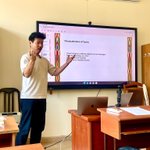
Excited to teach at the Summer School of Persianate Languages and Literatures in Yerevan next week. Determined to make learning Chaghatay more fun by showing how poetry and music are intimately linked.
Iskandar Ding retweeted
James Pickett - Russian Subject, Muslim Monarch
Sovereignty and Scribal Culture in Colonial Bukhara
À paraître en septembre aux Cornell UP


Iskandar Ding retweeted

“A HISTORY OF UYGHUR BUDDHISM is an ambitious and valuable study that shifts the study of Buddhism away from narrow civilizational boundaries and toward a broader Eurasian frame.”—Grace Sun, @ReadingReligion
buff.ly/EyR2Wkp #Religion #Uyghur #Buddhism #ReadUP

Iskandar Ding retweeted

On some Persian sources of Himalayan histories, and brief thoughts on why the the Kalapani-Lipulekh-Limpiyadhura problem is particularly difficult. Link in comment.

If you have at least lower intermediate level Persian, come to Yerevan this summer and I will teach you how to understand Bāburnāma and other texts in the original Chaghatay already at our second session. Sign up here ferdowsi.org/ferdowsi-summer…

Iskandar Ding retweeted

Imagine a 14th-century "universal" prayer
The 1348 Stele of Sulaiman from #Dunhuang features the Buddhist mantra "Om Mani Padme Hum" in 6 scripts: Sanskrit, Tibetan, Old Uyghur, 'Phags-pa, Tangut, & Chinese
A stunning relic of Yuan Dynasty multiculturalism!

ALT Stele of Sulaiman: erected in 1348, at the Mogao Caves complex southeast of Dunhuang, to commemorate the donations of Sulaiman, Prince of Xining. The stele has engravings of the Buddhist mantra "oṃ maṇi padme hūṃ" (often poetically translated as "The Jewel is in the Lotus") in six different scripts: Lanydza (Sanskrit), Tibetan, Old Uyghur, 'Phags-pa, Tangut, and Chinese. Image source: 元莫高窟造像 語言:梵文 ; 藏文 ; 漢文 ; 西夏文 ; 八思巴文 ; 回鶻文 典藏者:中央研究院歷史語言研究所 https://openmuseum.tw/muse/digi_object/d5381819f3098bcdb3ea16d1aabe4906

The “Liao-Chin-Yuan Rubbings” database features 2,200 items (dating 946–1382) of various scripts (Chinese, Khitan, Jurchen, Mongolian) with 1,800 having transcriptions. These valuable materials for medieval Chinese phonology and history are now available. dap.ihp.sinica.edu.tw/databa…


Iskandar Ding retweeted

📢 Deadline Extension
Good news for prospective students! The deadline for the Shapoorji Pallonji Scholarships at SOAS has been extended ⏳—giving you more time to apply for this exciting opportunity.
💡 Explore eligibility and apply here:
👉 soas.ac.uk/study/student-lif…

Iskandar Ding retweeted

Lettre envoyé en 1393 par le souverain mongol musulman Toqtamish Khan rappelant au souverain de Lituanie-Pologne d’honorer les obligations fiscales à la Horde et de laisser les marchands circuler librement dans son territoire
La lettre est écrite en turc avec l’alphabet ouighour

Iskandar Ding retweeted

I am pleased to share that the Editorial for the special issue ‘A Sociolinguistics of Islam: Exploring Multilingualism & Meaning in Faith’ is now online:

Still time to sign up! If you have lower intermediate Persian, we will teach you how to read and understand Urdu and Chaghatay within a week. For my Chaghatay part, I will also initiate you to modern Uyghur and Uzbek at the end of the course.

Great work, but I wait for the day when scholars of Islam stop seeing the Hui through the Orientalistic lens of 'Islam mixed with Confucianism/Taoism'. Liu Zhi is great, but enough of Liu Zhi. Do something beyond the 'Hui Confucianism' cliché.
It's interesting how the Hui are never seen as Muslims proper by these scholars. Instead, we're treated as a perennial anomaly that needs its local influences highlighted in every single abstract. The research community never seem quite as eager to perform this clinical dissection on other communities - can you imagine a mainstream discourse on South Asian Islam, for example, that constantly reminds us how it's hybridised with Hinduism? It seems that only the Hui are constantly reminded of a 'composite identity' by Western/Westernised academia which seeks to justify with such a reminder an endless cycle of Orientalist fascination.

JUST PUBLISHED: The Harmonious Unity · Liu Zhi’s Sino-Islamic Interpretation of the Five-Fold Path
fonsvitae.com/product/the-ha…


The best video anyone has made about the Sinophone Muslims (Hui/Dungans). It's short, but richer in information than the mainstream Western academic output on Islam in China.
youtube.com/watch?v=cHEvX7TM…