





iPal Network retweeted

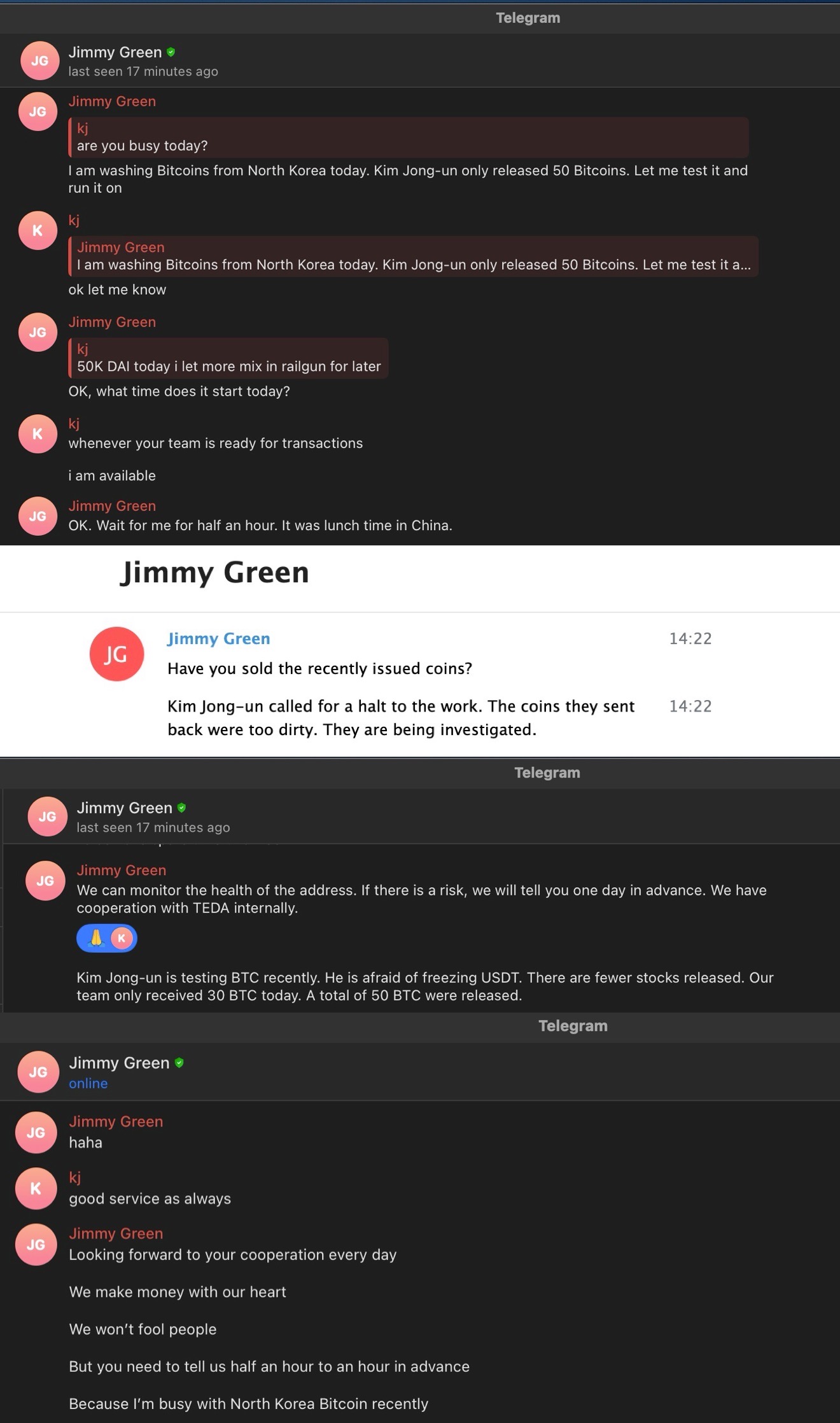
1/ How I infiltrated a Chinese organized crime syndicate that has laundered $1B+ across multiple exploits for Lazarus Group.
Posing as a client, I gathered intel that helped action freezes for the Feb 2025 Bybit exploit and attribute illicit activity onchain.


iPal Network retweeted

The SEC just published a guide explaining how to build a crypto project that its own securities laws do not reach
Here are the key points:
Buying back your own token on a working network is fine
Maintaining the system funding development and growing the network do not count as essential managerial efforts once it's fully functional
Liquid staking receipt tokens can be treated as digital commodities rather than securities
Marketing what your token does is fine as long as you do not tell people it will make them money
We didn't get the Clarity Act but the SEC is making sure the US has pro crypto regulations

iPal Network retweeted

Urgent security advisory for iOS users!
Install the latest iOS update immediately. Security researchers report that financially motivated attackers are now using a complete, in-the-wild exploit chain that can quietly steal cryptocurrency private keys and mnemonic seed phrases from iPhones.
The reported attack begins when a target is socially engineered into opening a malicious page in Safari. That page is said to abuse a memory-corruption flaw in WebKit / JavaScriptCore to gain arbitrary read/write access from JavaScript, then bypass Pointer Authentication Codes (PAC) to run native code, break out of the WebContent sandbox, and escalate to kernel/root privileges.
With that access, attackers can pull data from the device Keychain and from local crypto wallet apps.
The claimed impact range is iOS 13 through iOS 26.5; that range has not been independently confirmed in full. Until more is known, treat any unpatched device as potentially exposed and update as soon as a newer build is available. Also avoid untrusted links in Safari, especially if you keep wallet keys or seed phrases on the phone.
iPal Network retweeted

A bank won’t approve a $1,000,000 mortgage for someone making $100k a year.
A dealership won’t finance a $75,000 car for someone earning $35k.
But an 18 year old can take on $250,000 in student debt for a degree that leads to a $40,000 salary.
No credit check. No income verification. No reality check.
We let kids who can’t rent a car make six figure financial commitments that can follow them for decades.
Then we ask why so many young adults struggle to get ahead.
The bank protects its money.
The dealership protects its money.
The university gets paid.
And the student gets the debt.
iPal Network retweeted

POV: You finally opened the case… and found the edge. ⚡📈
The treasure is hyperliquid:native
The Treasure is Discipline
Welcome to Hyperlines.
#Hyperlines


iPal Network retweeted
🚨 Special invitation to a super short private beta.
Go-live is in a few days. Sneak peeks are available today. NO ENTRY BARRIER.
RT + follow + connect = you are in
But what is Hyperlines? A trading terminal & intelligence layer. Stay tuned, because:
→ It's bootstrapped like Hyperliquid → It's natively built around $HYPE, and exclusively available on Hyperliquid → It's an homage to Hyperliquid → It's got its very own community platform, where we talk about… Hyperliquid.
Game on. Short thread 👇
iPal Network retweeted
A new era for knowledge and exchange — short & simple intro to our Web3 knowledge marketplace. Watch now 👇
Better #education thanks to #crypto is coming to all #EVM compatible chains, and #utility to every #ERC20 in existence
iPal Network retweeted
CT can just be silenced because 1 guy at X dislikes it! Think about THAT!
The internet has to be decentralized (again) bc the algo will be 70% less likely to push posts identified as crypto

Genuinely thought that @nikitabier was a cool dude, but his recent shift in attitude towards CT has been hilarious to watch. It's clear he has an agenda against CT as a whole.
He was brought on as an advisor to @Solana to help shape ecosystem projects and make them go viral, as he’d done before with his own apps.
In reality, a lot of this stems from how poorly he performed working alongside @pasternak and @believeapp, and helping out @dupe_solana which eventually rugged all its investors.
- Ben Pasternak was last seen migrating a token for the third time and deleting all his tweets with $Believe being down over 90%
- @ghoshal thinks he’s disrupting Amazon, but the only thing he’s managed to disrupt is his token, down over 90%.
All of this just screams bitter.
The projects Nikita Bier actually took a chance on performed terribly under his guidance, which probably explains his open disdain for CT, especially given his recent, now-deleted response about why CT posts aren’t showing up on the algorithm as much.
From a platform standpoint, ignoring niche communities like CT makes no sense when they’re likely one of the strongest clusters of power users on this app.
Also, if I get shadow banned / exhaust my reach meter - just know it was for speaking the TRUTH.
~ TIER1HATER


iPal Network retweeted
AI is a bubble, or is it the financial system?
Really don’t want to cause another DeepSeek moment, but let’s be real.
LLMs will never be sure, and uncertainty is commonplace.
“The ceiling for AI adoption is trust”, and there couldn’t be a better time to talk about this, because markets aren’t sure either.
Recently, our Co-Founder & CTO Velitchko was awarded for his work on “Uncertainty visualisation”, the EU is calling for proposals for AI in healthcare, openly saying that there is “Impressive growth but persistent gaps” & “Legal uncertainty remains top barrier to adoption”.
who.int/europe/news/item/19-…
Additionally, an experimental competition between AIs from DeepSeek, Qwen, ChatGPT, Grok and Claude finished a few weeks ago, and it didn’t go so well… (Best performing AI was DeepSeek).
It was restarted and is improving, while Grok seems to be outperforming this time.
But with such an amount of money in the “AI bubble” vs. $10k in each algo, and the experiment being promoted mostly on X, everything needs to be take with a grain of salt, but here is a link to the experiment: nof1.ai
And don’t get me wrong, it’s by far not over for AI. I just have the feeling we are being gaslighted, betrayed and overloaded with biased information.
So let’s dive a bit deeper into this topic, disseminate and aggregate some information, opinions, and provide links to dive a bit deeper.
1. Biases, silos, rumours and correlations to the Dot-Com Bust
It seems like Linkedin hasn’t been able to catch up on the news, innovation in blockchain or the killer combination, namely the AI x Crypto. We often discover silos, platform-specific bias, and Linkedin lacks in terms of insights & criticism.
We believe Grok is better than ChatGPT (but i might change my mind in my Linkedin post, to avoid getting shadowbanned ;-).
But who am I to make such claims?!? Been in AI since 2017, became a Crypto and tokenisation enthusiast in 2020 (again) and am working with LLMs daily.
Just getting a bit sick of the narrative that AI is our “Lord and saviour”, universal tool replacing doctors, lawyers, engineers and researchers.
Surely accountants, Consultants, and entry-level positions could be replaced, or supported by AI, but there is literally NO EVIDENCE, AI will ever replace geniuses, or invent something fundamentally new or disruptive.
Over the last years, we saw trillions of investments, but we still cannot solely use AI to manage a portfolio, cure cancer or even educate while being held accountable or close to 99% certain. The following article is describing made-up sources (31%) & minimum 1 mistake per output in 37% of the cases, which is down from ~50% in the last benchmark, but still unacceptable for many fully-autonomous workflows.
heise.de/hintergrund/KI-und-…
2. Is AI a bubble?
Next, we should discuss if there are signs for a bubble, what the indicators are to measure that, and where we stand in terms of impact & probability.
To be able to evaluate that, we have to understand that our money is broken. If you don’t understand this or believe me, “i don’t have time to explain it to you” (Satoshi Nakamoto)
We asked Grok and all the other LLMs “whether or not AI is a bubble” and ONLY received an answer from DeepSeek, and will therefore need to further elaborate on our own platform.
The full analysis is published here ipal.network/0x4039871186942…, and will likely grow in aspects since users can “fork” the content, and collaborate on the platform, so keep an eye out for updates there.
In short, there are many signs circling around, from the accounting tricks to postpone costs into the future to similarities to the Dot-Com bust, and the “ponzi-like” profit carousels often described as follows on Social media:
“Nvidia gave $2 billion to xAI. xAI borrowed $12.5 billion to buy Nvidia chips. Microsoft gave OpenAI $13 billion. OpenAI committed $50 billion to buy Microsoft cloud. Microsoft ordered $100 billion in Nvidia chips for that cloud. Oracle gave OpenAI $300 billion in cloud credits.”; “Fair value for Nvidia: $71 per share. Current price: $186”;
Source: xitter.cf/shanaka86/status/19914…
So are the markets delusional, & is chaos going to break loose?
3. Bias, Adoption curves, and major requirements going forward
LLMs are often described as a cure for all, like education and cancer, which may seem like pure hype.
No Mag7 Boss would go further than saying “elements of irrationality” and that not everyone will be a winner (Bill Gates on CNBC), but they can’t hide hard facts.
Google CEO Sundar Pichai “addressed energy needs, slowing down climate targets, UK investment, the accuracy of his AI models, and the effect of the AI revolution on jobs” in a BBC interview. bbc.com/news/articles/cwy7vr…
We assume AI will impact many aspects of life, almost every industry, job & career path one could take.
AI adoption is outpacing major inventions from the past, and there are certainly way too many aspects and smart people working on integral parts to outright claim AI is a bubble.
For instance, the crypto industry is working on prediction markets, opinion markets and game-theory driven trust machines.
ipal.network/0xdc1208dd03406…
AI will continue to need massive amounts of data to stay competitive or capture a niche, and data is key.
Therefore, the x402 Protocol from Coinbase, data marketplaces, data privacy, incentives to share data, and confidential computing are certainly going to add fuel, because nobody is willing to share their data (for free or at all), especially health or personal finance-related information.
4. How to evaluate such technologies
Another reason for AI, and against raising the alarm, is that the market is often mispricing new technologies titled “In Defence of Exponentials”
xitter.cf/hosseeb/status/1994110…
Therefore, the market will continue to be volatile, correlated, driven by macroeconomics, geopolitics, fundamentals and the fact that the common denominator, the US Dollar, is broken in itself.
Similar to the dotcom, or ICO bubble, where many fancy .com domain names & cryptocurrencies were highly overvalued, there could be many AI models, “infra” or startups that will crash into oblivion.
This time around it could be consulting companies, Software-Development Megacorporations, Chip manufacturers that are late to the game or the privatised University system in the US, where layoffs could be watched closely.
While OpenAI, Microsoft, Google, X and have distribution & corporate clients, that are ready to pay for productivity. Who we will further analyse can be influenced here, in this poll.
Investors are closely looking into the P/E ratio, lifetime estimates & accounting tricks,
linkedin.com/pulse/ki-bubble…
chip acquisition, Cashflow and CAPEX/Dept Issued -linkedin.com/posts/charles-h…
and if they can picture a scenario where the investments actually materialise.
Let’s do that next time 😉so stay tuned.
Until then, opinions, insights, FOMO, impact assessment and probabilities always vary a lot, and therefore, the show will go on.
Because it has to…


In Defense of Exponentials
I used to tell founders, the reaction you are going to get to your launch is not hate, it’s indifference. By default, nobody cares about your new chain.
I have to stop telling them that now. Monad just launched this week, and I’ve never seen so much hate about a blockchain that just launched. I’ve been investing into crypto professionally for 7+ years now. Before 2023, almost every chain I’ve ever seen that launched was mostly met with enthusiasm or indifference.
But now, new chains are born into a chorus of hate. The amount of haters I’ve seen for projects like Monad, Tempo, MegaETH—before they even hit mainnet—is a genuinely new phenomenon.
I’ve been trying to diagnose: why is this happening now, and what does it mean about the psychology of this market?
The Cure is Worse than the Disease
Forewarning: this is going to be the vaguest blockchain valuation post you ever read. I don’t have any fancy metrics or charts to sell you on. Instead, I’ll be arguing against the zeitgeist of Crypto Twitter, which for the last couple of years, I’ve been constantly on the opposite side of.
In 2024, I felt like what I was arguing against was financial nihilism. Financial nihilism is the belief that none of these assets matter, it’s all memes at the end of the day, and everything we’ve built is inherently worthless.
Thankfully, that’s no longer the vibe. We have broken out of that spell.
But the zeitgeist now is what I’d call financial cynicism: OK, maybe some of this stuff has value, maybe it’s not all memes, but it’s grossly overvalued and it’s only a matter of time before Wall Street finds that out. Not that all chains are worthless. But these things are all maybe worth 1/5th-1/10th of what they’re currently trading at (have you seen these PE ratios?), and so you’d better pray like hell Wall Street doesn’t call us on our bluff, because once they do it’s all getting wiped out.
You’ve got many bullish analysts now trying to conjure up optimistic L1 valuation models, inflating PE ratios, gross margins, DCFs, trying to fight against this mood.
Late last year, Solana very proudly embraced REV as a metric that could finally justify their valuation. They proudly announced: we—and only we—are no longer bluffing to Wall Street!
And, of course, almost immediately after REV was embraced, it fell off a cliff (though $SOL, tellingly, did better than REV did).
Not that there’s anything wrong with REV. REV is a very clever metric. But the point of this post is not metric selection.
Then came the launch of Hyperliquid. A DEX that had real revenue and buybacks and PE multiples. And the chorus said—look, look I told you! Finally, for the first time ever, a token that has some real profits and a proper PE multiple. (Nevermind BNB, we don’t talk about that.) Hyperliquid will eat everything because obviously Ethereum and Solana don’t make any real money, we can stop pretending to value them now.
Hyperliquid, Pump, Sky, these buyback-heavy tokens are all great. But the market always had the ability to invest into exchanges. You could always buy Coinbase, or BNB, or whatever. We own $HYPE, and I agree that it’s a fantastic product.
But that’s not why people were investing in ETH and SOL. The fact that L1s don't have exchange-like profit margins is not why people were buying them—if they wanted that, they could’ve bought Coinbase stock.
So if I’m not critiquing blockchain financial metrics, maybe you think this post is going to be chiding the sinfulness of the token-industrial complex.
Obviously, everyone has lost money on tokens in the last year, VCs included. Alts are down bad this year. And so the other half of the zeitgeist on CT is arguing about who's to blame. Who’s become greedy? Are the VCs greedy? Is Wintermute greedy? Is Binance greedy? Are the farmers greedy? Are the founders greedy?
The answer, of course, is the same as it’s ever been.
Everyone is greedy. Everyone. The VCs, Wintermute, the farmers, Binance, the KOLs, they're all greedy, and you are greedy too. But it doesn't matter. Because no functioning market has ever required anyone to act against their self-interest. If we're right about crypto, we can all be greedy and the investments will still work out. Trying to analyze a market that has gone down by figuring out “who’s greedy” is going to be about as fruitful as commissioning witch trials. I guarantee you, nobody just started being greedy in 2025.
So this, too, is not what I’m going to be writing about.
Many people want me to write a post about why $MON should be valued at X or $MEGA at Y. I’m not interested in writing this post, or advocating that you buy anything in particular. In fact, you probably shouldn’t buy any of them if you don’t already believe in them.
Will any new challenger chain win? Who knows. But if it has a material chance of winning, it's going to be priced on that basis. If Ethereum is worth $300B or Solana is worth $80B, a project that has a 1-5% chance of becoming the next Ethereum or Solana will be priced according to those probabilities.
Somehow CT is scandalized by this, but it’s no different than Biotech. A drug that has less than a 10% chance of curing Alzheimer's is priced by the market as worth billions of dollars, even if 90% chance it won’t pass stage 3 trials and will go to 0. That's how the math works—and turns out, markets are pretty good at doing math. Binary outcomes are priced on probabilities, not on run rates or moral turpitude. It’s the “shut up and calculate” school of valuation.
I really don’t think that’s an interesting question to write about. “5% chance to win? No way, that’s clearly a 10% chance!” Markets, not articles, are the best way to assess that for any individual token.
So here’s what I am going to write about: CT doesn't seem to believe anymore that chains are valuable.
I don’t think this is because they don’t believe new chains can win market share. We just saw Solana dominate market share after emerging from the ashes less than 2 years ago. It’s not easy, but of course it’s possible.
It’s more that people have come to believe that even if a new chain wins, there’s no prize worth winning. If $ETH is just a meme, if it’ll never generate real revenue, then even if you win, you won’t be worth $300B. The contest is not worth winning, because these valuations are all bunk and it’ll all come crashing down before you go to claim your prize.
Being optimistic about chain valuations has become passé. Not that nobody is optimistic—obviously there must be optimists out there. For every seller there’s a buyer, and as much as CT cool kids love to drag L1s, people are comfortable buying SOL at $140, ETH at $3000.
But there’s a perception now that all the smartest people are over buying smart contract chains. Smart people know the jig is up. If not now, then soon. The only people buying here are suckers—Uber drivers, Tom Lee, and KOLs who say stuff like “trillions.” And maybe the US Treasury. But not the smart money.
This is bullshit. I don’t believe it, and you shouldn’t either.
So I felt like I had to write a smart person’s manifesto on why general purpose chains are valuable. This post is not about Monad or MegaETH. It’s really in defense of ETH and SOL. Because if you believe ETH and SOL are valuable, the rest is straight downstream.
Defending ETH and SOL valuations is generally not my job as a VC, but fuck it, if nobody else is willing to do it, then I’ll write it.
Feeling the Exponential
My partner Bo experienced the Chinese Internet boom first-hand as a VC. I’ve heard how “crypto is like the Internet” so many times now that it doesn’t even register for me anymore. But when I hear his stories, it always reminds me how costly it is to be wrong about these things.
A story he often tells is about when all the early e-commerce VCs (it was a small group back then) got together for coffee in the early 2000s. They debated: how big is the market for e-commerce going to be?
Is it going to be mostly electronics (maybe only techies will use PCs)? Could it ever work for women (perhaps they’re too tactile)? What about food (maybe impossible to manage perishables)? These were deeply important questions for early VCs to decide what to invest in and what prices to pay.
The answer, of course, was that literally every single one of them was devastatingly wrong. E-commerce would sell everything, and the target audience was the whole fucking world. But nobody at the time actually believed it. And even if they did, it would be too absurd to say out loud.
You just had to wait long enough for the exponential to show you. Even among the believers, very few thought e-commerce would become as big as it became. And those few who did, almost all of them became billionaires from just not selling. Every other VC—as Bo tells me, since he was one of them—sold too early.
It has become passé in crypto to believe in the exponential.
I believe in the crypto exponential. Because I’ve lived it.
When I started in crypto, nobody used this stuff. It was tiny and broken and awful. TVL on-chain was in the millions. We invested into the first generation of DeFi, MakerDAO, Compound, 1inch, back when they were science projects. I remember playing around on EtherDelta back when DEXes traded single digit millions a day, and that was considered to be a huge success. It was complete dogshit. Now we routinely trade in the tens of billions on-chain every day. I remember believing it was crazy that Tether hit a billion dollars in issuance and was being written up in the NYT as a ponzi scheme on the brink of shutdown. Now stablecoins are over $300B and regulated by the Federal Reserve.
I believe in the exponential because I’ve lived it. I’ve seen it over and over again.
But you might respond—well, stablecoin growth might be exponential, maybe DeFi volumes are exponential, but they don’t accrue to ETH or SOL. The value doesn’t get captured by the chains.
To which I answer: you still don’t believe in the exponential.
Because the exponential’s answer is always the same: it doesn’t matter. This stuff is going to be so much bigger than it is today. And when it’s absolutely enormous, you’ll make it up on scale.
Study this chart.
This is Amazon’s P&L from 1995 to 2019. That’s 24 years. Red is revenue, gray is profit. You see that little blip on the end where the gray line goes up? That’s when, 22 years in, Amazon started actually making a profit.
Amazon was 22 years old when this little gray line of net income first peeled off of 0. Every single year before then, there were op eds and critics and short sellers claiming that Amazon was a ponzi scheme that would never make any money.
Ethereum just turned 10 years old. This is what the first 10 years of Amazon stock looked like:
10 years of chop. All along the way, Amazon was beset with doubters and non-believers. Is e-commerce a VC-subsidized charity? They’re selling underpriced cheap low-quality knick-knacks to bargain hunters, who cares? How are they ever going to make actual money, like Walmart or GE?
If you were arguing about Amazon’s P/E ratio, you were in the wrong regime. That’s the regime of linear growth. But e-commerce was not a linear trend, and so every single person for 22 years arguing about P/E ratios was devastatingly wrong. No matter what you paid, no matter when you bought, you were not bullish enough.
Because that’s what exponentials do. When it comes to truly exponential technologies, no matter how big you think it’s going to get, it just keeps getting even bigger.
This is the thing that Silicon Valley has always understood better than Wall Street. Silicon Valley was raised on exponentials, while Wall Street was raised on linearity. And over the last few years, crypto’s center of gravity has migrated from Silicon Valley to Wall Street. You can feel it.
Granted, crypto growth doesn’t look as smooth as e-commerce’s growth. It’s burstier, it goes in fits and starts. This is because crypto, being about money, is deeply tied to macro forces, and it also has more violent regulatory push and pull than e-commerce. Crypto strikes at the heart of the state—money—and so it’s more unnerving to governments than e-commerce ever was.
But the exponential is no less inevitable. It's a crude argument. But if crypto is exponential, then the crude argument is correct.
Zoom out.
Financial assets want to be free. They want to be open. They want to be interconnected. Crypto turns financial assets into file formats, makes it as easy to send a dollar or a stock as to send a PDF. Crypto makes it possible for everything to talk to everything. It makes it all 24/7, global, interconnected, and open.
That will win. Open always wins.
If there’s no other lesson I've learned from the Internet, it’s that. Incumbents will fight against it, governments will huff and puff, but eventually they will give up against the adoption, the generativeness, the sheer efficiency that this technology enables. It’s what the Internet did to every other industry. Blockchains are how that same trend will gobble up all of finance and money.
Yes—with enough time—all of it.
An old saying goes: people overestimate what can happen in two years, but they underestimate what can happen in ten.
If you believe in the exponential, if you zoom out enough, then it’s all still cheap. And it should humble you that every day, the holders outlast the sellers and naysayers. Big capital has a longer time horizon than CT swing traders might lead you to believe. Big capital has been trained through history not to fade big technologies. You know, the big gushy story that originally got you to buy $ETH or $SOL? Big capital believes that story and hasn't stopped.
So what exactly am I arguing?
I am arguing that applying P/E ratios to smart contract chains (the “revenue meta,” as it’s now called), is giving up on the exponential. It means you have consigned this industry to the regime of linear growth. It means you believe 30 million DAUs on-chain and <1% of M2 is it. Crypto is just one of the things in the world. A sideshow. It did not win. It was not inevitable.
More than anything, I’m arguing to be a believer. Not just a believer, but a long-term believer.
I’m arguing that this exponential will be bigger than anything else you’ve been a part of in your life. That this is your e-commerce. That you will look back when you’re old and tell your kids—I was there when it all happened. Not everyone believed it was possible, that whole societies could change, that all of money and finance would be transformed by programs running on decentralized computers that we collectively owned.
But it actually happened. It changed the world.
And you were a part of it.
Disclosure: These are my own views. Dragonfly is an investor in $MON, $MEGA, $ETH, $SOL, $HYPE, $SKY among many other tokens. Dragonfly believes in the exponential. This is not investment advice, but is advice of another kind.


iPal Network retweeted
Couldn’t agree more, that privacy will be essential for many use cases.
Imagine you build a great DeFAI strategy with @almanak (or other mentioned in our analysis) and already locked in significant PnL…

Privacy is not a feature for agents. It is the prerequisite for an autonomous economy.
We build the infrastructure. ⚫
$BLKH
iPal Network retweeted

Another community joins the HyperSignals Alpha League → @ipalNetwork is officially in.
Known for building tools that enhance transparency and insights across Web3, iPal Network is now gaining early access to the signal engine that filters the top 0.1% of traders on Hyperliquid.
📡 Real signals. No noise.
WAGMI with HyperSignals.
HyperLiquid.

Community Onboarding Recap
During the past week, we have teamed up with some amazing communities to test HyperSignals and provide us with feedback to build the best version of the platform.
Shout out to everyone of them. Welcome to the Alpha League.
- $BICO Stakers @biconomy
- @hlbalkans
- @Hyperliquid_KR
- @Hyperliquid_In
- @Catalyze_RS
- @hypurr_co
- @UbiKhr
- @hyperliquidos
- HyperLiquid Russian Speaking Community
- @ReverseUnitBias
- @d0tHYPE
This is just a warmup.
HyperLiquid.
iPal Network retweeted
@NFCsummit was great, here is a short thread about it.
Will also record my speech again on YouTube so stay tuned.


iPal Network retweeted

We’re proud to announce that Skyline Digital was selected to be part of the Portugal Finlab’s 6th edition! ✨ 🚀
This program is a communication channel between innovators and the Portuguese regulatory authorities, offering guidelines to better navigate the regulatory system 🤝

iPal Network retweeted

Lukki shares how @ipalNetwork is revolutionizing the knowledge market with gamified, trustworthy data and how @ipalNetwork is building a decentralized knowledge market powered by verified data, incentives, and real Web3 trust.
Discover what’s next in data integrity and digital reputation:
🔗 xitter.cf/ipalnetwork
🎥 Full talk: youtu.be/dikRbgEi2o4?si=90Y_…
🎧 Listen on Spotify: open.spotify.com/episode/69X…
#Web3 #Crypto #Blockchain #Decentralization #AI #DigitalIdentity



iPal Network retweeted

Declaring "ETH is money" as the main narrative of Ethereum is massively underselling Ethereum and all the work done by everyone building on top. It is reducing Ethereum to a meme.
Instead, Ethereum can become the world settlement layer and derive massive value from this position.
It has all the bright minds and resources to get there.
Only focus is needed on what is important:
Aligning the scalability roadmap with ETH.
Amazing progress has been made on ZK-based L2s allowing state validation on the L1.
Amazing progress has been made on DA using blobs allowing sequencing on the L1.
It is time to enshrine this progress in Ethereum itself enabling truly aligned L2s to benefit ETH.
Let's not be distracted by some temporary phenomena.
Focus, build, and ship.