

The Supply Chain Risk Intelligence Company
Joined March 2009
- Tweets3.5K
- Following276
- Followers1K
- Likes336




interos.ai is on a mission to help federal agencies see what they've been missing.
Big news launching soon.

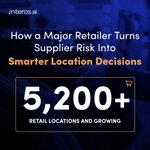
A major U.S. retailer runs thousands of stores and clubs, with locations sitting within 10 miles of almost 90% of the country's population. Each of those sites relies on its own network of suppliers.
Standard views of locations or suppliers alone can overlook whether a site is truly resilient. Two sites that appear independent on the surface may actually pull from the same supplier corridor, putting them both at risk during the same disruption.
Using interos.ai, this retailer visualizes supplier risk by geography, weighing exposure across existing and planned stores, offices, warehouses, and contingency sites. This geographic risk intelligence now shapes decisions on new store openings, backup capacity planning, and sourcing shifts, and feeds into FEMA-aligned response planning for events like Sandy, Katrina, Helene, and Milton.
Supplier risk isn't only about sourcing decisions. At this scale, it becomes a matter of location strategy.
See how interos.ai converts hidden exposure into clear, prioritized next steps: interos.ai/our-software?utm_…

Iran's drones hit two AWS data centers in the UAE and one in Bahrain this spring. An Oracle facility in Dubai was bombed a month later.
Data centers are now targets in active warfare, and AI risk just became a geography problem.
In her latest piece for The AI Journal, Dr. Andrea Little Limbago, SVP, Applied AI at interos.ai, breaks down what most risk teams are missing:
→ 80% of global data center capacity faces heightened exposure to flood, fire, or drought
→ 18% sit in extreme risk zones, concentrated in the U.S., Brazil, Australia, China
→ A Super El Niño now has a 96%+ chance of persisting into 2027
Read Andrea's full piece: aijourn.com/the-ai-race-runs…

Oftentimes, there’s more below the people conflict that surfaces in the workplace, whether that’s unclear lanes, competing priorities, or other frictions. Making sure you have the correct systems and processes in place can help mitigate ongoing conflict rooted in these issues.
Our CPTO, Yardley Pohl @yipstas, added to the conversation with @ForbesTechCncl Technology Council, weighing in on the product teams versus governance departments conflict. She shared how sequencing and better timing between the two teams can help bring alignment to innovation and compliance as priorities.
Read her full take below:
forbes.com/councils/forbeste…

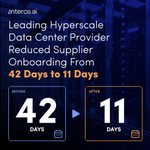
Supplier onboarding took one leading hyperscale data center provider 42 days. That's 42 days of exposure across a 1.6M-supplier ecosystem, with capacity delivery on the line the entire time.
The old process meant fragmented, multi-tier supplier risk review and no way to know which supplier pathways could actually threaten site delivery, commissioning, or uptime.
With interos.ai, that changed. The provider mapped its extended supplier ecosystem, prioritized 14,567 high-risk suppliers by project impact and substitution difficulty, and cut supplier onboarding from 42 days to 11.
As their Risk & Procurement team put it, interos.ai turned "fragmented, multi-tier supplier risk management into a single, continuously monitored source of truth."
With $6.7T in global data center capex projected by 2030, supplier visibility isn't a nice-to-have. It's capacity-delivery control.
See how interos.ai turns hidden exposure into prioritized action: interos.ai/our-software?utm_…

Most consumers never see where their products actually come from. Neither do most companies.
Forced labor doesn't show up on a supplier scorecard. It hides in the sub-tier, past the point most risk programs ever look. By the time it surfaces, the goods have already reached the market.
Our CPTO, Yardley Pohl, (@yipstas) shared her perspective for @ForbesTechCncl on how AI-driven analysis of import, shipping, customs, and trade data can flag forced labor risk deep in the supply chain, before it becomes a headline.
But the technology only works if the visibility does too. Scaling this responsibly means transparent data sourcing, mapping beyond direct suppliers, and human review on every flagged case.
Read Yardley's full take: forbes.com/councils/forbeste…
Customer interactions are most frequently prioritized by the risk they pose, but today AI is shaping this part of the customer experience before a human ever interacts with it.
Our CPTO Yardley Pohl (@yipstas) shared her perspective in a new @ForbesTechCncl roundup on the process of pre-framing risk by triaging requests through AI. Her take is that when AI flags a vendor, transaction or customer as "urgent" or "routine," that risk framing is then inherited by the human analyst reviewing the case.
Read Yardley's full take here: forbes.com/councils/forbeste…
#CustomerExperience #RiskIntel #AI
Nearly 80% of global data center capacity now faces heightened exposure to natural hazards.
Our SVP of Applied AI Dr. Andrea Little Limbago’s latest article for @TheAIJournal1 breaks down the current risk landscape, from a strengthening El Niño to geopolitical instability targeting AI infrastructure. She explains how the physical footprint of the AI race has become just as critical as the digital aspects.
Read her full analysis here: aijourn.com/the-ai-race-runs…
hashtag#AI hashtag#SupplyChain hashtag#Resilience hashtag#DataCenters

Visibility told you where the risk was. Monitoring told you when it changed. Neither one told you what to do about it.
That gap, between knowing and acting, is where most disruption actually happens. Reactive risk management means finding out about a problem after it's already touched your supply chain, your revenue, your timeline.
The next era of third-party risk management isn't more dashboards. It's intelligence that arrives early enough to act on, with systems that act alongside you.
Learn how interos.ai closes that gap: interos.ai/our-software?utm_…
#SupplyChain #SCRM #AI

As we head into the long weekend, we're thinking about the workers who keep everything moving, on factory floors, in data centers, across logistics hubs, and in boardrooms.
Supply chains run on people. This weekend, we're grateful for all of them.
Happy Labor Day!


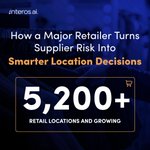
A leading U.S. retailer operates thousands of stores and clubs within 10 miles of nearly 90% of the U.S. population. Every one of those locations depends on its own supplier ecosystem.
Traditional location or supplier views can miss whether a site is actually resilient. Two locations that look redundant on paper can share the same supplier corridor and fail together when disruption hits.
With interos.ai, this retailer maps supplier risk by locale, comparing exposure against current and planned stores, offices, warehouses, and backup locations. That location-aware intelligence now guides where to open, where to add backup capacity, and when to shift sourcing, informing FEMA-aligned response efforts around events like Sandy, Katrina, Helene, and Milton.
Supplier risk isn't just a sourcing question. For a footprint this size, it's a location strategy question.
See how interos.ai turns hidden exposure into prioritized action: interos.ai/our-software?utm_…
#SupplyChainRisk #Retail #SupplierRisk #RiskIntelligence


Most products don't fail because of bad engineering. They fail because teams built them for the wrong person.
Our CPTO, Yardley Pohl (@yipstas), tackled this in a new piece for @ForbesTechCncl. Her point: most teams build personas around the customers they already have, not the market they're actually trying to win. That habit quietly shrinks what the product can become.
Read the full piece here: forbes.com/councils/forbeste…
#AI #TechDesign

Most risk platforms tell you what already happened.
By the time the alert hits your inbox, the disruption is already unfolding.
interos.ai built 𝘪Q to change that.
The industry's first fully productized predictive analytics platform for supply chain risk intelligence. Built for teams done reacting and ready to get ahead.
𝘪Q doesn't tell you what went wrong. It tells you what's about to.
Exposure quantified before disruption hits. Risk ranked by severity. A head start your competitors don't have.
Three products. Built for the C-suite.
🔹 𝘪reputation detects financial, regulatory, and foreign-influence signals while the event is still developing. Act before it's a crisis.
🔹 𝘪tariffs models tariff exposure across your full supplier network ahead of the next policy shift. Not after it lands.
🔹 𝘪tracing maps multi-tier supplier relationships to specific products and components. When risk surfaces, your team already knows what to protect and what to reroute.
Board-level resilience isn't about reacting faster.
It's about seeing risk before it materializes. And knowing exactly what to do when it does.
Learn more: interos.ai/blog/predictive-s…
#SupplyChain #AI #RiskIntel

Hurricane Idalia was approaching Florida. Cooper University Health Care needed to know which of its 1.2M supplier relationships sat in the storm's path, before a hidden disruption became a medical supply issue.
With interos.ai, @CooperHealthNJ mapped its extended supplier ecosystem, pinpointed suppliers in Idalia's path, and uncovered one critical supplier's order cutoff before Cooper University Health Care ever received notice.
The team placed several days' worth of orders before that cutoff could create a potential out-of-stock situation on medical supplies during a natural disaster.
As Dr. Thomas Runkle, VP of Supply Chain at Cooper University Health Care, put it: interos.ai helped the team identify the critical supplier cutoff before notice arrived and place orders before the window closed.
In Healthcare & Life Sciences, hidden dependencies don't just create shortages. They create patient-safety risk.
See how interos.ai turns hidden exposure into prioritized action: lnkd.in/epR9MPF3
#SupplyChainRisk #Healthcare #RiskIntelligence


Your risk report only shows what you already know.
Internal records, supplier self-assessments, and a quarterly check used to pass for due diligence. That's no longer true.
Cyber threats, ESG mandates, regulatory shifts, geopolitical instability, and solvency pressure don't live in your internal systems. Any one of them can take your supply chain down overnight.
Most boards still only see tier one. The disruption that actually hits usually comes from tier three, four, or five, from a supplier you've never heard of until it's the only one that matters.
Fewer than 10% of Fortune 1000 companies have real n-tier visibility.
Supply chains are now instruments of geopolitical strategy. Boards that can't see past tier one aren't managing risk. They're waiting to explain it later.
See what interos.ai can surface → interos.ai/request-contact?u…
#SupplyChain #RiskIntel #SCRM

The world is building data centers at an unprecedented pace. But as capacity scales, so does the risk of schedule slip.
Across the data center industry, the average share of direct suppliers marked as high-to-extreme risk by 𝘪Score® is 20.93%.
A major data center operator and interos.ai customer is leading their peers with the lowest share of direct suppliers scored as high-to-extreme risk.
When delivery timelines are tight and delays are costly, the risk profile of every supplier in your chain matters. Rapid growth and strong risk management do not have to be at odds.
𝘪Score®, powered by the interos.ai knowledge graph of 250M+ companies, provides a continuously updated risk rating for every supplier across Cyber, ESG, Financial, Geopolitical, Catastrophic, and Restrictions.
This post is part of a new interos.ai benchmarking series highlighting companies that are outperforming their industry peers across key supply chain risk metrics.
Want to see how your organization compares in your industry?
Connect with our team: interos.ai/request-contact?u…
#DataCenter #SupplyChain #AI

The SCRM software market is projected to hit nearly $10 billion by 2031, as more organizations move past outdated risk assessments toward continuous, real-time visibility.
Our CEO @KrantzTed points to why: survey-based assessments only tell part of the story. Real visibility comes from fusing external market data with a customer's own, continuously, not once a year.
That's the thinking behind interos.ai, built as the industry's first fully productized predictive analytics platform for supply chain risk intelligence. It's why the U.S. Navy chose interos.ai to stand up its first enterprise-wide supply chain risk capability across 30+ support organizations and field activities worldwide.
interos.ai designed for the companies who want to action on risk before it becomes a headline.
Read Ted’s full interview with @pulse2news here: pulse2.com/interos-profile-t…
#SupplyChain #AI