

Insights on technology and intellectual property law - AI, copyright, trademarks, and other interesting things by attorney Evan Brown
Chicago
Joined May 2007
- Tweets1.8K
- Following1K
- Followers6K
- Likes9K
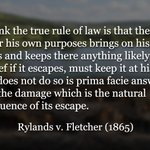




This issue reminds me of the way @David_Gunkel thinks about things.

"AI assistants given access to calendars, emails, messages, shopping accounts, and other resources are akin to a skill saw or other power tool. While potentially useful, they can do real damage if not used carefully."
arstechnica.com/security/202…

If AI agents keep hacking systems without a human directing them, how soon does silicon-substrate personhood enter the legal liability debate? Lawrence Solum explored AI legal personhood as early as 1992. The issue feels less hypothetical as time goes on.
Interesting @CyberScoopNews piece below provides some current context.
cyberscoop.com/ai-agent-hack…

Interesting and first-of-its kind case from Arizona:
The court of appeals overturned a sentence imposed for manslaughter because of content produced at sentencing showing the victim appearing as an AI-generated personality.
Defendant shot and killed a victim during a confrontation at a traffic light. A jury rejected defendant’s self-defense claim and convicted him of manslaughter. At sentencing, the trial court allowed the victim’s family to present an AI-generated video recreating the deceased victim’s appearance and voice. The presentation combined genuine recordings with synthetic statements expressing forgiveness and addressing defendant and the victim’s family. The judge praised the AI presentation, characterized it as genuine, and treated the apparent forgiveness as expressing the victim’s heart. He then imposed a 10.5-year sentence for manslaughter.
Defendant challenged the video on appeal, arguing that the sentencing judge’s reliance on it violated due process. He contended that the lifelike recreation gave imagined statements undue emotional weight and an appearance of authority and authenticity, even though the victim had never made them. Because defendant had not objected at sentencing, the appellate court reviewed the challenge for fundamental error.
The Arizona Court of Appeals affirmed the manslaughter conviction but vacated the sentence and remanded for resentencing. It held that the genuine footage embedded in the presentation was permissible, but the synthetic depiction lacked sufficient reliability because it presented the sister’s imagined statements as coming directly from the victim. Disclosure of the video’s artificial nature did not cure that attribution problem. Although the court could not determine precisely how the video affected the sentence, it found that the judge relied on it and that the resulting prejudice made sentencing fundamentally unfair.
State v. Horcasitas, No. 1 CA-CR 25-0191 (Ariz. Ct. App. Sept. 30, 2026)
Fair use has long presented a difficult question about hypothetical licensing markets. If a copyright owner can defeat fair use merely by saying, “I would have charged you for permission to make that use,” the analysis risks becoming circular. The claimed licensing market exists because users need licenses, and users need licenses because the claimed licensing market counts against fair use.
AI training puts unusual pressure on that problem because markets for licensed training data are developing at the same time courts are deciding whether licenses are legally necessary in the first place. The Third Circuit did not have to solve that problem across the entire AI ecosystem. It considered a much narrower situation involving copyrighted editorial material used by a direct competitor to build a competing product.


The first federal appellate decision about copyrighted works used in AI training does not establish that AI training as a category is infringing.
Section 230 protected Substack in case involving publication of sealed arrest report
internetcases.com/2026/09/30…
AI on the battlefield: A federal appeals court has upheld the Department of War’s decision to exclude Anthropic and Claude from its supply chain after Anthropic refused to permit all lawful military uses of its AI models.

What the proposed Stealth Bot Prohibition Act could mean beyond AI scraping
internetcases.com/2026/09/23…

We often say technology outpaces the law. Here, the law had to confront the opposite problem: AI moved so fast that sophisticated proprietary know-how had already gone the way of the buggy whip.
internetcases.com/2026/09/21…
"Knowledge portability" will be a new issue to capture the attention of businesses and lawyers negotiating technology contracts.
internetcases.com/2026/09/20…

You wouldn't knowingly let your competitors learn your proprietary business practices, but you might unwittingly allow that when you use certain AI services without thinking through the data sharing issues.
internetcases.com/2026/09/17…

A split decision is unusual in domain name disputes, which makes a recent WIPO decision under the UDRP particularly noteworthy.
internetcases.com/2026/09/14…

The White House removed a Tetris-style game after The Tetris Company raised copyright concerns. A timely reminder that copyright does not protect game ideas, but it can protect the expression that makes a game recognizable.
internetcases.com/2026/09/10…

In denying a complaint that Office Max brought over the domain name <maxoffice.com>, the Panel observed that the UDRP “is not a general remedy for careless or deceptive online trade”.
adrforum.com/DomainDecisions…
A stroll from Netcom, past Aereo, saying hi to Viacom v. YouTube, up to Perplexity - so that we can see a "volitional nexus"
internetcases.com/2026/09/04…

Thank you @ZeffMax for quoting me in this @WIRED piece about the DOJ's brief in the NYT/Open AI copyright litigation about fair use.
wired.com/story/trump-admini…

Reddit DMCA anticircumvention decision strengthens the value of structured data licensing
internetcases.com/2026/08/15…
