

Biopharma Operator & Strategic Advisor | Founder, Katogen | Board Member | PubCo CEO | M&A, Capital Strategy | Read My Newsletter: https://xitter.cf/t.co/CISSuxuCBe
United States
Joined May 2011
- Tweets3.7K
- Following575
- Followers2.6K
- Likes7.4K



Pinned Tweet
I am excited to share that @BetterLifeBio has closed a US$100 million financing, today.
For people living with cluster headache, this is significant. Attacks can last up to three hours and recur several times a day, while many current treatments were adapted from other conditions. Many migraine patients face a similar challenge, moving from one therapy to the next without sufficient relief.
The financing supports the clinical plan for BETR-001: Phase 1A in healthy volunteers, parallel Phase 1B studies in cluster headache and migraine, and then Phase 2 trials in both indications. Running the studies in parallel helps move the program to patients faster.
The round was led by Deep Track Capital, with significant investments from Coastlands Capital, Marshall Wace, RA Capital Management, Perceptive Advisors, and other specialist healthcare funds. Support of this scale from investors of this caliber is unusual for a preclinical company, and I’m grateful they took the time to understand the program and its potential.
Thank you to the BetterLife team and to the shareholders who stayed with the company to reach this important milestone.
The full release: newsfilecorp.com/release/314…

A first-in-human study is a small trial, but it shapes every study that follows it. We've spent the past two months putting people around BETR-001 who know how to get that first step right.
Yesterday we announced a Scientific Advisory Board for the headache program, and Professor Peter Goadsby agreed to co-chair it. Few people have shaped modern headache medicine as much as he has.
The board will advise management and our directors on clinical strategy, on the design and conduct of our planned studies in chronic cluster headache and chronic migraine, and on the science behind our discussions with regulators.
This morning we announced that Sheila Leitzinger joined as Head of Clinical Operations. Her first job is the healthy-volunteer study, running it carefully and building the clinical infrastructure we'll need once the program moves into patients. She joins Dr. Mahan Chehrenama, who became our Chief Medical Officer in August.
BETR-001 is an investigational oral therapy targeting an IND filing in the first quarter of 2027. Between now and then, the work is getting the design, the operations and the scientific judgment right before the first participant is dosed.

Welcome Professor Peter Goadsby, MD, PhD, FRS as Co-Chair of the @BetterLifeBio Scientific Advisory Board. We look forward to working together to build the BETR-001 program in cluster headache and migraine.
finance.yahoo.com/healthcare…

Doug Drysdale retweeted

Biopharma M&A - Great slides from Lifesci Capital. Slow activity in Q3 but still 2026 is trending towards being a record year.


Doug Drysdale retweeted

An open letter from the Chairs of AstraZeneca, Boehringer Ingelheim, Chiesi Group, Ipsen, GSK, Novo, Novartis, Roche, and Sanofi
worldpharmanews.com/business…
The Index That Stopped Measuring Biotech
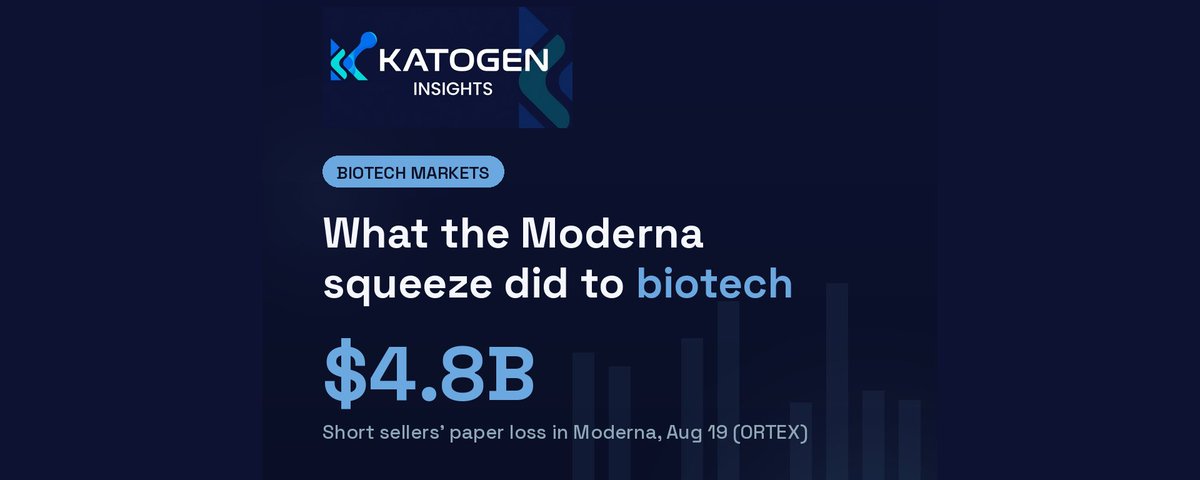
August 19 became known as the Moderna squeeze. The stock jumped 177% after positive Phase 3 melanoma results with Merck, leaving short sellers with an estimated $5.5 billion in paper losses that day, according to S3 Partners.
The mechanics show who absorbed the loss. When a short rises that sharply, it becomes a larger share of a fund’s book without any new trade. Risk systems then reduce gross exposure, often by selling winners to raise cash. Mizuho said funds caught in the squeeze sold crowded AI, infrastructure, and momentum longs to cover, while Goldman’s prime desk reported that systematic long-short funds fell about 1.4% intraday - their worst session in more than two years. A Treasury buyback announcement that day added pressure.
Biotech was on the other side of the trade. XBI ended August up more than 10%, and biotech indexes set records that week - but the rally was near its peak. In September, the Fed raised rates for the first time since 2023 and the 10-year yield reached 5%. By October 7, XBI was about 12% below its August high, though still up roughly 23% for the year.
That headline gain overstates the sector’s strength because of how the index is built. Since June 2024, the index behind XBI has not been meaningfully equal-weighted. S&P caps holdings by trading liquidity, giving larger weights to liquid names and smaller weights to thinly traded ones. Companies with less than roughly $400 million to $500 million in float-adjusted value are excluded. BioCentury warned that XBI would no longer reflect small- and mid-cap biotech; two years later, I think that prediction has proved accurate.
Beneath the index, the market looks different. Stifel data through March showed valuations rising for companies with strong clinical results while those with average or poor data declined. On average, investors in smaller companies’ follow-on offerings this year have lost money.
This matters beyond scorekeeping. A board seeing XBI up 23% for the year may assume a financing window exists when a $300 million company may have none. The window is open for late-stage companies with clean data, but most of the sector is raising capital during a rate-hiking cycle while the most widely cited index suggests conditions are healthy.
Investors who funded tech longs with biotech shorts learned a costly lesson about binary risk on August 19. If you serve on a small-cap biotech board, benchmark performance against the median of a true peer group. $MRNA
The cluster headache patients in the 2010 Karst paper had already been through oxygen, triptans, verapamil (some couldn't tolerate higher doses), steroids and lithium. In the week before treatment they were having between 6 and 19 attacks.
Cluster headache is often called the suicide headache, and the people who treat it will tell you the name isn't an exaggeration.
Migraine is a different scale of problem. It affects an estimated 1.1 billion people worldwide and is the leading cause of disability in people under 50. Triptans, gepants and the CGRP antibodies have helped a lot of them. They haven't helped everyone, and the patients still struggling tend to be the hardest cases.
BETR-001 is an oral capsule for both conditions. It works through serotonin receptors that migraine treatment already relies on and adds a plasticity component through 5-HT2A. It's designed to be taken at home, without hallucinations and without a controlled-substance label.
We're targeting an IND filing in the first quarter of 2027, and we plan to run Phase 1B studies in cluster headache and migraine in parallel.

Doug Drysdale retweeted

Biotech is a stock pickers market right now. So many wonderful companies are beaten down 40% or more from their highs. You can go through chart after chart of high quality late stage and early commercial companies and find great value. On the other side, there is a AI theme in biotech driving a massive bubble in many of the techbio companies. Same narrative that existed in 2021 before they all imploded.
If you avoid the bubbly biotech stocks and focus on the mispriced excellence, there is a lot to love in biotech. I have at least 10 companies I love and want to build positions into. Then there are at least 5 to 10 more I like but don't even own. Be a wise investor and avoid the meme garbage stocks and focus on the undervalued excellence.
On Monday the Nobel Assembly gave the 2026 Prize in Physiology or Medicine to Karl Deisseroth, Peter Hegemann, and Georg Nagel for optogenetics. The idea is almost absurdly simple. A protein from a pond alga opens a channel when blue light hits it. Put that protein into a chosen set of neurons, thread a fiber into the brain, and you can turn those cells on or off in a living animal with millisecond precision.
That switch rewrote neuroscience. Circuits that were only inferred from lesions and imaging could be tested directly. Memory, anxiety, appetite, movement, and the compulsive loops of psychiatric disease all became experimental objects rather than black boxes. Deisseroth is a psychiatrist as well as a bioengineer, and the clinical implication was never far from the work. The same logic is already in early human use. A few people with inherited blindness have regained modest sensitivity to light after an optogenetic gene therapy, and groups are testing light-controlled approaches in epilepsy and pain.
For anyone building drugs in neurodegeneration or mental health, the lesson is not that light will replace small molecules. It is that causal circuit maps change what a drug target even means. If you can prove a cell type drives a symptom, you stop guessing which receptor to block. Twenty years from an algal protein to a Nobel, and the therapeutic chapter is only starting.

Why we began with headache
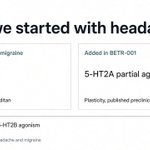
Serotonergic drugs are already widely used to treat migraine. Sumatriptan targets 5-HT1B and 5-HT1D, while lasmiditan, approved in 2019, is a 5-HT1F agonist. Rather than betting on an untested concept, we chose a receptor family already validated in neurology.
BETR-001 is an oral capsule for cluster headache and migraine. It activates 5-HT1B, 5-HT1D, and 5-HT1F and partially activates 5-HT2A, adding a plasticity component. In published preclinical work, 2-bromo-LSD promoted dendritic and synaptic growth through 5-HT2A (Lewis et al., Cell Reports, 2023). BETR-001 also avoids 5-HT2B agonism - a key distinction because that activity limited older lysergic migraine drugs such as methysergide.
BETR-001 is non-hallucinogenic, is not a controlled substance, and would be taken as a capsule at home, rather than administered in a monitored psychedelic session. We have completed our pre-IND meeting and are targeting an IND filing in the first quarter of 2027.
BETR-001 combines familiar acute pharmacology with a plasticity component absent from triptans, without requiring a clinic visit for each dose.
🤖 Made with AI

BetterLife Pharma Announces Rescheduling and Reclassification of Annual General Meeting to Annual General and Special Meeting
newsfilecorp.com/release/316…

Mental health, metabolic health, perhaps consciousness - all seem to have a road that leads back to mitochondria. Those little engines that formed about 1.5bn years ago after a free-living bacteria was engulfed by another cell and, instead of being digested, stuck around as a tenant. That partnership became permanent, which is why mitochondria still carry their own circular DNA and divide independently. Endosymbiosis.

WOW LIFE AS A QUANTUM PROCESS. NEW PAPER.
A QUIET FREQUENCY THAT COULD CHANGE HOW WE SEE LIFE
Something extraordinary has been heard inside living cells. Deep within mitochondria—the tiny, folded engines that power every heartbeat, every thought, every movement—researchers have detected a vibration ringing at 71 trillion cycles per second.
The signal appears only while those engines remain intact and alive. Break the architecture and the note falls silent.
That single peak, reported in a 2026 preprint by Yu Yang, Zhenglong Gu and Bo Song, is more than a spectroscopic curiosity. It is a invitation. It suggests that the most important organelles in biology may be doing something subtler and more elegant than classical chemistry alone can explain.
The team used infrared light to listen to living human cells, fresh tissues, and carefully isolated mitochondria. Again and again they found the same unexplained 71 THz feature. Their model is beautiful in its simplicity: light trapped among the cristae couples to the collective dance of lipid CH₂ bonds, creating a polariton—a hybrid state that is part light, part matter. The familiar 87 THz vibration splits.
One of the new notes is the 71 THz signal we can now hear. The living mitochondrion, in this picture, is not just a factory. It is a resonator.
When the researchers gently shone light at that same frequency onto cultured cells, ATP production rose by about ten percent. A nearby control frequency did nothing. Frequency mattered.
The cell’s energy currency responded as if someone had found a hidden dial.
This is still early science. The paper awaits peer review and independent confirmation. That is how good science works. Yet the possibility already feels generous. If mitochondria can host a light-matter quantum state that we can address from outside, then energy metabolism is no longer a closed chemical book. It becomes a system we might one day tune.
Imagine therapies that raise cellular energy without harsh drugs—soft, precise infrared light helping failing hearts, tired muscles, or aging neurons recover their spark.
Imagine a deeper understanding of why life is so efficient, why warm, wet cells can still exploit quantum resources we once thought belonged only to laboratories at near-absolute zero. Imagine mitochondria not merely as batteries but as possible channels for both energy and information, quietly coordinating the business of being alive.
Quantum biology has waited years for a clear experimental foothold inside living animal cells. This 71 THz peak may be that foothold. Even if later work refines the interpretation, the observation itself is a gift: life is still capable of surprising us at the smallest scales.
The original research is available:
biorxiv.org/content/10.64898…
The universe did not have to make cells this interesting. It did anyway. We are only beginning to learn the frequencies they sing.

This is very interesting work from David Olsen et al. Great to understand the components of the LSD molecule - which elements are cardiotoxic? what drives hallucinations?
@BetterLifeBio's BETR-001 is not an agonist at 5HT2B (cardiotox) and does not cause hallucinations when engaging the 5HT2A receptor as it is a partial Gq biased agonist.
Great to see the BETR-001 thesis confirmed independently. Potent neuroplasticity without the trip.

By systematically stripping down the complex structure of the LSD molecule, scientists have pinpointed the exact components that trigger hallucinations. This breakthrough paves the way for safer, non-hallucinogenic psychiatric treatments that harness the… dlvr.it/TVf2bn

Doug Drysdale retweeted

By systematically stripping down the complex structure of the LSD molecule, scientists have pinpointed the exact components that trigger hallucinations. This breakthrough paves the way for safer, non-hallucinogenic psychiatric treatments that harness the… dlvr.it/TVf2bn
The human data signal for BETR-001:
Karst et al. (Cephalalgia): open case series of racemic 2-bromo-LSD
3 doses only ~30 µg/kg on days 1, 5, and 10.
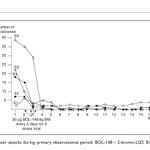
Figure 1 from the paper tells the story - weekly attack counts drop to baseline and stay down across the 16-week window. Four months essentially headache free after just 3 doses.
No hallucinations reported in the series, yet that response profile looks just like the data we have been seeing with psychedelics in depression, anxiety, etc.
@BetterLifeBio's BETR-001 is the next cut of the same idea: patented active (6R,9R) stereoisomer, modern CMC (synthesis not from LSD), IND targeted Q1 2027.
Lead indicartions: cluster headache and migraine, in parallel.
Same family. Sharper molecule. Clinic early 2027.
Source: Karst et al., Cephalalgia 2010 (PMID 20713566).
Figure: Course of cluster attacks, primary observational period.

Doug Drysdale retweeted

from heidi overton's opening remarks in her confirmation hearing: "President Trump's direction for me in this role should I be confirmed is to go fast. Slow and prohibitive requirements for cutting-edge therapies at the FDA means investment is increasingly flowing to China, who has found ways to do things faster and cheaper... China has surpassed the United States as a top venue for clinical trials... When we lose this advantage, we lose our health security. And when we lose our health security, we lose everything." "The FDA has begun work... to make sure every aspect of clinical trials and drug development is optimized." "The recent rapid approval of a new treatment for pancreatic cancer... should be the norm for the FDA."
Doug Drysdale retweeted

Link to full paper:
journals.sagepub.com/doi/10.…
Disclosure: long $BETRF

ALT Karst et al. (Cephalalgia, 2010)

4/7
Is there any human signal?
Yes.
Karst et al. (Cephalalgia, 2010) tested racemic 2-Br-LSD (BOL-148) in a small pilot in cluster headache. Authors reported reduced attack frequency/intensity, without hallucinations in that study, after just 3 doses - lasting for 4 months.
That is historical, racemic mix data. BETR-001 is the selected active stereoisomer. Different molecule package; same chemical family.
Doug Drysdale retweeted

Claude has discovered a previously unknown enzyme system hidden in the DNA of bacteriophages. Beside the enzyme’s gene sits a long array of repeating DNA—a structure that looks somewhat similar to CRISPR.
We don’t yet understand what this system does, but only a handful of known systems share its features, and all of them are able to cut, copy, and paste DNA. Historically, the discovery of such programmable systems has helped revolutionize medicine. CRISPR, for instance, is now the foundation of genetic medicines. But it will take much more work to learn what this system does, and whether it can be put to similar use.
Read more: anthropic.com/news/claude-di…
