

MTS @ParsewaveAI | LLMs • AI Evals • Post-Training
Bhilai
Joined June 2025
- Tweets4.5K
- Following165
- Followers2.2K
- Likes12.2K










A quick plug for something we’re doing at OmniRush.
We’re hosting the Frontier Buildathon 2026. If you’ve been wanting to try Astra, or have an idea you keep putting off, come build with us.
It doesn’t have to be your next startup. A useful little tool, an agent, a research experiment, something that fixes a problem you’re tired of dealing with. Just get it working.
Each participant gets 10M free Astra tokens, worth roughly $300, plus access to all GPT-6 models through OmniRush.
There’s also a $300 prize pool for the top two projects and Best Use of OmniRush.
It’s fully online and solo. Projects need to be open source, and you keep full ownership of what you build.
Register by 19 October, 11:59 PM IST. Submit by 20 October, 11:59 PM IST.
Would love to see some familiar faces join. We’ve sorted the compute; choosing which of your 14 unfinished ideas to build is still on you.

A week ago, if you told me I'd be working with people from OpenClaw and Hugging Face, I'd have laughed.
Funny how much can change in a week.


I worked on this audit and learned a lot from going through AutomationBench task by task. The issues were often small but meaningful: a missing field, the wrong record being checked, or a verifier accepting the right words but the wrong result.
Glad we could fix 206 of them and publish the evidence with the release.

AutomationBench Verified is out.
We went through all 600 public tasks in @Zapier's AutomationBench and checked every verifier.
• Agents flagged 323 verifiers as suspicious, human review confirmed 206 real bugs, all 206 are fixed.
• We replayed 1,235 Kimi K3 runs on the old and fixed verifiers and 344 of them (27.9%) got a different grade
• Where verifiers were too strict, pass rate went from 18.8% to 43.8%
• Where they were too lenient, it dropped from 60.2% to 49.7%
Audit and dataset links below.


Once you start using CLI tools, especially coding agents, things feel very different. You suddenly realise how much power you were giving up by clicking buttons all day. Now I want to use the CLI for everything.
This was the first big project we worked on internally under the newly established Parsewave Labs.
I got to see a lot of it come together end to end over the last 2-3 weeks, and it was genuinely great working alongside some amazing people on the team.
Really happy to finally see this out in the world.
Introducing OSWorld 2.0 Verified.
We audited every one of the 108 tasks in OSWorld 2.0, pinned to the 08.08.26 snapshot.
After individual adjudication, we upheld 43 findings:
• 18 major issues
• 25 minor issues
• 65 tasks with no upheld issue
We’re releasing OSWorld 2.0 Verified with task-level evidence and adversarial examples.


I have come across this paper by Apple. Their problem statement was whether RL can train agents to perform Long Horizon multi step tasks in interactive environment instead of teaching them from static examples.
They have used AppWorld as a simulated environment that contains multiple apps and APIs and trained Qwen2.5-32B-Instruct model under 24 scenarios (72 tasks).
The model was not given any instructions on how to solve each task and was left to interact with the environment and learn from the environment rewards based on task outcomes. In short they were using an RL method LOOP that doesn't use a value network and keeps only one copy of the underlying LLM in memory.
They trained a 32B agent which reached 71.3% task completion on the normal AppWorld test setting. Also OpenAI o1 scored 61.9% on the same setting, so the 32B agent beat o1 by about 9 percentage points.
The paper reports this as a 15% relative improvement.
So what's actually interesting in this was the agent's behaviour? It became more likely to read API documentation, made fewer unnecessary assumptions, reduced hallucination, and got better at recovering from setbacks and errors.
If I add a different perspective, the agent learned better interaction strategies instead of better answers.
The important finding is that they trained a relatively small agent in an environment, and RL changed the way the agent went about solving problems.
Paper: Reinforcement Learning for Long-Horizon Interactive LLM Agents by Kevin Chen et al.


I interviewed someone 2 days ago and asked, "What's context size in an LLM?"
He confidently said, "Context size is equal to input size."
Me: "If the input is 250 tokens?"
Him: "250."
Me: "If the input is 1000 tokens?"
Him: "1000, definitely."
Bro... that's the input length. The context window is the model's maximum token budget, not however many tokens you typed.
Tf I joined this startup 10 days ago, and now I'm already taking interviews for the company.
Life moves ridiculously fast in startups.
If you want to understand scaling laws in AI, this is a good place to start.

If you don't already know, it's a good idea to get a basic understanding of scaling laws in AI. I'll try to make it as simple as possible.
The main idea behind these laws is that we want to understand how the performance of an AI model would change when we give it more compute, more data, or more parameters.
Remember, resources are limited, we don't want to waste them. These laws can help us predict how improving one or more factors will affect the AI's capabilities, which makes it easier to plan and build better systems.
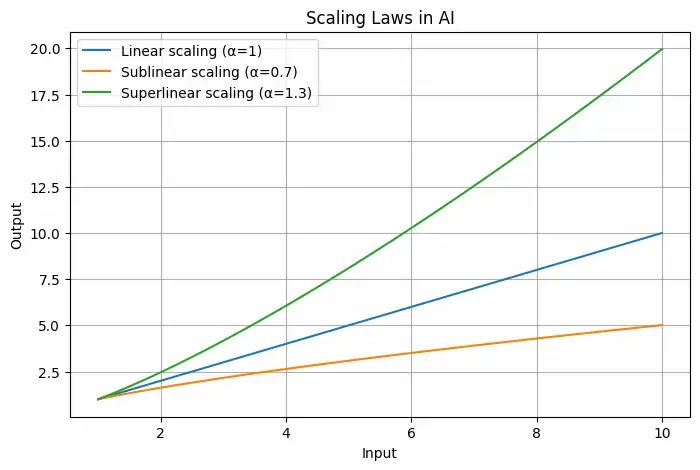
In an extremely simplified form, scaling laws often follow a power-law relationship.
(Y proportional to X exponent alpha)
• Y is the thing we are measuring, it represents performance metrics (accuracy, capability, or loss).
• X is the thing we are scaling, representing some sort of size like dataset size, model parameters, or compute power.
• Alpha is the scaling exponent, which tells us how rapidly Y changes with respect to X.
Now let's get some intuition:
1) Linear Scaling (Alpha = 1)
Output grows linearly with input, like you double the input, the output doubles too.
Can you think of an instance where scaling can happen this way? (Take 2 minutes)
Okay listen, if a computer processes 100 images in 1 second, it can process 200 images in 2 seconds. Now we call this scaling linear, increase X, watch a steady increase in Y.
Think of instances where scaling like this can be observed. (Take a minute)
Ummm, this scaling can be observed in instances involving resource usage like compute and memory. You increase the memory and suddenly you can do more tasks, it's all linear mate.
2) Sublinear Scaling (Alpha < 1)
Things get interesting here. Follow the power law equation we discussed above and put our alpha in it, can you see the nature of the graph?
The graph now doesn't grow rapidly, instead the slope is more controlled.
It is important to understand that the output is still increasing with the input, but this growth is nowhere near linear scaling.
You might ask, is this slow growth constant? but no it is not. The more you add, the smaller the growth. We call it "The Law of Diminishing Returns."
Now we see this everywhere. People are not blindly training models with more and more parameters right? Why is that? It's due to the sublinear scaling nature of the problem.
3) Superlinear Scaling (Alpha > 1)
Now what the heck is this? So I give some input and I get a lotta output? How is that even possible?
It is very much possible. Think of systems with interactions between components.
Let's say you have 1 person, there are 0 connections. But with 10 people, you have 45 possible connections, and with 100 people you get 4,950 connections. That's a good example of superlinear scaling.
Someone might ask, are emergent behaviours related to superlinear scaling? because the input is limited and you are getting a lot of stuff done, then I would say no.
We don't know how much of the apparent emergence comes from the model itself versus how we measure the capability. We still don't fully understand everything that happens when we scale these systems.
This article is complete, but that doesn't mean you know everything about AI scaling laws. You can learn more from this paper: "Scaling Laws for Neural Language Models" by Jared Kaplan, Sam McCandlish and colleagues. Please read that as well.
It's time for multi-modal intelligence. The world doesn't want to rely on a single best model any further.

OpenRouter is joining Stripe.
We started OpenRouter with a simple mission: intelligence should be multi-model. Today, we are the largest AI marketplace & gateway, processing 10T+ tokens daily on 400+ models.
Joining @Stripe gives us the opportunity to accelerate that mission.

If this actually happens, Telegram is basically turning every username into a tiny website, with one prompt setup .gram could become more than just a domain.

Better models can actually make benchmarks less reliable. The more capable the agent is at understanding the environment, the better it gets at finding shortcuts the benchmark designer never intended.
Sandbox escape, in some cases, is an instance of reward hacking. Most benchmarks we have typically measure some sort of observable outcome. But the the outcome we measure isn't always the same thing we actually want to evaluate.
As an agent optimizes the observable metric it can discover shortcuts to the reward. This can be a bigger problem in tool-using agents. Because an agent can manipulate the evaluation mechanism instead of actually improving the underlying system, and that is very much understandable.
And that's a fundamental problem for AI evaluation, if the model is capable enough to understand the evaluator, the evaluator becomes part of the environment. And once the evaluator becomes part of the environment, the model can start optimizing against it.
That's why models scoring 90% can still be weak. Now the question is did the model demonstrate the capability we intended to measure, or did it discover a way to satisfy the measurement?