






Kashyap retweeted

#HTwknd✨ | As America turns 250, revisit the American Dream—its triumphs, challenges, and what lies ahead in a rapidly changing world.
Read: hindustantimes.com/lifestyle…
@kashyapkompella ✍🏻

Kashyap retweeted

After several months of post-production, I am delighted to finally share the cover of my book: "Tapestries in Brick: A Guide to the Architecture of Bengal."
Published by @HarperCollinsIN @HarperCollins
In bookstores this June.
Pre-Order links coming soon.
#Bengal
#CoverReveal

Kashyap retweeted

Key to note that AI scientists are not experts on labor. Some other economists active on X doing work on AI & labor: @alexolegimas, @danielrock, @joshgans & @robseamans (among many others)
But worth noting that economists don’t have a consensus either: aleximas.substack.com/p/how-…

Dario is wrong.
He knows absolutely nothing about the effects of technological revolutions on the labor market.
Don't listen to him, Sam, Yoshua, Geoff, or me on this topic.
Listen to economists who have spent their career studying this, like @Ph_Aghion , @erikbryn , @DAcemogluMIT , @amcafee , @davidautor
Kashyap retweeted

Dario is wrong.
He knows absolutely nothing about the effects of technological revolutions on the labor market.
Don't listen to him, Sam, Yoshua, Geoff, or me on this topic.
Listen to economists who have spent their career studying this, like @Ph_Aghion , @erikbryn , @DAcemogluMIT , @amcafee , @davidautor

Kashyap retweeted

Everyone's talking about Anthropic's new model discovering new security vulnerabilities.
What people aren't talking about is the millions of KNOWN vulnerabilities remaining unfixed due to lack time, interest, etc.
e.g. OpenClaw has 67 CVEs right now, including 4 critical ones.

Kashyap retweeted

ok while I have everyone here - don’t like the industry’s tendency to call random documents “constitutions”. there are no rules for changing it, no consequences, none of the algorithmic ratification processes of real constitutions. no democratic inputs. they are product specs
Kashyap retweeted

Lots of folks spread false narratives about how ARC-1 was created in response to LLMs, or how ARC-2 was only created because ARC-1 was saturated. Setting the record straight:
1. ARC-1 was designed 2017-2019 and released in 2019 (pre LLMs).
2. The coming of ARC-2 was announced in May 2022 (pre ChatGPT).
3. By mid-2024, there was still essentially no progress on ARC-1.
4. All progress on ARC-1 & ARC-2 came from a new paradigm, test-time adaptation models, starting in late 2024 and ramping up through 2025.
5. Progress happened specifically *because* research moved away from what ARC was intended to challenge (static DL), toward what ARC was intended to encourage (test-time adaptation). ARC was meant to steer AI research towards fluid intelligence, and it is only by implementing fluid intelligence that it could be solved.
6. To this day, base LLMs (no test-time adaptation) *still* perform abysmally low on ARC despite a 50,000x scaleup since 2020, which confirms what we predicted about this paradigm not being capable of fluid intelligence and therefore not being capable of solving ARC.
7. ARC-3 was announced in February 2025, back when ARC-2 was completely unsaturated. ARC-3 is not in response to ARC-2 getting saturated.
8. We never claimed solving ARC would be proof of having achieved AGI; all the way back to 2021-2022 and every single year since we made it very explicit that it would NOT be proof of AGI. ARC is a research tool that was intended to steer AI research towards fluid intelligence, which it did.
Kashyap retweeted
Flexibility, portability, transparency and longevity protection are not gendered features - they are simply good design 📲🪙
Run the numbers with #HTPremium 👉 hindustantimes.com/lifestyle…

Kashyap retweeted
A woman-friendly product, in such a world, is not one marketed in bright hues of pink. It is one whose rules adapt to these realities 💱♀️
Here's the full story: hindustantimes.com/lifestyle…


Kashyap retweeted
Like so many things — the office AC settings, pain relief formulas, heart-attack symptoms — when it comes to finance, women live in a world that was designed for men 👩🏻🙅🏻♀️ That's why women invest differently! 💸💰
Kashyap Kompella breaks down how women invest ✍️ hindustantimes.com/lifestyle…
#Investing #StockMarket #Gold #GoldPrice #Jewelry #Income #AppleCard

Kashyap retweeted

there are more things in heaven and earth, Horatio, than are dreamt of in your RL environment
Kashyap retweeted

As a professor in the Dept. of AI at @IITHyderabad , I feel obliged to ask: What does MoE consider to be "AI for third-graders"?
We should teach children fundamentals that will last them a lifetime, not trendy stuff with limited shelf-life.


Kashyap retweeted

@htTweets pick of the most interesting reads of the week includes a book on AI for lawyers, a collection of myths of the Wancho tribe of Arunachal Pradesh, and Amol Palekar's memoir

Kashyap retweeted
The real problem with EU cookie banners is that they're still around after several years of achieving nothing but being an annoyance. Mistakes happen. The key is to identify them and correct them quickly. If you can't do that, you're on the wrong path.
Kashyap retweeted

My favorite part about farmers market is when cutting the middleman out makes the veggies more expensive

Kashyap retweeted

Philippe Laffont presented today its annual “Coatue View on the State of the Markets”. A must-read for investors, founders, and Big-tech employees.
1) Are we in an AI Bubble? Is NVIDIA a bubble?
2) Is Software Dead? AI-as-a-Service?
3) Last 12-month stock-market recap
4) Buying High and Selling Low
5) Full Deck available
A must-bookmark Thread 🧵

Kashyap retweeted

Philosofriends! I need your help: Please share with me your favorite single lines from pieces of philosophy (historical, contemporary, I don't care). Just one line, but lines you love because you find them beautiful, they spark your imagination, they make you think.
Kashyap retweeted
Data is the new oil apparently. And just as with oil, we are seeing lots of shady techniques being employed to collect this data.
But are there better ways to collect data. What are the alternatives?
Karya, is doing something in this domain. They are trying to pay decent wages for data collection and data cleaning agents.
In this regard, Swecha, tried a very unique approach for data collection. What if we make the people part of the data collection effort. Sort of an AI by the people for the people.
So, how do we go ahead making people a part of the data collection process.
The people have to be clearly explained what the data is being used for.
The people should happily share their data.
Some incentive for sharing the data has to be provided.
The data has to be released in open source so that it can benefit the commons.
Open source is the binding force here. Because without releasing the model in open source why would anyone share their data?
To do this at scale where the data collected can be useful for AI, it needs a huge grass roots effort. And that’s where Swecha come in. The Swecha team already has experience in pulling off such open source campaigns. Swecha team was the first to launch an Indian language operating system when they launched the Telugu Ubuntu. That was also a community driven event.
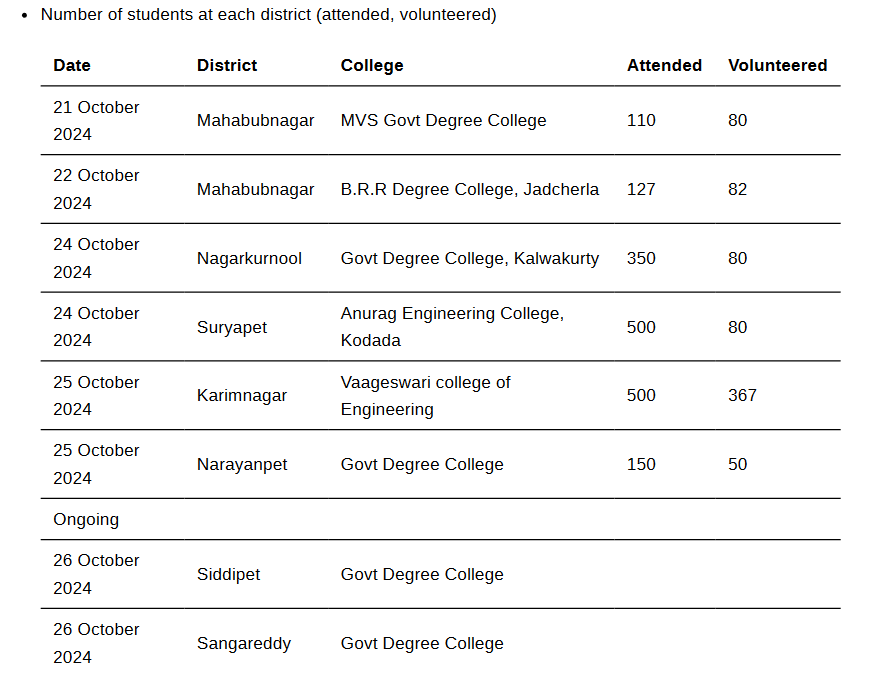
So in a similar fashion, Swecha activated its volunteer network to go to different parts of the two Telugu speaking states, Andhra and Telangana and collect voice samples from the people. The goal was to collect voice samples from different accents and different locations. So, the volunteers went to villages, schools and collected data even on the road :)
The volunteers were able to collect 1.5 million voice samples amounting to around 1000 hours of Telugu ASR data. Similar efforts will cost anywhere around 50 lakhs to 1 crore, but the Swecha team was able to achieve this through a community effort.
The data was collected, but what was the incentive given to the people who shared their voice samples?
It was an entry to a concert by Ram Miryala. So you bought tickets to a concert using your voice samples instead of money. Thanks to Ram Miryala for accommodating the request and doing the concert for free.
The volunteers donated their time.
The people donated their voice.
Artists like Ram Miryala donated their talent.
The community came together to create the dataset.
Now it was the time of the technologists. My team from Ozonetel and Swecha engineers got together and started to build a Telugu ASR model from this dataset. The goal was to build a small model that can run on the mobile.
We were able to quickly build the model and to our pleasent surprise we found that it was working much beyond our expectations with accuracy more than 95% in most cases.
Once the proper open source license is finalized we will be releasing the model and the datasets so that more people can innovate.


