

Helping people awaken to their true capabilities and unlocking the power within. improvemyworld publishes books and provides in-depth coaching
United Kingdom
Joined May 2018
- Tweets1.6K
- Following4.7K
- Followers2.1K
- Likes971



The Toxicum framework asks us to look at both sides of difficult interactions: what is happening externally and what is being activated internally.
That is where greater control becomes possible.

Checking what remains after the situation has ended.
Ask:
“What am I still carrying from that interaction?”
Composure helps you manage the moment.
Processing helps you stop carrying it into the next one.

The more someone's identity becomes attached to being right, competent, or respected, the harder it becomes for them to receive correction.
Growth starts when people can separate who they are from what they did.
Until then, every conversation feels like a personal attack.

Knowing what the conversation actually requires.
Do people need more information?
Is there something important you haven’t considered?
Or do they simply disagree?
Listen carefully to disagreement.
But don’t automatically treat it as evidence that something must be fixed.

Trust is not an emotional concept.
It is a behavioural one.
The more predictable the behaviour, the stronger the trust.

Learning to evaluate your decision separately from their reaction.
Ask:
“Has new information appeared that should change my decision?”
If not, you may not need a different decision.
You may simply need to tolerate an uncomfortable response to it.

Many professionals think they're tired from meetings.
Often they're tired from constantly managing other people's reactions.
The solution isn't fewer meetings.
It's fewer unhealthy behaviour patterns inside them.

Before a difficult conversation, ask:
“What has actually happened, and what have I added?”
Prepare for the facts.
Not every version of the conversation your mind can create.

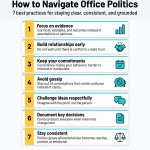
Challenge ideas respectfully.
Document important decisions.
Politics grows where clarity is missing.
The more consistent your behaviour becomes, the less vulnerable you are to someone else's agenda.

The next time you recognise a familiar pattern, don’t only ask:
“Why are they doing this?”
Also ask:
“What is happening inside me right now?”
That is the part of the interaction where your control begins.

Real growth is measured by how consistently you refuse to let it dictate yours.
The goal has never been to control difficult people.
he goal is to stop giving them control over you.
That is where lasting change begins.

Before asking, “What’s next?”
Ask:
“What can I do now that I couldn’t do a year ago?”
Progress needs to be recognised if you want to see yourself accurately.


Listen until the other person has actually finished.
Then decide what requires a response.
You may discover there is less to defend than you initially thought.

Help because it is appropriate.
Step back when it isn’t.
Being valuable and being constantly needed are not the same thing.


Strong teams are not teams where everyone agrees.
They are teams where disagreement can happen without punishment.
If people are afraid to challenge ideas, mistakes become much harder to catch.
And much more expensive to fix.

improvemyworld retweeted
People don't follow your words.
They follow your example.
Trust fades when actions don't match values.
Great leaders lead with integrity.
Because when your actions match your values,
people choose to follow.
What's more influential: words or actions?
improvemyworld retweeted
If your peace depends on everyone understanding you, you'll spend a great deal of energy chasing something you cannot fully control.
Once you've communicated honestly and thoughtfully, it's okay to let the conversation rest.

improvemyworld retweeted
You can remain understanding without becoming naive.
Because every additional chance has a cost.
Time.
Energy.
Trust.
Resources.
The question is not whether people can change.
The question is whether there is evidence they are trying to.
Those are very different conversations.

improvemyworld retweeted
The emotion isn't the problem.
Automatic behavior is.
The goal has never been to stop feeling.
The goal is to create enough space between the feeling and the response that you get to choose what happens next.
