
@ilobov
Account based inUnited Kingdom!
About this account
- Account based in
- United Kingdom
- Connected via
- United Kingdom Android App
X says this location may be affected by a proxy or VPN.
Account-level information from X, not a live location or the device used for a specific post.
Research Engineer @GoogleDeepMind, ex @Criteo. DiffusionGemma team, previously - AI for hardware design automation.
St Albans, England
Joined February 2011
- Tweets132
- Following174
- Followers338
- Likes323





Pinned Tweet
Our team just released 55 pages of learning and results of making DiffusionGemma. I do recommend for anyone interested in text diffusion models.
Big shout out to @jean_tarbou, @bshahr, Martin, James, Daniele, @cindyxywu, @flennerhag, @bodonoghue85, Pasha and many others who have put so much effort into making this report.
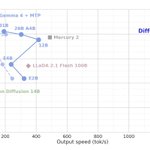
Highlighting my favourite take in the report - diffusion can brings very different throughput frontier. It is not only bs=1 technology.
arxiv.org/abs/2608.00146


Ivan Lobov retweeted

Traditional LLMs write one token at a time. Diffusion models don't.
At the London PyTorch Meetup I gave an intro to text diffusion and how DiffusionGemma gets ~4x faster text generation. If you know LLMs but diffusion is a black box, this one's for you!
youtu.be/3n5RN7i8h2Y

Nice claim, but if you look carefully, they used Qwen3.8 Flash Next 180b/a6b for benchmarking. This is a local model that barely uses any flops at all even on a single Dgx Spark. It is not the right model to compare perf/$ for monsters like b300 and rubin. Use Kimi k3 or glm 5.3 instead.
Also, seriously, Flash Next is a great local model but making caps-level claims relying on it is... Well, strange.

ALERT🚨: NVIDIA SGLANG INFERENCE RUBIN IS 4.23x BETTER 🚀 PERF PER DOLLAR THAN EVEN GB300 NVL72. This is on the widely used production LLM engine called @sgl_project. (1/2)🧵

What can you actually run locally, on which hardware, and how fast?
What an actual banger Qwen3.8-Flash-Next is! It hits the sweet spot for capable local devices - all major manufacturers have devices that can run it at 30+ t/s speed.
Full report: iv2nl0b9v.github.io/local-in…


Let's go! 💥🚀

We want people to have the freedom to move to a better job and help our most promising businesses grow.
Today, the PM announced we will legislate against non-compete clauses, so they no longer hold back workers or stand in the way of startups hiring the talent they need.
We’ll also bring forward options to tackle wider restrictive practices, like excessive notice periods.
We have to empower the people taking risks to build something, giving them the freedom to start and scale.
Ivan Lobov retweeted

🔥Welcome 🔺Simplex Diffusion Models🔻!
Standard discrete diffusion models suffer from "information collapse" because they discard uncertainty at intermediate steps by sampling categorical tokens. (1/5)

If you are as confused as I was reading that 8b model sets SOTA on Deepswe and Terminal bench, this is for you: they use Opus/Fable to actually generate trajectories and CLM 8b picks the best actions based on those choices.
Honestly, I like verifiers research direction and this looks an impressive step towards better ones, but you have to tone down the announcements or make them clearer.

Introducing Contrastive Language Model (CLM): an ultra-fast System One Model trained with a contrastive learning objective that connects states and actions.
CLM-8B is pre-trained on internet-scale data and delivers up to 9× faster inference than Jev ⚡ while achieving comparable performance across computer-use, gaming, and tool-calling tasks.
With lightweight fine-tuning, CLM-8B sets a new SOTA on challenging agentic coding benchmarks, such as DeepSWE (81.6%) and Terminal-Bench 2.1 (87.6%). In contrast, Jev fails to serve as an effective verifier for these long-horizon tasks.
We also build an efficient training and serving infra for CLMs by disaggregating states and actions, allowing their embeddings to be cached and reused independently. This substantially reduces inference latency in settings where the state evolves continuously while the action set remains fixed.
Finally, we establish scaling laws for CLMs and show that the test contrastive loss decreases predictably as a power law in training compute, model size, and dataset size.
📄 Blog: contrastive-lm.notion.site
💻 Code: github.com/Contrastive-LM/CL…
🗣️ Discord: discord.gg/5dAQEDJBs
🤗 Data & Models: huggingface.co/Contrastive-L…
More details on CLM’s architecture, data recipe, and scaling laws in the thread below 🧵
Mad respect for the folks! Next step is streaming on twitch the babysitting and hot fixes, I would tune in

Nearly half a year of silence. We spent it studying one problem: how far RL can scale.
MiMo-V2.6 is in the middle of its RL run right now. Three things we scaled: compute (~2B tokens per step, 1568 prompts × 16 rollouts, fully async), environments and harnesses (multi-task agentic RL, mixed across multiple harnesses in one run), and grader compute (agentic in-group credit assignment, with test-case and rubric-based rewards). We'll open-source the details piece by piece over the coming weeks.
Streaming the run: mimo.xiaomi.com/rl/

Ivan Lobov retweeted

Seems like interesting work, but "Beats ALL diffusion LLMs" is simply not true. Latency-quality is comfortably Pareto dominated by both Mercury 2 and DiffusionGemma.
(I can only post the Uno-Qwen point because strangely the LCBv6 number for Uno is missing from the writeup.....)


Diffusion LLMs have two limitations relative to AR models:
(1) Lower quality, and
(2) Slower inference at large batch sizes.
We address this "Uno"
> Retains the AR architecture of LLMs
> Each layer has two sets of weights: AR weights and Diffusion weights
> Diffusion weights enable parallel sampling from the AR distribution losslessly
Results:
💥Faster than all speculative decoding methods: DFlash and EAGLE-3
🔥 Beats ALL diffusion LLMs: Mercury 2, Diffusion Gemma, Llada
Links to the paper, models, code below

I was trying to digest what OAI has just recently announced, but here's what struck me the most:
"from initial design to tapeout in nine months".
This is absolutely insane. I've worked closely with the hardware teams when developing AI tools for them and I think it's pretty much unheard of.
@cdleary congrats on the tapeout and an amazing result!
openai.com/index/jalapeno-fi…

Amazing to see what better systems design can bring! Frontier-level models are servable locally today 🤯

Your gaming PC can now serve frontier models at interactive speed using official checkpoints without extreme quantization!
Qwen3.6 35B → 8GB RTX 4060 laptop @ 39 tok/s
DeepSeek-V4-Flash 284B → RTX 5090 desktop @ 22-25 tok/s
GLM-5.2 753B → RTX PRO 6000 workstation @ 15 tok/s
Run your claude code or codex now with frontier model for $0
Meet FreeToken 🧵
Ivan Lobov retweeted

What UK AI startups need: @KanishkaNarayan
In California, one can start a company the day after leaving Google. My colleagues Jeff Dean, Oriol Vinyals et al made this very clear recently with their impressive speed.
In the UK, the same American companies impose 1 year garden leaves on senior AI researchers and 6 months on junior researchers. @GoogleDeepMind for example forced people to sign these contracts at the time of promotion, not the time of hiring.
What this means is that researchers cannot start new companies for up to 1 year, cannot easily hire, and in short: they cannot compete.
American VCs cannot understand why we move so slow.
It is time for UK Gov to do the right thing: Make garden leaves optional for employees.
If you’re an AI entrepreneur or VC in the UK or Europe, I would appreciate your comments here. You’ve all confided in me. It is time you let government know the urgency of this — everyone should speak up.
Ivan Lobov retweeted

Sure would be a tragedy if there were a frontier AI lab out there that was already making Nobel-level contributions to life sciences but was forced by management to pivot away from basic research towards LLM products.


More work on diffu-patching AR models. We are getting closer to closing the gap, imo. 🚀

Finally wrapped up my work at @AdobeResearch, and excited to share FLARE: Diffusion for Hybrid Language Model🔥
Hybrid attention is having a moment.
Recent releases such as Qwen3.8 and Kimi K3 reinforce a compelling direction for efficient LLMs: combine linear attention with periodic full attention. Bounded recurrent states make long-context processing economical, while full-attention layers retain direct global interaction.
With FLARE, we asked whether this increasingly important architecture could also support diffusion-style multi-token generation—without rebuilding the model from scratch or giving up the capabilities of its pretrained checkpoint.
FLARE transfers Qwen3.5 hybrid-attention checkpoints into diffusion language models with a cheap budget of around 10B training tokens. We release FLARE-2B, FLARE-4B, and FLARE-9B.
The key is to train two complementary views of each document: a clean causal stream that preserves next-token behavior, and a noisy block-bidirectional stream that learns diffusion denoising. The resulting checkpoint supports two inference paths:
> AR-Trust verifies parallel drafts through the clean causal stream
> Diffusion-Trust denoises multiple tokens within an active block
Making this transfer work revealed a broader lesson: conversion quality depends on more than the diffusion objective.
First, transfer data sets the capability ceiling. Under the same source checkpoint and token budget, changing the balance of reasoning traces, mathematics, code, and instruction-following data reshaped which capabilities survived conversion. A data mixture that helped one capability could hurt another; the best overall transfer came from preserving coverage across them.
Second, the clean stream is what anchors the converted model to its source behavior. Clean causal context recovered most of the loss from diffusion-only training, and retaining next-token prediction closed much of the remaining gap. Meanwhile, training across partially completed noisy blocks preserved the flexibility needed for Diffusion-Trust decoding.
Hybrid diffusion is also a systems problem. During training, small blocks multiply the number of recurrent-state boundaries that would otherwise be materialized in GPU memory. We developed a fused two-stream route that keeps chunk computation Tensor-Core friendly, stores only strided checkpoints in HBM, and reconstructs boundary states in registers. This makes small-block training substantially more practical and brings its efficiency closer to conventional causal training.
Inference requires a different form of state discipline. Paged KV cache and recurrent GDN state must remain synchronized while tokens are still provisional. Our SGLang-based stack commits state at the accepted offset for AR-Trust, keeps denoising rounds read-only for Diffusion-Trust, and updates the causal state only after a block becomes final.
Across reasoning, knowledge, instruction following, and coding evaluations, FLARE models preserve a strong capability profile while enabling diffusion-style multi-token generation. With the optimized serving stack, FLARE reaches up to 4.8× higher decoding throughput in our evaluation setup.
Everything is open now: the training code, the inference stack, and the FLARE checkpoints.
We hope FLARE makes it easier to explore diffusion-style generation on modern hybrid backbones. Try the models, reproduce the results, or use the code to build fast language models of your own. We’re excited to see where the community takes it.
This was joint work with @ChongjianG30781, @HaoTan5, @Xu_Arthas, @ZhuWanrong, Jason Kuen, @koustavagoswami, @YongxinChen1, @MoleiTaoMath, and more importantly, with support from my beloved mentors Jiuxiang @ethan_jxgu and Jing @Jingorz at Adobe Research.
📄 Paper: arxiv.org/abs/2606.01774
🌐 Website: tokflare.github.io
💻 Training & inference: github.com/yuchen-zhu-zyc/FL…
🤗 Checkpoints: huggingface.co/collections/y…
Ivan Lobov retweeted

"DiffusionGemma Technical Report"
DiffusionGemma turns Gemma 4 26B A4B into a discrete diffusion model that denoises 256 tokens in parallel, reaching about 20 tokens per forward pass and 1,500 tok/s on one H100.
By using SFT to teach bidirectional denoising, then use sampler distillation plus RL to reduce denoising steps, they did not have to train this DiffusionLM from scratch while maintaining generation quality.
Read more about the technical report here:
alphaxiv.org/abs/2608.00146

It is interesting that both Demis and the musketeers, big names in Gemini/GDM, are leaving to do more applications and not more LLMs 🤔
Ivan Lobov retweeted

Our tech report on DiffusionGemma is out! 🚀
My biggest highlight? Online post-training is a game changer for text diffusion.
We performed joint Sampler Distillation and Reinforcement Learning (SD⋅RL) after SFT, pushing the quality-speed Pareto frontier into a new regime 📈

Ivan Lobov retweeted

Those folks ship!

Today we launch stt-translate and s2s-translate: real-time speech-to-text and speech-to-speech translation. They compete with gemini-3.5-live-translate and gpt-realtime-translate on latency and quality, while allowing you to speak in any voice from our catalog or one you clone. Try them for free today on gradium.ai/translate
