

International peer-reviewed open-access journal in educational sciences. Indexed in ERIC, DOAJ & TR Dizin. Research methods • AI • Global education.
Konya, Türkiye
Joined January 2021
- Tweets448
- Following8.7K
- Followers8.6K
- Likes1.3K


Pinned Tweet
Welcome to IJONMES—an international, peer-reviewed, open-access journal advancing research across educational sciences.
Indexed in ERIC & TR Dizin.
📖 Read the latest issue
📝 Submit your manuscript
🌐 ijonmes.net
#EducationResearch #OpenAccess

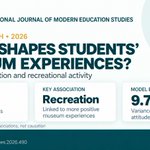
What shapes students’ museum experiences?
A study of 284 high school students links recreational participation with more positive museum experiences and attitudes toward museum education.
doi.org/10.51383/ijonmes.202…
#MuseumEducation
🤖 Made with AI

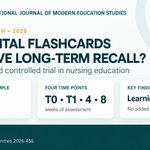
Do digital flashcards improve long-term recall?
In an RCT with 109 nursing students, both digital-flashcard and traditional-memorization groups improved, but flashcards showed no added advantage for short- or long-term recall.
doi.org/10.51383/ijonmes.202…
🤖 Made with AI

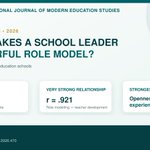
What makes a school leader a powerful role model?
Among 100 special education teachers, role modelling was strongly linked to teacher development (r = .921). Openness to experience and learning was the strongest predictor.
doi.org/10.51383/ijonmes.202…

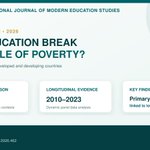
Can education break the cycle of poverty?
Panel evidence from 16 countries (2010–2023) links higher primary-school enrollment with lower poverty, while effects at upper levels vary by model.
Read the open-access study:
doi.org/10.51383/ijonmes.202…
#EducationPolicy

How can loyalty be measured across diverse learners?
The Turkish Individual & Group Loyalty Scales showed supportive validity and reliability among 797 gifted and typically developing children.
Open-access study:
doi.org/10.51383/ijonmes.202…
#GiftedEducation

IJONMES retweeted

El 93 % de los profesionales de la educación superior utiliza herramientas de IA de forma habitual u ocasional.
Sin embargo, solo el 33,4 % se siente muy seguro a la hora de utilizar la IA.
¿Cómo pueden los docentes convertirse en líderes de la transformación digital? Únete a la Semana del #AprendizajeDigital para obtener más información: unesco.org/es/weeks/digital-…

Can we measure students’ capacity for deep work?
A 21-item scale, tested with 840 seventh graders, showed good fit and reliability (ω=.86; α=.86). Its two factors capture motivational goal orientation and cognitive focus.
🔗 doi.org/10.51383/ijonmes.202…
#DeepWork

Does knowing art was made by AI change how we judge it?
A meta-analysis of 37 studies (N=1,920) found a moderate devaluation effect (g=-0.37), strongest for creativity ratings. Culture and AI type mattered.
🔗 doi.org/10.51383/ijonmes.202…
#AIArt #Creativity

Do rewards create lasting motivation—or only short-term compliance?
When a reward is removed, what usually happens to students’ effort, participation and willingness to learn?
Share your experience, evidence or a classroom example. 👇
#Education #Motivation #StudentAgency

Can multiple intelligences bring science to life?
A 7-week 4th-grade pilot found active participation and real-life connections. It also showed plans need fewer activities and more time for student voice.
🔗 doi.org/10.51383/ijonmes.202…
#ScienceEducation

Can social media enrich history learning?
After an assignment, 46 history students’ views shifted from cautious or negative to more positive. Participants also emphasized sharing strategies and ethical posting.
🔗 doi.org/10.51383/ijonmes.202…
#HistoryEducation

Can VR help future teachers speak with less anxiety?
After 8 weeks of immersive practice, 10 pre-service teachers showed lower speech anxiety and higher external self-confidence.
Promising pilot evidence.
🔗 doi.org/10.51383/ijonmes.202…
#VRinEducation

Can an LLM score EFL essays as consistently as human raters?
Across 110 essays, human–LLM agreement (QWK = .487–.501) was comparable to human–human agreement (.469).
AI as a second reader—not a replacement.
🔗 doi.org/10.51383/ijonmes.202…
#AIinEducation

Can creative drama make science learning last?
A study with 36 Grade 8 students found that creative drama activities on the seasons led to significantly higher achievement and retention than the regular curriculum.
🔗 doi.org/10.51383/ijonmes.202…
#ScienceEducation #CreativeDrama
🤖 Made with AI


5 signs your literature review is just a summary:
❌ You discuss studies one by one.
❌ Every paragraph starts with: “Author X found that…”
❌ There is little comparison between studies.
❌ Contradictions in the literature are ignored.
❌ The research gap appears only at the end.
A strong literature review does not summarize studies.
It synthesizes ideas.
How many of these mistakes do you see most often?

Unpopular opinion:
A research gap is not enough.
Many studies identify a gap in the literature.
Far fewer explain why filling that gap actually matters.
A gap without significance is just an empty space.
A meaningful study answers two questions:
What is missing?
Why should anyone care?
Which is more common in published research: poor methodology or weak significance?

Many manuscripts fail not because the data are weak…
but because the STORY is weak.
Strong academic writing tells a clear intellectual story:
• What problem exists?
• Why does it matter?
• What is still unknown?
• How does this study help?
Research is not only analysis.
It is argument, logic, and meaning.

One of the clearest signs of weak academic writing:
The study answers questions that nobody actually asked.
Strong research begins with: • a meaningful problem
• a clear gap
• a justified purpose
Before asking: “How should I analyze the data?”
Researchers should first ask: “Why does this study deserve to exist?”
