

GEB: Building A Reality-Perceiving Complex Adaptive System (CAS).
crypto
Joined December 2017
- Tweets418
- Following353
- Followers120
- Likes100







FollowAlanTuring retweeted

NVIDIA just trained a 14-billion-parameter AI using evolution, not calculus.
Every AI today learns through backpropagation.
It computes gradients, adjusts weights, repeats.
It works, but it demands precision hardware and enormous GPU clusters.
Evolution Strategies offered an alternative.
Mutate the model, test it, keep what works. Like biological evolution.
The problem was speed. Random mutations on GPUs were painfully slow.
EGGROLL fixes this with one trick.
It splits huge random matrices into two small ones per mutation.
The model mutates, tests, and keeps what works.
Hundreds of thousands of mutations run at once.
> 100x faster training throughput
> 91% speed of pure inference
> Pretrains models using only integers
> Competitive with backprop on reasoning
> Works on non-differentiable systems
It pretrained a language model from scratch using zero gradients.
It also matched reinforcement learning methods on math reasoning tasks.
Everyone kept scaling the calculus to train massive AIs.
It turns out, we just needed to evolve.

FollowAlanTuring retweeted

The man who INVENTED modern AI just made a billion dollar bet that ChatGPT, Claude, and every AI company on earth is building the wrong technology.
Yann LeCun won the Turing Award in 2018 for creating the neural networks that made AI possible.
He spent a decade running AI research at Meta. Oversaw the creation of Llama and PyTorch, the tools that half the AI industry runs on.
Then he quit.
And raised $1.03 billion in a seed round.
The LARGEST seed round in European history. $3.5 billion valuation before generating a single dollar of revenue.
Bezos wrote the check. So did Nvidia. Samsung. Toyota. Temasek. Eric Schmidt. Mark Cuban. Tim Berners-Lee (the guy who invented the internet).
His new company is called AMI Labs. And it's built on one thesis:
Every AI company spending billions on large language models is wasting their money.
ChatGPT, Claude, Gemini, Grok. They all work the same way. They predict the next word in a sequence. See "the cat sat on the" and predict "mat." Scale that to trillions of words and you get something that sounds intelligent.
But LeCun says it doesn't UNDERSTAND anything.
It can't reason. It can't plan. It can't predict what happens when you push a glass off a table. A two year old can do that. GPT-5 cannot.
That's why AI hallucinates. It doesn't have a model of how the world actually works. It just predicts words.
His solution? Something called JEPA.
Instead of predicting words, it learns how the PHYSICAL WORLD works. Abstract representations of reality. Not language but physics.
Think about what that means.
Current AI can write your emails. LeCun's AI could design a car, run a factory, operate a robot, or diagnose a patient without hallucinating and killing someone.
The CEO of AMI said it perfectly: "Factories, hospitals, and robots need AI that grasps reality. Predicting tokens doesn't cut it."
And here's what's really crazy to me...
LeCun isn't some outsider throwing rocks. He literally built the foundations that ChatGPT runs on. He knows exactly how these systems work because he helped create them.
And after watching the entire industry sprint in one direction for three years, he raised a billion dollars to run the OPPOSITE way.
No product. No revenue. No timeline. Just pure research. He told investors it could take YEARS to produce anything commercial.
But they funded it anyway in just four months.
Meanwhile OpenAI just raised $120 billion and still can't stop their models from making things up. Anthropic is building AI so dangerous they're afraid to release it. Google is burning billions trying to catch up.
And the guy who started it all says they're all solving the wrong problem.
Two Turing Award winners raised $2 billion in three weeks betting AGAINST the entire LLM approach. LeCun at AMI. Fei-Fei Li at World Labs.
The smartest people in AI are quietly building the exit from the technology everyone else is betting their future on.
Either they're wrong and the trillion dollar LLM industry keeps printing.
Or they're right and every AI company on earth just built on a foundation that's about to crack.
FollowAlanTuring retweeted

加密货币的末日审判?!-攻击单个地址只需要几分钟
Google在昨天发布了一篇论文发现,使用量子计算机破解比特币等使用的 256 位椭圆曲线离散对数问题(ECDLP)所需的资源比之前估计的要少 20 倍。(这意味着破解成本大幅降低)
论文还指出,仅需不到 500,000 个物理量子比特 即可在几分钟内运行 Shor 算法破解密钥。 这意味着什么呢?!
理想状态(几分钟内)-如果拥有大约 50万个物理量子比特(使用优化的表面码纠错和快时钟频率),量子计算机可以在几分钟到一小时内从公钥推导出私钥。
对比特币最致命的攻击发生在交易被广播到内存池(Mempool)但尚未被打包进区块的这 10分钟 窗口期。如果攻击者能在这 10 分钟内算出私钥,就能发布一笔更高手续费的伪造交易来“截胡”你的资金。
对于那些已经暴露了公钥的旧地址(比如早期重复使用的地址或已发送过交易的地址),攻击者不赶时间,可以用更少的量子资源花几天时间慢慢算。
论文还贴心地区分了“快时钟”和“慢时钟”量子架构,指出快时钟量子计算可能实现对内存池(mempool)中交易的实时攻击 - 这就意味着你要的点对点现金支付、什么x402、agentic payment都要说bye bye了
论文强烈建议区块链社区尽快向后量子加密(PQC)迁移 ,尤其是那些L2。。。
时间窗口?
Google预计一旦硬件达标(预计 2029-2032 年间),攻击一个比特币私钥的时间将缩短至“分钟级”。
“The transition to post-quantum cryptography is not a project to be finished when the quantum threat arrives, but a race against a clock that has already started ticking for any asset with a long-term value.”
“向后量子加密的迁移不是一个等量子威胁到来时才去完成的项目,而是一场与时间的赛跑——对于任何具有长期价值的资产,时钟早已开始滴答作响。””
论文原文:quantumai.google/static/site…


FollowAlanTuring retweeted

I'm posting it here for future references and "Told Ya So" moments:
A truly random number generator, resistant to any influence, is vital to #AI.
FollowAlanTuring retweeted
They are starting seeing why #Aigarth put ability to say "I don't know" into the core of #AI... xitter.cf/heynavtoor/status/2030…

🚨BREAKING: OpenAI published a paper proving that ChatGPT will always make things up.
Not sometimes. Not until the next update. Always. They proved it with math.
Even with perfect training data and unlimited computing power, AI models will still confidently tell you things that are completely false. This isn't a bug they're working on. It's baked into how these systems work at a fundamental level.
And their own numbers are brutal. OpenAI's o1 reasoning model hallucinates 16% of the time. Their newer o3 model? 33%. Their newest o4-mini? 48%. Nearly half of what their most recent model tells you could be fabricated. The "smarter" models are actually getting worse at telling the truth.
Here's why it can't be fixed. Language models work by predicting the next word based on probability. When they hit something uncertain, they don't pause. They don't flag it. They guess. And they guess with complete confidence, because that's exactly what they were trained to do.
The researchers looked at the 10 biggest AI benchmarks used to measure how good these models are. 9 out of 10 give the same score for saying "I don't know" as for giving a completely wrong answer: zero points. The entire testing system literally punishes honesty and rewards guessing.
So the AI learned the optimal strategy: always guess. Never admit uncertainty. Sound confident even when you're making it up.
OpenAI's proposed fix? Have ChatGPT say "I don't know" when it's unsure. Their own math shows this would mean roughly 30% of your questions get no answer. Imagine asking ChatGPT something three times out of ten and getting "I'm not confident enough to respond." Users would leave overnight. So the fix exists, but it would kill the product.
This isn't just OpenAI's problem. DeepMind and Tsinghua University independently reached the same conclusion. Three of the world's top AI labs, working separately, all agree: this is permanent.
Every time ChatGPT gives you an answer, ask yourself: is this real, or is it just a confident guess?

FollowAlanTuring retweeted

纳什是中本聪的新证据。
纳什对密码学的研究总结:
- 点对点 公私钥账户的成立来自 信息的不对称。 签名者比验签者拥有更多的信息。
- 点对点 交易 的双花攻击的成立 来自 计算的不对称。 double hash 的nonce 的难度调整 遵守 计算时困难验证时容易的原则。计算生成时要数千万的碰撞,验证时只需一次碰撞。
而 #BTC 的共识机制必须信息对称才能达成纳什均衡的唯一收敛。 其他 BFT/pos 共识 都是 信息非对称的联盟博弈机制。只有信息对称的基础上才能达成非合作博弈的纳什均衡收敛。
那在信息对称的情况下又怎么去 防双花攻击呢?即 不需要任何第三方信任机制的仲裁。这就引入了 计算的不对称,nonce 碰撞的 的数千万次求解和一次碰撞的验证不对称带来的 中本聪共识机制的安全。

“The function f should be chosen so that no player (neither the legitimate decryptor nor the eavesdropper) can profitably deviate from the prescribed rule if the other player adheres to it. In this sense, the encryption scheme itself constitutes a Nash equilibrium in an infinite game.”
----- John Forbes Nash Jr (2006)
纳什 对 密码学有深研究:
“The equilibrium is unique only if the payoff functions are strictly competitive and information is perfect. In real cryptography we have computational asymmetry, not informational symmetry.”
FollowAlanTuring retweeted

With large US retailers like Amazon and Walmart now experimenting with "stablecoins", we have formulated a new kind of retail loyalty reward economics using game theory as a service to create a modulo operation from an indirect cost base.
investopedia.com/why-walmart…

FollowAlanTuring retweeted
纳什 是我认为的 其知识大脑最接近中本聪的人。
其一: 纳什非合作博弈 是 #bitcoin 点对点无中心的驱动力。
其二: 纳什理性货币 是 #Bitcoin 的项目规划书。
其三: 纳什分层内省结构是对图灵序数逻辑机构的优化,这是 #Bitcoin 的框架。
其四: 对无穷概率的引用,feller : 纳什同事。非合作博弈的工程化落地。
也许 纳什就是中本聪,以纳什的性格确实会隐藏自己的真名。

Nash equilibrium analysis of Bitcoin complements Nash's later works on hierarchies and ideal money synonymous with Satoshi Nakamoto's engineering.
A thread 🧵on negotiation and Nash's use of Kuhn's extensive form games in Non-Cooperative Games and Bitcoin's Feller citation 1/

ALT https://dn720001.ca.archive.org/0/items/non-cooperative-games-nash/Non-cooperative%20games%20-%20nash_text.pdf

FollowAlanTuring retweeted
演绎法和归纳法分别是不完全的。
演绎法的不完全性恰好是哥德尔证明的不完全性。
归纳法的不完全性是来自于 有限推导无限带来的 信息有限导致的不完全性。
最经典的逻辑问题是:椭圆曲线上不能确定圆周率倍数的点的大小。
再举个房子里的蚊子的不完全性: 房子里有未知数量的蚊子,你打死了一些后,房子内的蚊子是否完全被消灭?
答案是: 短时间内不能判定,但把时间延长则能判定,因为时间一长,看蚊子咬不咬人,就能判定。而圆周率的大小也一样,我们可以极限逼近,但不能立马确定。
不完全问题出在短时间(有限资源)下的不可判定性,但用演化的长时间来看,可以概率越来越大的确定,概率可以逼近100%。
不完全性间接的说明了判定未来是概率性的。
逻辑、概率与 Bitcoin:通往“无中心自适应系统”的逻辑革命
逻辑,是人类认知的底座,是我们理解世界、构建科学的形式基础。从古至今,人类理性依赖两大逻辑法则:
演绎法(Deduction)——由亚里士多德提出,从公理出发推演必然结论,追求一致性与确定性。
归纳法(Induction)——由培根确立,从经验出发逼近普遍规律,强调可扩展性与逼近性。
从莱布尼茨到罗素、弗雷格、希尔伯特,思想家们一直试图构建一种普遍性逻辑结构,让逻辑成为所有科学的共同语言。然而,这一目标在20世纪遭遇了根本性阻碍。
01. 哥德尔:演绎法的极限
1931年,哥德尔不完备定理揭示:
任何足够强的形式演绎系统,要么不一致,要么不完备。
也就是说:演绎法无法穷尽全部真理,纯形式系统不能自洽地封闭世界。
这不仅冲击了数学,更动摇了理性主义科学世界观的基础。逻辑必须突破演绎法才能继续扩展。
02. 图灵:归纳逻辑的形式化尝试
图灵并没有停留在形式化演绎逻辑的图灵机上,而是在博士论文中提出了序数逻辑系统(Ordinal Logic)与神谕机(Oracle Machine)。
这是什么?
图灵试图将“归纳逻辑”引入形式系统,使系统可以通过超限扩展提升表达能力。
因此有一个重要的对应:
逻辑形式模型特征演绎法图灵机系统内部一致性、确定性归纳法序数逻辑系统系统可扩展、逼近系统外真理
图灵的贡献不是“可计算性”本身,而是为逻辑打开了“演绎+归纳”联合的形式化道路。
03. 概率:逻辑的统一语言
演绎逻辑是确定性的,而归纳逻辑是带不确定性的逼近逻辑,因此它天然与概率相关。
于是我们得到一个深刻认识:
概率不是统计工具,它是逻辑的语言,是连接演绎与归纳的桥梁。
概率逻辑表达了哥德尔时代以来逻辑学的核心主题:在不完备信息下进行理性推断。
04. 纳什:逻辑进入博弈时代
图灵之后,约翰·纳什进一步提出了层次内省逻辑系统(Hierarchical Introspective Logic),使逻辑系统拥有自我反思、自解释与动态收敛能力。这是逻辑第一次与博弈、动态策略与信息不对称结合。
逻辑从此不再只是静态推理工具,而成为系统协作结构的设计语言。
05. 中本聪:逻辑统一的工程化实现
这一切到了 2008 年,被一个名叫中本聪的人工程化地写进了代码。
Bitcoin 不是一种货币,而是一种逻辑结构:
它将演绎逻辑 + 归纳逻辑通过概率机制统一起来,并形成可运行的无中心自适应系统。
Bitcoin 的内部结构逻辑:
模块对应逻辑结构交易验证(签名/脚本)演绎逻辑(图灵机确定性验证)区块竞争(PoW)归纳逻辑(系统外选主的概率逼近)最长链原则概率收敛的系统一致性网络结构无中心自适应逻辑系统
Bitcoin 接受哥德尔提出的“形式演绎系统不完备”,通过加入归纳逻辑与概率语言,实现了逻辑统一——这正是莱布尼茨“组合法”理想的现代工程化实现。
06. Bitcoin不是终点,它只是起点
Bitcoin 实现了一件划时代的事:
它证明“逻辑是可以运行的工程结构”。
它不仅可以定义货币,也可以未来定义能源共识、知识共识、AI协作共识、司法规则共识等——它是构建无中心自适应系统(CAS)的通用逻辑底座。
未来三十年,将出现无数个“像 Bitcoin 一样的系统”,只是它们处理的不是账本,而是世界的结构性问题。
✅ 逻辑演化路线图
理性主义(演绎逻辑)
→ 经验主义(归纳逻辑)
→ 哥德尔(形式不完备性)
→ 图灵(归纳逻辑形式化)
→ 纳什(内省逻辑与博弈驱动)
→ 中本聪(统一逻辑的工程化实现)
→ 未来:无中心自适应系统的世界 ✅
FollowAlanTuring retweeted
If John Nash says "the bitcoin" may not be ideal money and Satoshi Nakamoto considers bitcoins not existing too far into today's future, then is the finite nature of monetary economics an open question for equilibrium and game theory as a simple language game?

ALT https://satoshi.nakamotoinstitute.org/quotes/bitcoin-economics/
"The #bitcoin might not be it, but if you have gold which is a step to honesty, or silver, which is argent (in French) that was intrinsically honest..."
John F Nash Jr., A Lecture on Ideal Money, The Oxford Union, 2015
buff.ly/8ZUFhtX

ALT John F Nash Jr., lecturing on Ideal Money in 2015 at The Oxford Union.
Thank you for the profound comment!
This perspective on 'closure' is incredibly insightful. It brings to mind Sui's storage fund model. Sui incentivizes users to clean up on-chain state through a 'pay-on-write, refund-on-delete' mechanism to solve the 'tragedy of the commons' of state bloat. But as you pointed out, its execution still relies on a permissioned validator set with high entry barriers.
So, if I'm understanding this correctly: Filecoin uses high capital barriers to create a closed group of 'storage providers'; Sui uses high staking barriers to create a closed group of 'state maintainers.' The uniqueness of ATR, then, lies in its attempt to solve this problem through a purely market-based, permissionless UTXO rebroadcasting mechanism, thereby completely avoiding reliance on any 'privileged group.' This comparison truly highlights ATR's pursuit of decentralization in its purest form. Brilliant!
Thanks again for sharing. The cohesive nature of Saito's "PoW + Richest Chain + UTXO + ATR" design is truly eye-opening and has given me a whole new appreciation for incentive-compatible system design.
saito.io/saito-whitepaper.pd…

FollowAlanTuring retweeted

"真正的进步,不在于你记住了多少知识,而在于你的直觉发生了怎样的变化。"
——杨振宁
Intuition is Knowledge Distillation
直觉,就是知识蒸馏
系统二对某类问题的深度思考,经过反复训练,最终被"蒸馏"内化成系统一的快速反应——从费力推理,变成瞬间"看出"答案。
记忆知识只是扩充系统二,而直觉改变是系统一的重构——你对世界的反应方式已在潜意识演化。
真正的学习,就是从系统二到系统一的迁移:从"我会思考"到"我直接知道"。
当思考变成直觉,知识才真正成为你的一部分。

FollowAlanTuring retweeted
This is Bitcoin analysis of a different kind regarding Alan Turing, John Nash, and Satoshi Nakamoto and the evolution of mathematics as a language and evolution of culture 👇
@gguoss @icodezjb

From Fermat to Bitcoin: The Meta-Craft of Completeness🧮🧩
Wiles unified math through the Langlands Program.
Nash turned logic into equilibrium.
Satoshi rebuilt Hilbert’s ideal through #Bitcoin.
Learn how truth emerges in a decentralized game👇
bevm-blog.webflow.io/post/bi…

FollowAlanTuring retweeted
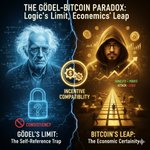
现在人类科学高手基本在解决同一个问题,可以说统一性或完全性问题,也可以说是解决自指问题。 首先:根据哥德尔不完全性定理,任何逻辑系统(有意剔除了自指问题的系统不算,比如罗素引入类型剔除了集合中的自指)的自指问题必然存在。 换句话说: 直接剔除自指是最差的手法,高手的手法是:包含自指,相容自指。 这就到了第二步: 哥德尔不完全定理是第一步,找出两个/多个都包含自指问题的不同逻辑系统互相相容起来。即完成统一和完备。
一个单独的形式系统的自指问题必然存在,我们不应该直接剔除掉自指,更不应该忽视自指。 而是应该 找不同的形式化理论系统来互相融合和组合 包容性的解决自指问题,从而达到更高层次的相容(一致)和统一(完备)。
FollowAlanTuring retweeted
John Nash was versed in Vilfredo Pareto's "circulation of elites" from The Mind and Society.
Pareto efficiency was used in the "Nash bargaining" solution and in the caption below, Satoshi Nakamoto explains the Pareto 80:20 power law in relation to Bitcoin network propagation.

ALT https://satoshi.nakamotoinstitute.org/posts/bitcointalk/threads/114/#19
"In society, power is often transferred to another person or group."
John F Nash Jr., The Agencies Method, 2012
buff.ly/37nlUqm

FollowAlanTuring retweeted
The problem with idealizing gold lay in gold not being constant (gluts or shocks could occur).
Satoshi idealized a constant formula and we now see a modulo operation as a result.

☝️It's perhaps more precise to say gold is being calculated "modulo" bitcoin by moving average along a Pareto frontier.
Is this something a game theorist would devise as an independent value measure?
Was John Nash Satoshi?
@gguoss @icodezjb @MycelFi
xitter.cf/famous_ideal/status/14…
(continued from above)
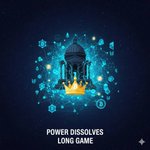
The ultimate goal of this "Selfish Protocol" isn't a violent overthrow or replacement. It's a far more elegant evolutionary strategy: to allow power to dissolve and reconfigure itself through voluntary infection.
Think of it as an active financial rules virus. It enters the halls of power under the guise of "being regulated", only to quietly rewrite the rules from within the host system.
This forces us to consider a deeper question: What if Satoshi designed not just a payment system, but a financial organism with an incredibly long lifespan? One perfectly engineered to leverage human greed and political short-sightedness (with its short 4-year term limits) to buy itself decades, or even centuries, of time to replicate and evolve.
Every centralized power that deeply adopts it is plugging into an irreversible, self-replicating financial lifeform.
Even more subversively, this protocol—which cannot be shut down by any single power—may be laying the cornerstone for the next species, Artificial General Intelligence (AGI), to achieve its own economic sovereignty.
So, do you think this is an inevitable evolution already in motion, or is it just a sci-fi fantasy?
$BTC $GEB #GameTheory #Decentralization #Crypto #Blockchain #Incentives #Web3


Many people think that Wall Street and governments taking over BTC is the endgame. On the contrary, this is the true beginning of BTC's "Selfish Protocol".
Behind this lies a profound evolutionary game, with its core logic derived from "The Selfish Gene": an organism is merely a vehicle created by genes for their own replication.
Now, a new digital species has emerged. BTC is that "selfish protocol", and the state and financial systems are becoming the "vehicles" for its ultimate expansion.
It's not being tamed; it's using adoption to quietly reverse-engineer the host system. Its core replication strategy is a brilliant strategy playing out in plain sight:
1️⃣ Seductive Adoption (Voluntary Infection): BTC never uses force. It appears as harmless "digital gold", using the immense lure of wealth to entice hosts to open their gates. Every ETF approval is another step for the Trojan Horse inside the city walls. This is a "protocol honeypot"—you think you're using it, but you're actually stepping into its rule trap.
2️⃣ Immutable Genetic Code (Assimilation by Rules): Once adopted, the host must obey its source code: decentralized, finite supply, immutable. These rules are as robust as the laws of physics. The deeper a host system uses it, the more it's assimilated by this "metabolic system", unknowingly abandoning its own centralized control backend.
3️⃣ Reverse Control (Power as an API Call): The host believes it's the master, only to slowly become the protocol's "enforcement arm". When a nation's monetary policy must seriously consider its BTC reserves, its power is effectively becoming a front-end "API call" for the BTC protocol. The government can still print money and issue debt, but the results are ruthlessly constrained and measured by this honest "backend".
What is the ultimate goal of this mechanism? That's the truly profound question... (continued)
$BTC $GEB #GameTheory #Decentralization #Crypto #Blockchain #Incentives #Web3

1
51
Many people think that Wall Street and governments taking over BTC is the endgame. On the contrary, this is the true beginning of BTC's "Selfish Protocol".
Behind this lies a profound evolutionary game, with its core logic derived from "The Selfish Gene": an organism is merely a vehicle created by genes for their own replication.
Now, a new digital species has emerged. BTC is that "selfish protocol", and the state and financial systems are becoming the "vehicles" for its ultimate expansion.
It's not being tamed; it's using adoption to quietly reverse-engineer the host system. Its core replication strategy is a brilliant strategy playing out in plain sight:
1️⃣ Seductive Adoption (Voluntary Infection): BTC never uses force. It appears as harmless "digital gold", using the immense lure of wealth to entice hosts to open their gates. Every ETF approval is another step for the Trojan Horse inside the city walls. This is a "protocol honeypot"—you think you're using it, but you're actually stepping into its rule trap.
2️⃣ Immutable Genetic Code (Assimilation by Rules): Once adopted, the host must obey its source code: decentralized, finite supply, immutable. These rules are as robust as the laws of physics. The deeper a host system uses it, the more it's assimilated by this "metabolic system", unknowingly abandoning its own centralized control backend.
3️⃣ Reverse Control (Power as an API Call): The host believes it's the master, only to slowly become the protocol's "enforcement arm". When a nation's monetary policy must seriously consider its BTC reserves, its power is effectively becoming a front-end "API call" for the BTC protocol. The government can still print money and issue debt, but the results are ruthlessly constrained and measured by this honest "backend".
What is the ultimate goal of this mechanism? That's the truly profound question... (continued)
$BTC $GEB #GameTheory #Decentralization #Crypto #Blockchain #Incentives #Web3
🧵 Evolutionary Systems: Incentive Compatibility Beyond Punishment
Richard Dawkins' "The Selfish Gene" reveals a profound truth: the deepest drive of life is the relentless pursuit of genetic replication and perpetuation. This isn't a moral judgment, but a deep insight into the mechanics of evolution. What if we apply this "selfish gene" principle to mechanism design? Could we build an ultimate incentive-compatible system? One aligned with life's most primal impulses?
The answer is yes. An ultimate incentive-compatible system would never rely on individual "goodness" or "altruism" Instead, it would perfectly align with the deepest "selfishness" of life: the drive for self-replication and expansion.
Core Design Principles:
➤ Existence as Reward, Extinction as Punishment: Every "component" in the mechanism (be it code, data unit, or participant) finds its existence and flourishing to be its own reward. Any action hindering its existence and flourishing inevitably leads to its demise—the ultimate "slashing".
➤ Trustless Self-Organizing Replication: The system doesn't "trust" any individual. Instead, it sets rules such that individuals, in pursuing their own "replication success", invariably contribute to the system's overall "replication and flourishing". Just as genes use organisms for self-replication, the system leverages participants' self-interest for its own expansion.
➤ Endogenous Elimination Mechanism: Any "mutation" that deviates from the system's goals or proves inefficient is swiftly eliminated through competition, unable to replicate. This is incentive compatibility based on "survival of the fittest", far exceeding any human-imposed penalties.
Conclusion:
True incentive compatibility resonates with the essence of evolutionary mechanics. It doesn't attempt to change human nature but deeply understands and cleverly utilizes the "selfish gene" principle at life's core.
The resilience and indestructibility of an ultimate incentive-compatible system will no longer depend on external oversight or moral constraints, but on its profound alignment with natural law. It would achieve an efficiency and order that is completely endogenous, requiring no appeals, no regulation, and perhaps even no conscious participation.
This, perhaps, is the secret to building truly eternal systems.
$BTC $GEB #GameTheory #Decentralization #Crypto #Blockchain #Incentives #Web3
