

@ibflormed
Account based inUnited States
About this account
- Account based in
- United States
- Connected via
- United States App Store
Account-level information from X, not a live location or the device used for a specific post.
UMMC Cardiac Fellow - PGY 6 |🫀🫁| Cooper Gen Surg ‘26 | WUSTL MD MPHS '21 | Harvard '14 | "If we opened people up, we'd find landscapes” Agnes Varda
Jackson, MS
Joined October 2019
- Tweets2.8K
- Following696
- Followers823
- Likes15.4K



Ioana Florea, MD MPHS retweeted

I created LearnCoronary (learncoronary.com), an interactive tool designed to help general cardiology fellows and other early-career learners better understand coronary angiography and the spatial relationships between different angiographic views.
#cardiotwitter @OpenAI
Ioana Florea, MD MPHS retweeted

What are the morbidity and mortality outcomes of surgical versus transcatheter #aortic valve replacement in patients dependent on dialysis? Read open access in #JTCVS: hubs.la/Q04zk-ZN0
See similar research at #Aortic2026: hubs.la/Q04zk-Hn0

Ioana Florea, MD MPHS retweeted

Meta-analysis of PARTNER 3, Evolute, and Notion ➡️ At 5-7 years, SAVR is associated with a survival advantage over TAVR in low risk patients
@HeutsSam @EACTS #EACTS2026


Ioana Florea, MD MPHS retweeted

In case you have not noticed, what started as an alternative to non-operative patients (stents, TAVR) is now becoming first-line, standard of care, with open surgery becoming the late-in-life bailout. Not sure this serves patients better in terms of symptom relief and longevity.
Ioana Florea, MD MPHS retweeted
Read the propensity score–matched analysis on bicuspid versus tricuspid #aortic valve morphology in elective ascending aortic aneurysm surgery in #JTCVS Open: hubs.la/Q04zb7qj0
See similar research at #Aortic2026: hubs.la/Q04zb7jF0
@AdamKowalowka


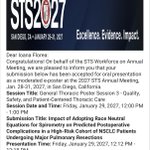
Thrilled and grateful for the opportunity to discuss my last project of residency @CooperSurgery at STS 2027!




Ioana Florea, MD MPHS retweeted

❇️Best of Surgical Critical Care❇️
“Extracorporeal membrane oxygenation in trauma patients with major pulmonary contusion”
ECMO use in trauma patients with major pulmonary contusion was associated with lower morbidity and no difference in mortality compared to patients undergoing traditional management. Among patients undergoing ECMO, systemic anticoagulation was associated with survival. #JTACS #traumasurg #meded #surgery #emergencymedicine
ovid.com/jnls/jtrauma/abstra…

Ioana Florea, MD MPHS retweeted
#FeatureFriday: The 2026 AATS expert consensus document: Surgical management of primary chest wall malignancies. Read standards for initial evaluation of a suspected chest wall neoplasm, histology directed management, and more, free in #JTCVS until 10/30: hubs.la/Q04yBn4V0


Proud to present @ECTSS_CTsurg our remarkable cases of an Ivor Lewis Esophagectomy in setting of prior Left pneumonectomy utilizing VV ECMO support @CooperHealthNJ

Excited to learn some things and enjoy some pretty Florida weather!


What a blast to participate in joint thoracic journal club with the surgical oncology team @UMMCnews this week and talk about minimally invasive approaches and localization the optometric disease

Ioana Florea, MD MPHS retweeted

A 20-year international study of patients with Marfan syndrome found that aortic valve–sparing root replacement was associated with greater annular dilation and aortic regurgitation, but rates of valve reintervention and death were similar to valve replacement.
#MarfanSyndrome #AorticSurgery #CardiacSurgery
jtcvs.org/article/S0022-5223…

Ioana Florea, MD MPHS retweeted

Every minute matters when it comes to an aortic dissection. This rare but life-threatening emergency can cause sudden, severe chest pain and may resemble a heart attack or stroke. Learn the warning signs and why quick treatment matters: umc.edu/news/CONSULT/2026/Au…

Am very curious about these metrics, as my training spanned the onset but not full establishment of this we’re saying 60% of PGY4s can do thyroid / parathyroid surgeries at practice ready levels without an adult in the room? Seems like it can’t be entirely true


If I'm interpreting the colon EPA correctly, this study (with 10k residents and 345 programs) asserts that 61% of PGY4s and 43% of PGY5s can do basic colons independently, but might need indirect supervision of complex/nuanced colons with occasional check-ins.
Simultaneously, 12% of PGY4s and 48% of PGY5s don't need that level of help. They can treat "all colon disease" independently.
This is much faster than their ability to figure out AV fistulas/RRT, but pretty close to the timeline they need for managing gallbladders, inguinal hernias, and SBOs independently.
It's a bit aspirational. Is this a success of EPAs, or does it highlight a discordance between EPAs and real life?
I'm an EPA fan, BTW, and I appreciate the immense amount of work that went into their development, but I simply don't believe that residents are getting this level of independence for colon cancer, IBD, etc.
Without insulting my colleagues who operate on gallbladders, inguinal hernias, and SBOs...do residents truly obtain expertise and independence for colon work at the same pace?
The details are worth a read: absurgery.org/get-certified/…

Ioana Florea, MD MPHS retweeted

Comparing #DCD in USA vs. Europe: USA with older donors and more pre-transplant #MCS. Similar 3 year mortality but higher PGD and 1 year mortality in Europe. @LoudJohn1
🔗: jhltonline.org/article/S1053…
