





Piny retweeted

We can fix smart TVs too?!

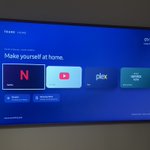
OmarchyTV is out in beta
An #Omarchy style launcher for Android TV: themes, Waybar style bar, live stats and a terminal-style screensaver.
It comes with the omarchy-tv plugin, so your Omarchy PC can push themes and share its screen to the TV.
Based on tv-vibehack by @gathint. Built for Omarchy by @dhh ❤️
It's on GitLab for now (my GitHub account is still stuck in review):
gitlab.com/piermark/omarchyt…
Wallpaper: Liftoff by @tcballard


Samsung put ads on my TV
I used AI to reverse engineer the OS and replaced the entire UI with my own custom one
it did it all over wifi
xitter.cf/iampiny/status/2109044…

Samsung put ads on my TV
Inspired by this tweet, I am using Codex to reverse engineer their software and replace the horrible UI with my own
And get rid of the stupid ads
xitter.cf/VaibhavSisinty/status/…



My favourite quality of life improvement is the brightness selector
There is a UI slider, but I also remapped the channel buttons (which I never use for anything) to control the brightness directly
xitter.cf/iampiny/status/2110480…
Samsung put ads on my TV
I used AI to reverse engineer the OS and replaced the entire UI with my own custom one
xitter.cf/iampiny/status/2109045…
Samsung put ads on my TV
I used AI to reverse engineer the OS and replaced the entire UI with my own custom one
xitter.cf/iampiny/status/2109045…
it freaking worked first try 🤦♀️
it did the whole thing over wifi; I didn't even have to plug anything in
The UI is kinda fugly (Codex is still shit at design), but it god damn works!
xitter.cf/iampiny/status/2109044…


Piny retweeted

Another angle to this is that dogs effectively stumbled onto what is for them the equivalent of artificial superintelligence 20,000 years ago. The Singularity already happened for dogs. They live in a world they cannot understand, surrounded by miraculous wonders they take entirely for granted, their every need seen to by entities whose thoughts they cannot begin to fathom.
The result is that there are about a billion dogs on the planet now. Most of them are pretty happy. Almost none of them need to work. It worked out pretty well for them.


Piny retweeted

Reverse engineered my AC, and vibe coded a lil status bar app so I don't have to find the remote every time.
No first world problem will remain unsolved in 2026.
it freaking worked first try 🤦♀️
it did the whole thing over wifi; I didn't even have to plug anything in
The UI is kinda fugly (Codex is still shit at design), but it god damn works!
xitter.cf/iampiny/status/2109044…
Samsung put ads on my TV
Inspired by this tweet, I am using Codex to reverse engineer their software and replace the horrible UI with my own
And get rid of the stupid ads
xitter.cf/VaibhavSisinty/status/…
Samsung put ads on my TV
Inspired by this tweet, I am using Codex to reverse engineer their software and replace the horrible UI with my own
And get rid of the stupid ads
xitter.cf/VaibhavSisinty/status/…

Someone on Reddit reverse-engineered their LG TV because the Plex app took 30 seconds to load
Built an entire native Plex client from scratch using Claude Code, Opus, and Fable.
Started in C, moved to Rust, ended up building his own OpenGL UI framework along the way
Same TV. Same hardware. Profile picker now loads in 3 seconds instead of 30. Runs at 60 fps. Supports 4K, Dolby Vision, Atmos. Fully open source
One person. One TV he was annoyed with. AI tools doing the work of an entire engineering team firmware reverse engineering, media playback, GPU profiling, shader optimization, UI architecture, all of it

Piny retweeted

Assorted things I've been mulling over regarding agents in the economy:
• Companies are in some sense the original superintelligence. It's often the case that they can use their amortized cognitive surplus to advance their interests against those of certain consumers: relative to the optimization capacity of companies, consumers can be inattentive, underinformed, irrational, etc. (Think, say, of some of the classic insurance upsells at the end of a booking process, which is typically priced substantially above what a regular policy would cost.) Herbert Simon introduced the idea of bounded rationality, and firms often end up benefiting from it. Thanks to personal agents, we will probably get somewhat more rational in how we engage with companies.
• How exactly will outcomes change? Well, certain kinds of price discrimination will work less well (how do coupons work if every agent hunts fastidiously for them?), and certain kinds of customer cross-subsidy will change (today, people who forget to cancel subscriptions subsidize those who don't). Taken across the economy as a whole, I'm not sure what the incidence of all of this will be.
• In corporate strategy, people have long debated the relative importance of distribution and product quality. Perhaps you've made something better, but does anyone know about it? Won't people just continue to buy the ACME Corp Mousetraps? Personal agents will, I think, act as a kind of structural subsidy for product quality. How would markets look different if individuals always spent at least 10 hours researching their purchases? On the margin, focusing on making a product better is, I think, going to become a more effective strategy for companies. This is good!
• It true, a corollary is that information about product quality will become more important and impactful. Today, most people have very limited ability to aggregate and integrate such data, but agents will have insatiable thirst for such signals. (It's often said that data is becoming more valuable because it helps in the training of models. That's obviously true, but I think there's a secondary way in which it's more valuable simply as a complement to cheaper intelligence.)
• A big question is whether agents will increase superstar effects (rational agents all settle on the same product) or increase dispersion (because everyone has slightly different tastes and preferences, which agents are good at eliciting, finally overcoming the artificial clustering we've been subjected to).
• Many internet companies have monetized demand routing, which is in turn often predicated on short attention spans. "I'll click on the first thing I see." This has led to some amount of inefficiency, as companies try to propitiate capricious ranking algorithms and incur various placement fees. It's not all deadweight loss (willingness to pay is itself a kind of signal, which is valuable to buyers), but it's not great. How will the nature and value of this routing change in a world of personal agents? I don't know the answer, but I think that the effects might be pretty big.
• Much of what I'm writing hinges on the assumption that personal agents will be on the consumer's side. I suspect that that will be the winning strategy, but whether it's true, and what it means to be true, involves a lot of other questions.
Taken as a whole, the market is a massively parallelized, decentralized, and highly imperfect value attribution machine, and, taking stock of all of the effects, it seems to me that the quality point may well be the biggest: that agents will change the nature of the backpropagation such that the rewards for better products increase. Maybe this is too optimistic, but I suspect (and hope) that companies that make things that they're proud of will feel that the universe is a little more partisan in their favor.
Piny retweeted

As you become an adult, you realize that things around you weren't just always there; people made them happen. But only recently have I started to internalize how much tenacity *everything* requires. That hotel, that park, that railway. The world is a museum of passion projects.

Piny retweeted
Start with the GDPR and DMA. Flush 'em whole! Then reboot a much, MUCH smaller effort to capture the good notes in a single page with such clarity that not a single lawyer or compliance apparatchik is paid for implementation.


Piny retweeted

With AlphaFold we mapped the protein universe - now with AlphaGenome Atlas we’re charting the human genome. It can predict the impact of all 9 billion possible single-letter DNA variants, helping scientists better understand disease. Freely available for academic research: alphagenome.google/atlas
