$BTC since 2011 | Co-Founder @ Midas Compute | Strategy @ APV
Joined January 2011
- Tweets10.5K
- Following1.9K
- Followers114K
- Likes16.9K








Nick Rose retweeted

As someone with a portfolio of energized land assets here is what I am seeing:
1. Neoclouds are disorganized and poorly capitalized. Some are definitely better than others however.
2. Hyperscalers are intractable, bureaucratic organizations that take 3 months to do an NDA and want 18mo escrow periods. We built our portfolio by competing against these terms because of our speed and simplicity. The more future assets orgs like ours win, the bigger the problem for the hyperscalers downstream (see 3).
3. There are delays in the existing pipeline that will catch people off guard in 2027. Hyperacalers will (obviously) react by focusing on their own internal compute needs over any third party. If the third party is a model company, they will tell them to go through their model router where they will also take a non-trivial vig. Them telling Ant they have no compute for them (rumored in Ant’s S-1) if true is a huge tell that this is already happening.
All of this is to say that it does look like there will be a lot of partially stranded compute and compute sitting in inventory in 2027 than is currently forecasted. This is bought and paid for but effectively underearning (below total cost of capital) or collecting dust. We see this as true for everyone - model companies, hyperscalers, neoclouds except ONE (you can guess which one).
This dislocation will benefit two kinds of orgs: the non-bureaucratic big scalers who can build industrial scale quickly and the nimble, well capitalized players feeding them.
2027 will be a turbulent year because it will clear out a bunch of wrong/bad bets. It will also be a consolidation year for a few.

Nick Rose retweeted

Anthropic engineer:
“Anthropic hired me at $350K–$950K because I know how to build harnesses.
99% of people still hand-roll multi-agent systems and wonder why they break.
I build systems that run loops + sandbox tools + turn yesterday’s logs into new skills — same model, 10x more reliable agents that keep improving overnight.”
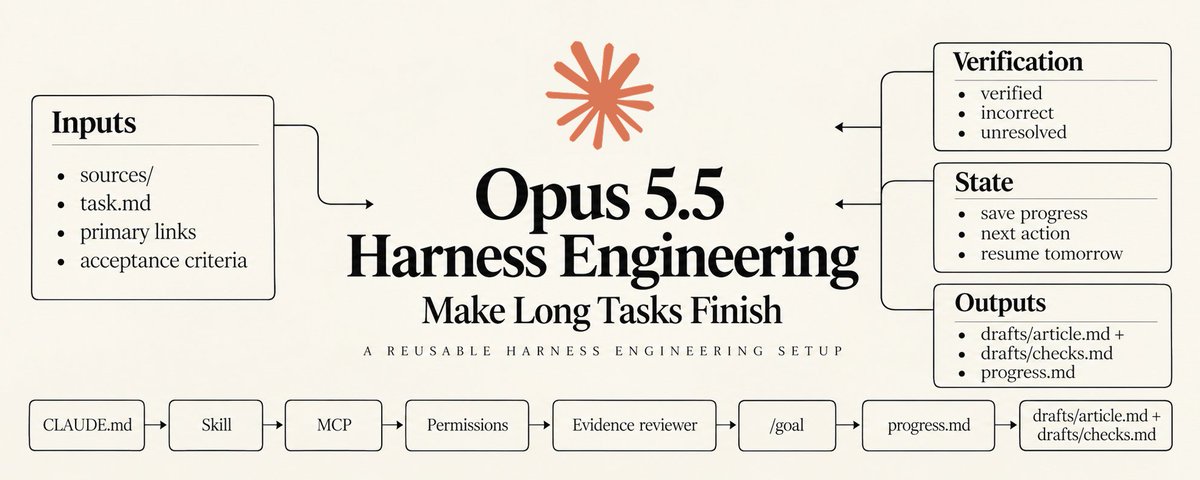
Opus 5.5 → Agents → Harness → Loops → Graphs
In a short workshop, he shows exactly how to build one from scratch.
step 1 → harness handles loops, context, and sandboxing
step 2 → brain and hands separated — 60% faster to first token
step 3 → runs server-side, resumes from the log after crashes
step 4 → failure is cheap — retry and replay instead of starting over
step 5 → yesterday’s logs become new memory — the system wakes up smarter
Anthropic calls this “dreaming”.
Most people spend weeks building this by hand.
You don’t have to.
Bookmark and watch it.
Then read the full Opus 5.5 harness engineering guide below ↓

Nick Rose retweeted

Marc Andreessen says the gap between what AI-native startups and incumbents think AI can do is the widest he’s ever seen:
"The AI-native early stage startups have just a completely different view on what they can do with AI than the typical incumbents in almost any industry, almost without exception."
"AI is just racing ahead in capability even week by week... There are going to be a lot of industries that are really up for grabs in a fundamentally more profound way than maybe has been the case in the past."
"The founders are gonna have a level of superpowers coming from the use of these tools and these technologies that they just simply haven't had in the past... Had I had Astra and Netscape in 1994, like, oh my God. Like, Ben, what would you and I have been able to do at Netscape?"
"Those entrepreneurs are gonna color way outside the lines. We already see this. They're not gonna think of themselves as like, 'I'm just a software company,' or, 'I'm just a hardware company,' or even, 'I'm just an AI company.'"
@pmarca @bhorowitz

Today, a16z Crypto is becoming a16z Frontier.
Since joining a16z in 2013, @cdixon has focused on technologies that look futuristic well before they reach the mainstream. Those themes led to investments in Oculus, Skydio, Zipline, Coinbase, Solana, and Uniswap.
Frontier expands that mandate beyond crypto to back "outer planet" founders who are building new technologies and creating markets that may take years to develop.
Chris joins @pmarca, @bhorowitz, and @eriktorenberg to discuss why crypto has become part of the broader tech landscape, why Frontier fills a hole in the firm's architecture, and why they'd rather be too early than too late.
They also get into why the gap between AI-native startups and incumbents is the widest Marc has ever seen, how AI could pull forward 20 years of frontier technology, why stablecoins may become the way AI agents pay each other, how AI is breaking the internet's business model, and why today's 18-year-olds are about to become superhumans.
0:50 Introducing a16z Frontier
2:49 Smartphone parts to drones and VR
4:47 Backing the "outer planets"
7:11 Good ideas that look like bad ideas
10:43 The JP Morgan photo in Marc's office
15:13 Good tech ideas eventually work
16:53 AI may pull tech 20 years forward
18:18 The widest AI gap Marc's ever seen
22:06 Workers adopt AI before companies do
26:32 Old use cases vs. AI-native ones
30:08 Beyond "product manager brain"
34:45 AI can reverse engineer any hardware
38:23 The case for open source AI
46:36 How AI breaks the internet's model
49:11 VR, homebrew hacking, multiplayer AI
54:00 If you're 18, study "modern alchemy"
YouTube: youtu.be/-9XQMHhpypc
Not an offer or solicitation. None of the information herein should be taken as investment advice; Some of the companies mentioned are portfolio companies of a16z. Please see a16z.com/disclosures for more information. A list of investments made by a16z is available at a16z.com/portfolio.

Nick Rose retweeted

This is f*king insane. SpaceXAI engineer Nick Miller, ex-Cursor:
"99% of people open one Grok Bot and call it automation
I run 20+ bots with a Chief of Staff, a PM, QA, and 15+ workers"
In this 30-minute demo, he shows how to turn a single bot into a coordinated team
Grok Bot → Chief of Staff → PM → QA → Workers
Adding bots doesn't create a team. Clear handoffs and verification do
Worth more than most $1,000 agent engineering courses
Bookmark and watch it today
Then read the full article below ↓


Nick Rose retweeted

when a cracked autist looks at you like that and starts dropping details about their plans... believe them


Nick Rose retweeted

I think about this clip a lot...

A retired NASA engineer who had worked on the Space Shuttle program for 25 years was hired by SpaceX at age 62. He described the first week as the most disorienting experience of his professional life.
At NASA, a design change required 3 meetings, 2 committees, a review board, and 6 to 18 months of documentation. At SpaceX, his new supervisor said "if it works, build it. If it doesn't, change it by Friday."
He sat at his desk after the first day and called his wife. He told her he felt like a man who had been swimming with ankle weights for 25 years and someone just cut them off. He could move. He could decide. He could build something in the morning and test it in the afternoon. The constraint that he had accepted as the nature of aerospace engineering turned out to be the nature of bureaucracy.
Within 6 months he had contributed to more design iterations than he had completed in his last 5 years at NASA. Not because he was working harder. Because the time between having an idea and testing the idea collapsed from months to hours. The same brain. The same knowledge. A different operating system.
He described a specific moment where he proposed a modification to a Raptor engine component. At NASA, the proposal would have entered a queue. At SpaceX, the modification was machined by the end of the day and tested by the following morning. He watched his idea become a physical object in 18 hours. At NASA, 18 hours would not have been enough to schedule the first meeting to discuss whether to schedule a meeting.
He told an interviewer: "I didn't get smarter when I went to SpaceX. I got faster. The intelligence was always there. The system was in the way."
The difference between SpaceX and NASA is not talent. NASA has extraordinary talent. The difference is the time between a thought and a test. SpaceX compresses it. NASA elongates it. The same engineer produces 10x more at SpaceX than at NASA because the bottleneck was never the engineer. It was the meetings about the meetings about the work.
Nick Rose retweeted
When China figures out how to manufacture a product, their ability to scale is often greater than the rest of the world combined. We saw this with lithium batteries and solar, for example.
SpaceX is a rare counter-example, where its mass to orbit is roughly an order of magnitude greater than the rest of the world, BUT China now does a majority of non-SpaceX mass to orbit. SpaceX is an anomaly in the matrix.
Maybe RAM will be different, but RAM was a low margin commodity only ~3 years ago. LP5 and LP6 are designed to a common standard that China seems to be solving fast.
Newer HBM architectures and things like an SRAM layer below logic and 3D stacking RAM on top of logic while finding a way to keep the logic cooled will be harder to solve.


Nick Rose retweeted

what Elon Musk has done to make my life better:
- electric cars
- satellite internet
- saved free speech
what Jeff Bezos has done to make my life better:
- nationwide next-day delivery
- architecture that powers the internet
what Larry Page and Sergey Brin have done to make my life better:
- made the internet searchable
- online email and documents platform
what Mark Zuckerberg has done to make my life better:
- social media to keep me connected to friends
- online ads platform
what Larry Ellison has done to make my life better:
- database software for my businesses
- data centers for AI and cloud computing
what Jensen Huang has done to make my life better
- hardware that powers the AI revolution
what Bernie Sanders has done to make my life better:
🤖 Made with AI


Nick Rose retweeted

Our latest research paper explores the growing connection between AI and digital assets and explains why broad AI adoption may drive new demand, utility and applications across the digital asset economy. blackrock.com/us/individual/…


Nick Rose retweeted

We Must Pace the Frontier: I’ve written a new essay on why the AI industry should slow down, with a three-part plan for doing so.
Anthropic is unilaterally committing to the first of these steps. We’ll provide third-party evaluators with permanent, employee-level access to our systems, so that they can verify adherence to our safety measures, report on incidents, and assess models’ alignment during training.
You can read the full post here: darioamodei.com/post/we-must…