
Uncovering global stories every day. One story at a time. ✨
Joined October 2011
- Tweets945
- Following125
- Followers346
- Likes8.3K




Pinned Tweet
A French boy was abandoned in the Australian wilderness at just 14.
Seventeen years later, when a British ship found him living with an Aboriginal community, he didn’t want to leave.
What happened to him in those 17 years is an extraordinary story of survival, belonging and an unexpected family.
His name was Narcisse Pelletier.
In 1858, Pelletier was working as a cabin boy aboard a French ship called the Saint-Paul, which was sailing towards Australia.
The ship struck a reef near the Louisiade Archipelago, off New Guinea. After the wreck, Pelletier escaped with a small group of sailors in a longboat.
They eventually reached the coast of Cape York, in northern Australia.
But Pelletier was sick and exhausted. When he stopped to rest beneath a tree, the sailors abandoned him and sailed away.
He was just 14, alone in an unfamiliar land, with almost no chance of finding his way home.
Three days later, a group of Uutaalnganu women found him. They gave him food, took him to their community and nursed him back to health.
They gave him a new name, Amglo, and welcomed him into their way of life.
Over the years, Pelletier learned their language, adopted their customs and became part of the community. He spent around 17 years with them, living a life completely different from the one he had known in France.
Then, in April 1875, a British pearling vessel called the John Bell came across him.
The crew took him aboard and eventually brought him to a European settlement.
But there was something remarkable about his account of the encounter.
Pelletier maintained that he had not wanted to leave. He said the Aboriginal people had not held him against his will either.
He had found a home among the people who had rescued him when he was abandoned.
Eventually, he returned to France, nearly 18 years after leaving as a young cabin boy.
He became a lighthouse keeper, married and lived until 1894.
But his story leaves us with an extraordinary question.
After 17 years, where did Narcisse Pelletier truly belong?
The country where he was born, or the community that had taken him in when he had nowhere else to go?

A Missouri miner once disappeared underground for five days. Five days later, he emerged somewhere else. And he couldn't explain how he had escaped.
In early 1904, Tom Morrow, a miner from Joplin, Missouri, decided to explore the abandoned mine shafts beneath the city.
He had told his wife about the idea a month earlier. He believed he could travel beneath Joplin by following the network of old underground passages.
She thought it was a wild dream.
Then one day, Morrow disappeared, taking the family's lantern with him.
After two days, his wife became alarmed. His friends were informed, but none of them wanted to venture into the abandoned mine to search for him.
They waited for his return.
Five days after entering the mine, Morrow finally found his way out.
But his ordeal had left him severely disoriented.
According to a newspaper report published on January 15, 1904, he had wandered through deep underground passages, repeatedly reaching dead ends and losing all sense of direction.
At one point, he came across a group of men working underground. They never noticed him, and he quietly retreated.
Then his lantern went out.
For the next four days, he struck matches and held them near his watch just to keep track of time.
Eventually, his matches ran out. He no longer knew how long he had been wandering in the darkness.
And when he finally emerged, there was one detail that baffled everyone.
Morrow came out of a cave roughly a mile from the entrance he had originally used.
He couldn't remember how he had escaped.
His wife and friends could only guess that, after becoming completely lost, some instinct had guided him towards an exit.
The newspaper also claimed that his black hair had turned grey during the ordeal, although that detail cannot be independently verified.
Five days underground. Four days without a working light. And an escape the man himself couldn't explain.
The strangest part was that he had gone down there willingly, convinced he could find his way beneath the city.

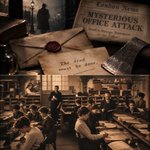
In January 1904, a 16-year-old office clerk in London vanished.
When the teenager eventually surrendered to the police, he handed them an extraordinary explanation.
His name was Thomas H. Schutz.
According to his written statement, everything had begun months earlier, when he discovered a mysterious letter in his office desk.
The letter allegedly threatened someone’s death and instructed whoever found it to carry out the deed.
Schutz said he initially dismissed it as a practical joke.
Then, he claimed, a strange man approached him in the street and asked him to buy an axe head from an ironmonger’s shop.
Over the following weeks, Schutz said he received mysterious handbills telling him to announce in the Daily Mail when he was ready to fulfil the letter’s instructions.
He believed the man who gave him these messages was the same stranger who had asked him to buy the axe.
Then came January 4.
Schutz claimed the stranger walked into his workplace, asked him for paper and an envelope, and handed him a sealed note along with a heavy brown parcel.
He told the teenager to deliver them to the company secretary, Mr Lane.
But as Lane began opening the letter, Schutz said the stranger suddenly rushed in, snatched the parcel and struck the secretary across the head.
The teenager claimed he was so confused that he briefly believed he had killed Lane.
The stranger then left him behind, telling him he would fetch something to drink.
Schutz waited. Eventually, after seeing newspaper reports about the attack, he panicked and fled.
He walked along the Thames towards Woolwich before spending the night at a lodging house.
The following evening, he surrendered at Charing Cross police station and signed a statement insisting that his account was true.
His father told the authorities that Thomas had worked for the company for three and a half years and had always been a good boy. He also mentioned that his son had been unwell and receiving treatment for his eyes.
The magistrate ordered that Schutz be remanded for a week and medically examined.
And the most unsettling detail?
The mysterious stranger, who Schutz described as short, very thin and having a large face with very black eyes, was still unidentified in the newspaper account.
The surviving report leaves us with the account, but no confirmed answer.

1
18
697
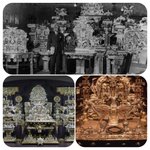
For 14 years, a quiet janitor in Washington, D.C., spent almost every evening inside a rented garage, secretly working on something.
When the garage was finally opened after his death in 1964, the discovery left everyone astonished.
The man was James Hampton, an African-American janitor who had no formal training in art.
Inside the garage was an enormous religious installation made from discarded furniture, cardboard, old light bulbs, jelly jars and scraps of aluminium foil.
He had transformed these unwanted objects into an elaborate golden sanctuary containing approximately 180 individual pieces.
There were thrones, altars, crowns, pulpits and beautifully arranged decorations, all covered in shimmering gold and silver materials.
But what was this extraordinary creation meant to represent?
Hampton called it “The Throne of the Third Heaven of the Nations’ Millennium General Assembly.”
He believed he had received divine visions and was preparing a place for Jesus Christ’s return.
Above the central throne, he placed two simple but powerful words:
“FEAR NOT.”
But the discovery had another mystery.
Among the objects were notebooks, handwritten notes and labels covered in a strange writing system that Hampton had invented himself.
Some pages contained biblical references and the word “Revelation”, but much of the writing remains undeciphered.
Hampton had spent years creating this extraordinary work without publicly displaying it. He died in 1964, aged 55, before anyone outside his private world could properly appreciate what he had made.
Six years later, the Smithsonian acquired the entire installation.
Today, it is preserved at the Smithsonian American Art Museum and recognised as one of America’s most remarkable examples of self-taught visionary art.

In 1869, doctors examining a woman’s body made a horrifying discovery. Her stomach was packed with human hair.
The discovery was so unusual that it was reported in the British Medical Journal.
But what doctors found was only part of the disturbing story.
When they questioned the woman’s sister, they learned that she had been eating her own hair for approximately 12 years.
The habit had continued for years, without anyone fully understanding the damage it was causing inside her body.
Over time, the swallowed hair had accumulated in her stomach, forming an enormous, tightly packed mass.
Human hair cannot be properly digested. Instead, it can collect inside the stomach, gradually becoming tangled with food and mucus.
In this woman’s case, the mass had caused severe thickening and ulceration of the stomach lining.
The damage was so extensive that doctors identified the accumulation of hair as the underlying cause of her death.
The medical report was published on December 11, 1869, under the title “Death from Accumulation of Hair in the Stomach of a Woman.”
Today, this condition is known as a trichobezoar, a mass of accumulated hair inside the digestive system.
The repeated eating of hair is called trichophagia.
What makes this case particularly disturbing is that the behaviour had continued for 12 years before it ended in tragedy.
More than 150 years later, the original medical report remains a chilling record of an extraordinarily rare and tragic case

3
22
837
In 1891, a family in Ohio claimed a ghost had moved into their home. But the strangest part? It was doing their household chores.
At first, the strange occurrences seemed relatively harmless.
The family of Hiram Ruthless, who lived in Mechanicsburg, Ohio, began hearing unexplained noises inside their rented house.
They heard someone pounding on the headboard of their bed in the middle of the night. They heard footsteps overhead and the sound of someone shovelling coal into the stove.
But whenever they got up to investigate, nobody was there.
Then one morning, they walked into their dining room and found something that left them completely baffled.
The knives, forks and plates had been neatly arranged on the table, exactly where they belonged.
Mrs Ruthless initially suspected her husband of playing a practical joke. He denied it and jokingly suggested that perhaps the ghost had done it.
His wife wasn’t convinced.
But the following night, something happened that frightened her husband.
He woke up to find a strange figure standing beside his bed.
It was covered from head to toe in a white robe and appeared to be bent forward like an elderly person.
Then the figure began slowly moving towards the dining room, seemingly signalling for him to follow.
Hiram got out of bed, put on his clothes and grabbed a revolver that he kept beneath his pillow.
But before he could approach the figure, it suddenly disappeared.
According to the newspaper account, it seemed to dissolve into a strange, glowing light.
The family continued reporting unexplained noises inside the house.
And the story took an almost comical turn when a newspaper later reported that the supposed ghost had started shovelling coal into the stove and setting the breakfast table.
Mrs Ruthless was considering dispensing with the services of their hired domestic worker.
Whether the family had encountered something genuinely unexplained, a practical joke or a case of newspaper exaggeration was never established.
The account appeared in American newspapers in 1891.
And somewhere in Mechanicsburg, Ohio, a supposedly haunted house had acquired a rather unusual reputation: its ghost was apparently willing to do the housework.

More than 1,200 pieces of human bone were discovered beneath Benjamin Franklin’s London home. 🦴🩻
In 1998, workers renovating the London property discovered thousands of human bone fragments buried in a concealed pit.
Some belonged to children. Several skulls had been cut open. Others showed marks left by surgical instruments.
The discovery was so disturbing that investigators had to establish whether they were looking at evidence of murder.
But the truth was stranger than a crime story.
The house, located at 36 Craven Street, had once been home to Benjamin Franklin, one of America’s Founding Fathers.
And the remains were connected to a little-known chapter of its history.
During the 1770s, a physician named William Hewson operated an anatomy school at the property. He was a respected scientist who studied human anatomy and blood.
His students needed human bodies to practise dissection, but obtaining them legally was extremely difficult. Grave robbing and the illegal trade in corpses were widespread in Britain at the time.
Researchers believe the remains discovered beneath the house were connected to Hewson’s anatomical research.
More than 3,500 skeletal fragments were recovered, representing at least 28 individuals, including children.
Some bones showed evidence of dissection and medical experimentation.
And there was one final twist.
Hewson himself died in 1774, aged just 34, after contracting a serious infection while performing a dissection.
Today, the discovery offers a disturbing glimpse into the hidden world of 18th-century medical education.
A property associated with one of America’s most celebrated historical figures had once concealed an anatomy school and the remains of dozens of people.
For more than two centuries, that extraordinary secret lay buried beneath its floor.

She went to the Arctic to earn enough money to bring her sick son home.
Two years later, she was stranded on a remote island. Three men from her expedition had vanished. Another had died. Polar bears roamed outside her camp.
Her only companion was a cat.
And she had to learn to hunt, trap and survive, because nobody was coming to save her.
Her name was Ada Blackjack, an Iñupiaq woman from Alaska.
In 1921, Ada was struggling to support her young son, Bennett, who suffered from tuberculosis. She had been forced to place him in an orphanage because she couldn’t afford his treatment.
Then an opportunity came along.
An Arctic expedition organised by explorer Vilhjalmur Stefansson was looking for someone who could sew and repair clothing. Ada was offered $50 a month.
It was a huge amount of money for her. She accepted the job, hoping it would help her bring Bennett home.
On September 15, 1921, the expedition reached Wrangel Island, a remote Arctic island in the Chukchi Sea, north of Siberia.
Ada was the only woman and the only Iñupiaq person among the expedition members. She had been hired as a seamstress, not as an experienced Arctic explorer.
The plan was to remain on the island and establish a claim to the territory.
But the expedition soon ran into serious trouble.
The ship expected to bring fresh supplies never arrived. Sea ice prevented it from reaching the island, and food became increasingly scarce.
In January 1923, three men, Allan Crawford, Milton Galle and Fred Maurer, decided to cross the frozen sea towards Siberia to find help.
They were never seen again.
The fourth man, Lorne Knight, was suffering from scurvy and was too ill to travel.
Ada stayed behind to care for him. She hunted and trapped animals, gathered food, maintained the camp and looked after Knight as his condition deteriorated.
Despite her efforts, he died on June 23, 1923.
Now Ada was completely alone.
She had arrived on the island with virtually no experience of hunting or surviving in the Arctic. But she taught herself to use firearms, set traps, hunt animals and protect the camp from polar bears.
She even made warm clothing from animal skins.
Throughout this ordeal, she kept thinking about her son. In her diary, she wrote about her longing to return home to him.
And then, on August 20, 1923, something unbelievable happened.
A ship appeared through the Arctic fog.
It was the rescue vessel Donaldson.
When its crew reached the island, they discovered that Ada was the only human survivor of the expedition. The expedition’s cat, Vic, had survived alongside her.
After nearly two years on the island, she was finally going home.
And she did reunite with Bennett. She eventually travelled with him to Seattle, where she was able to arrange treatment for his tuberculosis.
Ada Blackjack had accepted a job as a seamstress to save her son. Instead, she had found herself fighting for her own life in one of the harshest environments on Earth.
She survived when the expedition’s experienced men did not.

In October 1919, a famous actress boarded an ocean liner travelling from England to New York. The ship carried more than 1,000 passengers and crew.
She had asked for sandwiches to be brought to her. When the stewardess visited her cabin, she wasn’t there.When the stewardess returned the following morning, the sandwiches were still untouched.
The bed had not been slept in. And the actress’s belongings were exactly where she had left them.
The crew searched the entire ship three times.
She was nowhere to be found.
Her name was Marie Empress, a British actress, singer and dancer who had performed on both sides of the Atlantic.
She was 35 years old and had built a reputation as a glamorous stage performer. She was also particularly skilled at male impersonation, something that would become important when people began trying to explain her disappearance.
Marie was travelling aboard the RMS Orduña, which had departed Liverpool on October 16, 1919. The ship stopped at Halifax, Canada, before continuing towards New York.
On the evening of October 25, her stewardess brought dinner to her first-class cabin, numbered 480.
Marie asked her to return at 9:30 p.m. with sandwiches.
When the stewardess came back, Marie was gone. She left the sandwiches inside, assuming the actress would return.
But the following morning, the food was untouched and the bed showed no signs of having been slept in.
There was something else that made the mystery even stranger.
A newspaper reporter who examined the cabin found that its only porthole was approximately 13 inches wide. It was considered far too small for Marie to squeeze through.
The cabin door opened onto an interior passageway, and according to the reporter, it would have been extremely difficult for someone as recognisable as Marie to reach the open deck without being noticed.
Yet nobody remembered seeing her leave.
The crew searched the ship three times. They found no trace of her.
Then the theories began.
Some believed she had fallen or jumped overboard. Others suspected foul play.
But another possibility attracted enormous attention.
Marie was an accomplished male impersonator. Newspapers began reporting claims that she had been seen wearing sailors’ clothing and might have disguised herself as a crew member to escape unnoticed.
There was also speculation that the entire disappearance was a publicity stunt designed to generate attention before her arrival in New York.
A prominent Broadway press agent, Walter J. Kingsley, was even linked to that theory, although he never confirmed having arranged such a stunt.
But if Marie had deliberately disappeared, why did she never reclaim her luggage, which was eventually returned to Liverpool unclaimed?
No convincing answer emerged.
In 1921, a legal notice was published declaring her dead, with her death presumed to have occurred on or after October 25, 1919. British authorities recorded her as having presumably drowned after going overboard.
But no body was ever recovered.
More than a century later, nobody knows what happened to Marie Empress.
And the mystery of cabin 480 remains unresolved.

In June 1920, a doctor from a small town in Maine disappeared without telling anyone where he was going.
His family feared he had met with an accident, lost his memory or was in serious danger.
Missing-person notices carrying his photograph were distributed across the country. Newspapers reported his disappearance, but nobody could find him.
Then, nine years later, a hospital in upstate New York admitted a seriously ill man under an assumed name.
What happened next led hospital staff to uncover an extraordinary secret.
The patient was the missing doctor himself.
His name was Dr. Lorenzo Norton.
Norton was the only physician in East Baldwin, Maine. He was known as a kindhearted doctor who often treated patients even when they couldn't afford to pay.
But the years leading up to his disappearance had been difficult.
During the 1918–1919 influenza pandemic, he had worked relentlessly, travelling to remote areas to treat patients.
Newspaper accounts described him making difficult journeys, sometimes on snowshoes, to reach people who needed medical attention.
On June 5, 1920, he left home. He was 63 years old.
His family had no idea where he had gone.
The search that followed was extensive. His friends and relatives distributed printed notices describing his appearance, including his bald head, blue eyes and distinctive moustache.
One particularly heartbreaking detail appeared in the notice:
His family feared he might have lost his identity.
For years, there was no confirmed trace of him. In 1923, even reports claiming he had been found turned out to be false.
Then came the extraordinary discovery in 1929.
Norton was admitted to a hospital in upstate New York under an assumed name. He was suffering from prostate cancer.
But there was something unusual about the patient.
He was able to recognise and diagnose his own illness. This made hospital staff suspect that he had medical training.
Eventually, Norton revealed who he really was and contacted his family in Maine.
After nine years, the missing doctor had finally been found.
But one question remained unanswered.
Why had he disappeared in the first place?
Despite his return and reunion with his family, he offered no publicly documented explanation that settled the mystery.
He died in 1932, a little more than two years after being found.
His disappearance still remains one of Maine's strangest historical mysteries.

In 1934, a woman calling herself the Baroness of the Galápagos vanished from a remote island with her lover.
She claimed they had been invited aboard a yacht bound for Tahiti. But nobody could establish that the yacht had ever visited the island.
Then the man she left behind decided to escape the island himself.
Months later, his body was discovered on another island, alongside the remains of the man who had taken him away.
The missing woman was Eloise Wagner-Bousquet, and neither she nor her companion, Robert Philippson, was ever found.
It all happened on Floreana, one of the remote islands in Ecuador’s Galápagos archipelago.
In the early 1930s, a handful of Europeans had settled there, hoping to escape civilisation and build new lives.
Among them was Eloise, who called herself a baroness and claimed to be an Austrian aristocrat. She arrived with several men, including Robert Philippson and Rudolf Lorenz.
She had an ambitious plan: to build a luxury hotel called Paradise Regained, attracting wealthy visitors to the isolated island.
But life on Floreana was far from peaceful.
The settlers were constantly at odds with one another. There were arguments over supplies, property, visitors and even who had authority over the island.
And the Baroness was at the centre of much of the conflict.
Her relationship with the two men also became complicated. Philippson had become her favoured companion, while Lorenz was increasingly mistreated and eventually sought refuge with another family living on the island.
Then, in March 1934, everything changed.
According to the account given by one of the settlers, the Baroness appeared and announced that some American friends had arrived on a yacht. They had invited her and Philippson to sail with them to Tahiti.
She supposedly left immediately.
But there was a serious problem with this explanation.
Nobody else had seen the yacht. No visiting vessel was recorded, and no evidence ever emerged that the couple had reached Tahiti.
Their disappearance raised suspicions that something terrible had happened on the island.
Meanwhile, Lorenz was still there.
A few months later, desperate to leave Floreana, he persuaded a Norwegian fisherman named Trygve Nuggerud to take him to another island.
They set off in a small fishing boat called the Dinamita, accompanied by a young Ecuadorian deckhand.
They never reached their destination.
In November 1934, fishermen discovered the mummified bodies of Lorenz and Nuggerud on the remote, uninhabited island of Marchena. Their boat had apparently been carried off course by ocean currents, leaving them stranded without drinking water.
The young deckhand was never found.
But what had happened to the Baroness and Philippson?
Some settlers suspected that Lorenz had murdered them before leaving the island. Others believed that people living nearby might have been involved.
There were accusations, conflicting accounts and plenty of suspicion, but no conclusive evidence.
The Baroness and Philippson were never found. Their disappearance was never solved.

2
31
4,747
In 1957, a married couple disappeared from their home in El Paso, Texas.
They left behind their clothes, luggage, cars, and even their beloved cat.
Months later, messages began arriving from places hundreds of miles away, supposedly written by the missing husband. He claimed that he and his wife had left the country and would never return.
But handwriting experts couldn't conclusively establish that he had written them.
And then, decades later, a witness came forward with an allegation that made the disappearance even more disturbing.
The couple were William and Margaret Patterson. Neither has ever been found.
William, 52, and Margaret, 42, owned a photography supply business in downtown El Paso. They were last seen at their home on March 5, 1957.
What made their disappearance particularly strange was how they had left.
Their home was in disarray. Dinner dishes were still in the sink, clothes were lying around, and they had made no arrangements to stop their newspaper delivery or take care of their cat, Tommy.
Margaret was particularly attached to the cat. After the couple vanished, Tommy wandered away. He returned more than four months later, malnourished and filthy.
Then came the mysterious communications.
On March 15, their accountant received a telegram from Dallas containing instructions about managing their business and property.
A few months later, their lawyer received a letter postmarked from Laredo, Texas. It claimed that William and Margaret were leaving the country and would never return.
The letter also gave detailed instructions about distributing William's business and possessions among several employees.
But there was something far more interesting!
Handwriting experts examined the signature and found similarities with William's genuine writing, but also discrepancies. They could not confirm that he had actually signed it.
And why would a man who supposedly intended to disappear leave his business and property to employees rather than his own family?
Investigators were left with more questions than answers.
Then, in 1984, the case took an even darker turn.
A man approached authorities claiming that he had been hired to clean the Pattersons' home shortly after their disappearance.
He alleged that he had found blood around and underneath the water heater in the garage. Even more disturbingly, he claimed to have discovered a piece of human scalp caught in the propeller of William's boat.
He also claimed to have witnessed one of the couple's associates removing bloodstained sheets from the house.
The man's account was never independently confirmed.
He died in a car accident two years after giving his statement to police.
William and Margaret were declared legally dead in 1964, but their disappearance remains an open, unsolved case.

On December 1, 1919, a Canadian millionaire completed the sale of his theatre empire for $1.7 million.
The very next day, he disappeared without a trace.
His name was Ambrose Joseph Small, one of Canada’s most powerful theatre owners.
Small had spent decades building a network of more than 30 theatres. He was wealthy, influential and known for his extravagant lifestyle.
But after selling his entire theatre business to Trans-Canada Theatres Limited, something remarkable happened.
On December 1, the first payment of $1 million was received. The following day, while his wife, Theresa, was depositing the cheque, Ambrose was reportedly arranging a Cadillac, a fur coat and jewellery for her.
Everything appeared normal.
That afternoon, he met his lawyer, E.W.M. Flock, at the Grand Opera House in Toronto.
Around 5:30 p.m., the lawyer left.
Nobody could establish what happened to Ambrose Small after that.
He never returned home. His family and business associates could not locate him. And despite an extensive search, there was no trace of him.
But the mystery became even stranger.
His longtime secretary, John Doughty, also disappeared. Investigators discovered that $105,000 worth of Victory Bonds had been taken from Small’s bank box.
Doughty was eventually found in Oregon, where he had been living under an assumed name. He was extradited to Canada and convicted of stealing the bonds in 1921.
However, the kidnapping allegation against him was dropped for lack of evidence. He was never convicted of having anything to do with Small’s disappearance.
Meanwhile, Small’s wife initially believed that her husband had run away with another woman. She told people that he was in the hands of a “designing woman” and would eventually return.
But he never did.
Over the years, investigators explored several possibilities. Had he been murdered? Kidnapped? Or had he deliberately abandoned his old life to start somewhere else?
There were countless reported sightings, but none could be verified.
In 1923, Small was legally declared dead for probate purposes. His body was never found.
The Toronto police officially closed the investigation in 1960.
More than a century later, one of Canada’s most sensational disappearances remains unsolved.
A millionaire sold his business, received a fortune and then vanished from the face of the earth.

Unearthing the world 🌎 retweeted
Her family members kept dying one after another. She was always there to nurse them, comfort them and arrange their funerals. And strangely, whenever someone close to her fell seriously ill, she was the first person everyone turned to for help.
In early 19th-century Bremen, Germany, Gesche Margarethe Gottfried was known as the “Angel of Bremen.” She had built a reputation as a compassionate woman who looked after the sick and dying.
But behind that reputation was a horrifying secret.
Between 1813 and 1827, Gesche poisoned 15 people with arsenic. Her victims included her parents, three children, two husbands, her twin brother, friends and acquaintances.
Her method was chillingly simple.
She mixed arsenic into a substance known as Mäusebutter, a poisonous mixture used to kill mice and rats. She secretly added it to food, allowing her victims to fall seriously ill while she continued looking after them.
And because she appeared so devoted to their care, hardly anyone suspected her.
But there was one person who eventually began to notice something unusual.
Her landlord, Johann Christoph Rumpff, had become seriously ill after eating food prepared by Gesche. One day, he noticed tiny white particles in his meal. Suspicious, he took them to his doctor for examination.
The result was shocking. The particles contained arsenic.
The discovery eventually led investigators to Gesche, who was arrested on March 6, 1828.
But even after her crimes came to light, another question remained: Why had she done it?
Some murders appeared to have a financial motive. In other cases, however, money offered no convincing explanation. During questioning, Gesche struggled to explain her actions. She spoke of an inexplicable inner urge to poison people and sometimes claimed she had no particular reason for doing so.
Her motives were never fully established. Greed may have played a part in some killings, but it could not explain all 15.
After spending more than three years in prison, Gesche was publicly executed by beheading on April 21, 1831. It was the last public execution in Bremen.
Even today, a small stone known as the “Spitting Stone” (Spuckstein) is embedded in the pavement of Bremen’s Domshof square, marking the exact spot where she was executed.
People historically spat on it to express their disgust at her crimes.
Six people boarded a cargo plane in Tokyo in January 1979. They were carrying a collection of valuable paintings. Just 30 minutes later, the aircraft vanished over the Pacific. No survivors, no wreckage, no paintings.
It was as if the entire plane had disappeared from the face of the earth.
The aircraft was a Brazilian Boeing 707 operated by Varig Airlines. Its flight number was 967.
On January 30, 1979, it took off from Tokyo’s Narita Airport, heading towards Los Angeles before continuing its journey to Brazil.
There were six crew members aboard. No passengers.
But there was something unusual in its cargo hold.
The aircraft was carrying dozens of paintings by Manabu Mabe, a Japanese-born Brazilian artist whose works had recently been exhibited in Tokyo.
The collection was reportedly valued at approximately $1.24 million at the time.
Everything appeared normal after take-off.
At 20:45 local time, approximately 22 minutes after departure, the crew made their final recorded radio contact with air traffic control.
They reported no emergency.
Around 15 minutes later, the aircraft disappeared from radar.
No distress call followed. No explanation came from the crew.
Authorities launched extensive search operations involving aircraft and ships, but they found no confirmed wreckage.
The six crew members were never found. Neither were the paintings.
And there was another extraordinary detail about the missing aircraft’s captain.
His name was Gilberto Araújo da Silva.
Six years earlier, in 1973, he had commanded another Varig Boeing 707 that caught fire while approaching Paris. He managed to make an emergency landing, but 123 people died in that disaster.
He survived that incident.
In January 1979, he was once again at the controls of a Boeing 707.
This time, he disappeared along with his five fellow crew members.
Over the years, several explanations were suggested, including sudden cabin depressurisation, a possible hijacking and even military involvement.
However, none of these theories was conclusively established.
The aircraft was never recovered, and investigators could not determine exactly what happened.
The paintings never resurfaced either.
More than four decades later, Varig Flight 967 remains one of aviation’s most baffling disappearances.

Unearthing the world 🌎 retweeted
The 64-year-old American who was held in a wooden cage in the Philippine jungle for nearly 20 months.
His name was Arvey Duane Drown, and his ordeal began on October 19, 1990, in the mountains of northern Philippines.
Drown was an American businessman from Colorado who had travelled to the Philippines looking for gold-mining and investment opportunities.
One evening, while travelling through the northern province of Luzon, he encountered what appeared to be a military roadblock.
He got out of his vehicle to help direct traffic. But the men manning the checkpoint weren’t government soldiers.
They were members of the New People’s Army (NPA), a communist guerrilla organisation fighting the Philippine government.
The men seized Drown at gunpoint and took him into the jungle.
Initially, they suspected he was working with the Philippine military. American officials later confirmed that he had no connection to the CIA or any other American government agency.
But his ordeal was only beginning.
Drown was moved between different jungle camps, sometimes travelling for days through remote and dangerous terrain.
He reportedly attempted to escape three times. On one occasion, he managed to wander through the jungle for four days before his captors recaptured him.
Eventually, after repeated escape attempts, his captors locked him inside a crude wooden cage.
The cage was made from thick branches, with bars so substantial that he had very little chance of getting out.
By March 1992, nearly 17 months after his abduction, Drown was still imprisoned there.
He had lost considerable weight and grown a long, white beard.
Then something extraordinary happened.
Two Filipino journalists managed to reach his remote jungle hideout after an eight-day trek through the mountains.
They found Drown alive inside the cage.
A video recording of their meeting showed the 64-year-old looking directly into the camera and delivering a message that would finally let the outside world know he was alive.
“As you can see, I’m still breathing.”
He then made an emotional appeal for help, asking those watching to do whatever they could to get him out.
His wife, Ruth, who had been desperately waiting for news, was finally able to see him alive.
Negotiations for his release had repeatedly failed. But in June 1992, a group of three Catholic priests undertook a humanitarian mission to the rebel-held territory.
This time, the rebels agreed to release him.
On June 30, 1992, after more than 20 months in captivity, Arvey Drown was handed over to the priests and eventually reunited with his wife.
There was, however, an unusual detail to his story.
Drown had previously been convicted in the United States for his involvement in an investment fraud involving millions of dollars.
Even his own family had questioned some of the extraordinary stories he told about his past.
But there was no question about what had happened to him in the Philippines.
For nearly 20 months, he had been held by an armed guerrilla group, moved between jungle camps and eventually locked inside a makeshift wooden cage.
And somehow, he managed to survive.
The businessman who built an empire in Thailand, walked out of a holiday bungalow in 1967, and was never seen again.
His name was Jim Thompson, an American businessman who had become known as the “Thai Silk King”.
He had almost single-handedly transformed Thailand’s silk industry into an internationally recognised luxury business. His silk was attracting wealthy customers around the world, and he had built a multimillion-dollar empire.
But there was another side to his life that made his disappearance even more intriguing.
During World War II, Thompson had served in the Office of Strategic Services (OSS), America’s wartime intelligence organisation that later became the CIA.
He had also worked in Southeast Asia during the war and developed connections across the region.
By 1967, he was 61 and living a remarkably successful life in Thailand.
Then came March 26, 1967.
Thompson was spending Easter Sunday with friends at a holiday property called Moonlight Cottage in Malaysia’s Cameron Highlands.
After attending church and having lunch with his companions, everyone returned to the bungalow.
While the others went to rest, Thompson decided to take an afternoon walk.
He stepped out of the property and headed towards the surrounding hills.
He never returned.
At first, his friends assumed he would be back shortly. But when evening arrived and there was still no sign of him, they contacted the authorities.
What followed was one of the largest searches the region had seen.
Around 300 soldiers and police officers joined the operation. Helicopters searched above the dense forest, tracker dogs were brought in, and local indigenous trackers were recruited to comb through the difficult terrain.
Rewards were offered for information.
But investigators found absolutely no trace of him. There was no ransom demand either.
It was as though one of Asia’s most recognisable businessmen had simply vanished into thin air.
And because of his wartime intelligence background, speculation soon began.
Had he been kidnapped? Was he the victim of a planned assassination? Had someone from his past caught up with him?
Others suggested that he might have suffered a medical emergency or met with an accident in the dense jungle.
But none of these theories was ever conclusively established.
Seven years later, Thompson was legally declared dead.
Yet the mystery never disappeared.
His silk business continued, his famous Bangkok home became a museum, and his name remained associated with one of Southeast Asia’s most baffling disappearances.

In 1985, an American mathematics professor went hiking alone in Chile.
Ten days later, his backpack was found beside a river, but his passport was missing. Then investigators uncovered information suggesting he may have been taken to a secretive German settlement notorious for torture.
What happened to him remains one of Chile’s most disturbing unsolved disappearances.
His name was Boris Weisfeiler, a 43-year-old mathematics professor at Pennsylvania State University.
Boris was born in the Soviet Union but had moved to the United States, where he eventually became an American citizen.
He loved travelling alone and exploring remote wilderness areas. In December 1984, he travelled to Chile during his university vacation for another solo hiking trip.
He headed towards the mountainous region of southern Chile, far from the usual tourist routes.
On January 3, 1985, he met a shepherd near the Ñuble River. The two shared a meal, and Boris spent the night in the shepherd’s tent.
The following day, he continued his journey.
That was the last time anyone could reliably account for seeing him alive.
Ten days later, a farmer discovered his backpack near the river.
The contents were scattered, but something particularly strange caught investigators’ attention.
His sleeping bag, tent, clothes, shoes, money in Chilean currency and even his return airline ticket were still there.
His American passport, however, was missing.
The Chilean police concluded that Boris had probably drowned while attempting to cross the river.
But the problem was, his body was never recovered, and several details surrounding his disappearance raised serious questions.
Then, years later, declassified American government documents revealed a disturbing possibility.
An informant claiming to have been part of a Chilean military patrol alleged that soldiers had detained Boris, mistaken him for a Soviet spy and taken him to a place called Colonia Dignidad.
This was no ordinary settlement.
Colonia Dignidad was a heavily guarded German community in Chile, established by former German preacher Paul Schäfer.
During Augusto Pinochet’s dictatorship, the settlement was used as a detention and torture centre by Chile’s secret police. Political prisoners were reportedly held and tortured there.
According to the informant, Boris was handed over to the settlement’s security officials for interrogation.
The informant even claimed that he had later seen Boris alive inside the compound.
Another source suggested a much darker possibility: that he had been murdered there.
Neither account was conclusively established.
The revelations prompted renewed investigations, and in August 2012, a Chilean judge ordered the arrest of eight retired police and military personnel in connection with Boris’s disappearance.
But the central question remained unanswered.
What actually happened to Boris Weisfeiler?
Did he drown in the river, as the original police investigation concluded? Was he detained by military personnel and taken to Colonia Dignidad? Or did something else happen to him?
His sister, Olga Weisfeiler, spent decades trying to uncover the truth.
More than 40 years later, Boris’s fate remains unresolved.

In 1984, followers of an Indian spiritual leader carried out a shocking attack in a small American town.
They deliberately contaminated food at local restaurants with bacteria, making 751 people sick. But what made this incident even more disturbing was the reason behind it.
It happened in The Dalles, a small town in Oregon, USA.
At the centre of the story was a religious commune called Rajneeshpuram, established by followers of Indian spiritual leader Bhagwan Shree Rajneesh, popularly known as Osho.
The commune had thousands of followers and was led by his secretary, Ma Anand Sheela.
At the time, relations between the commune and the local population had become increasingly hostile.
The group was facing growing opposition from local residents and authorities. Tensions were particularly high as the commune expanded its influence in Wasco County.
Then, in September 1984, something extraordinary happened.
People who had eaten at several local restaurants began falling seriously ill.
They developed severe stomach cramps, fever, vomiting and diarrhoea.
Health authorities initially struggled to understand what was causing the sudden outbreak.
Eventually, laboratory tests revealed that the victims had been infected with Salmonella bacteria.
But this was no ordinary food poisoning outbreak.
Investigators eventually discovered that members of the Rajneesh movement had deliberately contaminated salad bars at multiple restaurants with the bacteria.
And then came the shocking revelation about why they had done it.
The commune’s leaders wanted to influence the upcoming November 1984 county elections.
They feared that local residents would vote against their candidates. Their plan was to make enough people sick that they would be unable to turn out to vote.
In other words, they had turned an ordinary restaurant meal into a political weapon.
The outbreak ultimately affected 751 people, with 45 requiring hospitalisation. Fortunately, nobody died.
The investigation eventually led authorities to the commune’s senior members.
Ma Anand Sheela and several associates were implicated in the conspiracy. Sheela later pleaded guilty to multiple federal charges, including assault and attempted murder.
She was sentenced to prison in 1986.
The incident became known as the 1984 Rajneeshee bioterror attack and remains one of the largest documented biological attacks in US history by number of victims.
