

Building 24/7 FX rails. Previously FalconX & Affirm. I write about why money still moves like it’s 1974
Miami, FL
Joined May 2010
- Tweets340
- Following453
- Followers126
- Likes74







Pinned Tweet
The real constraint in cross-border payments was never speed; it was liquidity.
Read more here: openfx.com/blog/the-story-of…

Where does FX liquidity come from?
A lot of people assume it's “the market,” similar to the way liquidity works in equities. But FX isn't centralized in the same way.
Let's say someone purchases €10 million from a bank. You might assume the dealer will go back into the market and buy euros to restore their position.
More often than not, they don't.
Instead, they wait for another customer to come along who wants to sell euros and offset the first trade.
This is called internalization, and it's one of the basic mechanisms underlying institutional FX.
BIS estimates that dealers internalized roughly 84% of customer spot flow in the UK and US, and 78% in Hong Kong and Singapore in 2025.
In some of the world's largest FX centers, the biggest source of liquidity wasn't the wider market, it was the dealer's own customer base.
The more business flowing through these institutions, the more chances they have to match one transaction against another, and the less risk they need to hedge externally.
Without that customer flow, the business economics would look very different.
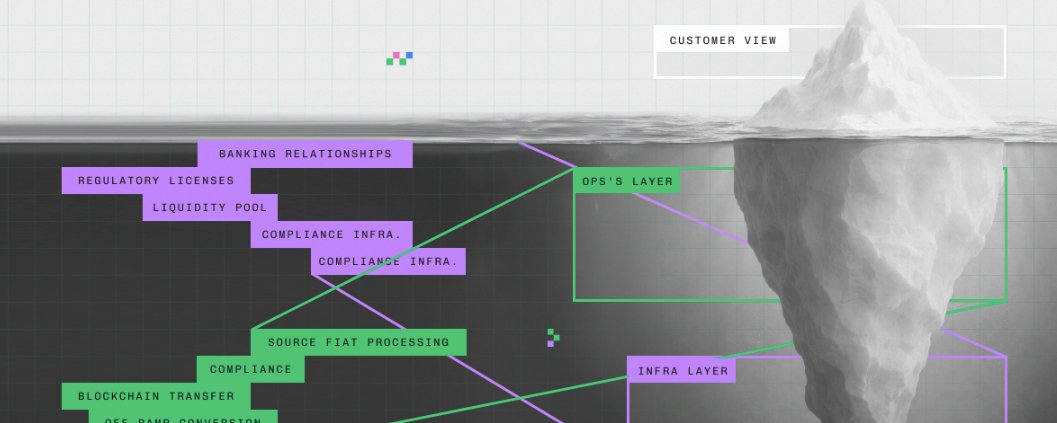
As always, liquidity is best understood by looking at the infrastructure and operations supporting it.
We call that the Iceberg, and we've written about below in comments


A lot of the stablecoin conversations still gets framed around the issurer.
USDC for @circle ? USDT for @tether ? PYUSD for @PayPal? Something else entirely?
This was a useful discussion to have a few years ago, but I think it's becoming less so now.
As the playing field expands and more coins enter the market, who issues the assets becomes far less important than how to get the volume you need to complete the transaction.
Stablecoin liquidity remains surprisingly fragmented, it sits across different chains and different market makers with slightly different prices. While these differences are often tiny, at large enough volumes they add up.
The best route today may not be the best route tomorrow. Depending on the corridor, there might not actually be one single route that will allow you to fill efficiently.
The job then becomes less about choosing the right issuer, and more about choosing the right combination of liquidity, rails and assets for each transaction as you need it.
That's orchestration. Read more linkedin in comments


There are exactly two ATMs in Antartica, both operated by Wells Fargo.
Only one is online at any given moment, the other serving as a kind of repository for parts.
These ATMs exist to serve the 1000 people or so who are at McMurdo Station, people who otherwise might not have access to hard currency for months at a time.
Providing liquidity to exotic corridors can feel a bit like this.
You are offering a service that people desperately need, but is operationally difficult to maintain.
People only really think about it when the machinery starts to break down.
It's a complex challenge, one that only becomes more complex when a blizzard blows in.
Article, link in the comments. 🔗

The FX market is open 24 hours. Liquidity is not.
People love saying FX never sleeps. Technically true. No closing bell. No auction. You can always find a price somewhere. That is not the same as a market you can actually use.
What you get is a handoff between Tokyo, London, and New York. When those cities overlap, especially London and New York, spreads are tight, and trades go through cleanly. Outside that window, the same order can slip, gap, or cost you a lot more.
Fine if the world ran on London time. It does not. The deep stuff was built for big institutions trading G7 pairs at hours that work for London and New York.
Meanwhile, some of the biggest payment corridors on earth need to move money when the book is thin. US-Mexico. US-Philippines. West Africa. A lot of South and Southeast Asia. That cost shows up fast: wider spreads, worse fills, and companies timing payments around someone else’s session instead of their own business.
A firm in Lagos should not have to wait for the London-New York overlap to pay a supplier. A remittance business should not watch off-peak hours eat the whole book. If you trade EUR/USD from New York, the market feels open all day.
Get further from that setup, and it starts to feel like visiting hours.
OpenFX wrote about who this market was built for, and who still eats the cost, linked in the comments.


wow,
such blue check
very verify
much official
so prestige
account now have shiny badge
many respect incoming
wow (also “reviewing soon” and “already here” at same time… such @X , very glitch, much excite anyway)

One of the most interesting features of the FX market is just how vicious it is.
Every time you need to move money, both sides of the transaction are, as often as not, actively trying to eat one another's lunch.
This is especially the case in illiquid markets driven by chat trades and broker relationships.
This has led the market to adopt a number of mechanisms to keep these brokers on the winning side of as many transactions as they can.
Last look is probably the most famous of these mechanisms, where quotes can expire if the liquidity provider thinks executing the trade will cause them to lose money.
But last look isn't the only way liquidity providers defend themselves, and that defensiveness itself might signal a bigger pathology simmering underneath.
I talk about this more here:
openfx.com/blog/adverse-sele…

On a day in 1974, a mid-sized German bank failed. Not an enormous problem; banks fail. The issue was what it was doing at the time: initiating a sizable cross-border payment.
Bankhaus Herstatt, the institution in question, had already received Deutsche Marks from its counterparties in Frankfurt; the other side of the transaction was supposed to settle later that day in New York.
Before it could, regulators shut the whole show down.
Those dollars never arrived.
The crisis that followed was chaotic enough to give an entire category of settlement risk its name: Herstatt risk.
This set off a series of events that culminated in what we call Continuous Linked Settlement (CLS), which ensures simultaneous FX settlements between member currencies and eliminates Herstatt risk.
As long as you’re a member.
If you happen to be in the 90ish percent of the world that doesn’t belong to the group, this risk must still be managed every time money moves. The more fragmented the corridor, the more complicated that wrangling becomes.
We wrote about what Herstatt actually taught the FX market, and why counterparty risk still hangs like a specter nearly a half-century on:
openfx.com/blog/herstatt-ris…

Harrison Mann retweeted

Nearly $1 Billion of stablecoins now sit on @RobinhoodApp Chain 👀
Almost none of it is being use to pay for anything. Its being used as a savings product
Around $350M sits in USDG, a synthetic dollar running a basis trade, yielding around 7%. Important to note that USDG reserves don't yield 7% so the difference is a credit risk wearing a dollar's clothes.
So stablecoins being used here not as a payment rail but as a credit fund in a dollar wrapper 💸

For years, PSPs have been squeezed on two sides.
The first is a dramatic increase in competition. Back in the halcyon days of payments, being a PSP was a pretty good deal, with high margins and manageable risk; you offered a service that people needed "instant settlement," and were willing to pay a premium for.
Second, they are no longer the only game in town. Real-time settlement systems are popping up worldwide, taking over much of the work that used to set PSPs apart and offering prices often very close to zero.
The result has been compressed margins and increased risk, a potential existential crisis for the industry.
We lay out the case and a potential solution here: openfx.com/blog/what-you-nee…

Not too long ago, I wrote about why cross-border FX effectively "closes" on the weekend.
Turns out that when you're talking about a global market, even the word "weekend" needs a bit more color.
Take Qatar, for instance: Sunday is a normal banking day. In New York, morning mimosas. What constitutes a weekend can differ pretty widely depending on where in the world you are and the precise cultural forces at play.
One thing remains constant: banks are closed.
Then the clock joins in.
Try moving money between Brazil and South Korea. Their central-bank settlement systems are highly sophisticated and efficient, but their operating hours never overlap.
So the problem isn't just avoiding initiating a transaction on Friday afternoon; it's figuring out what "Friday" means on both sides of the trade.
You can pick the correct business day, avoid the weekend entirely, and still discover that the useful settlement window lands somewhere around 2 AM for the person actually responsible for getting the transaction through.
Absurdities accumulate.
Learn more about why FX markets close on the weekends in the first place, here:
openfx.com/blog/banking-frag…

After an FX transaction, what exactly happens to your money?
If the money moves through the correspondent banking network, this question may be nearly impossible to answer until it lands.
Traditional FX is not designed for transparency. Except under some highly specific conditions, you have no access to the status of a cross-border payment in flight.
This seems a bit crazy when you think about it for more than a few seconds.
Millions and millions of dollars are winding their way through banks, and if something goes wrong, you'll need to hope that one of the correspondents gets in contact with you to let you know.
This is the entirely rational result of a system designed ad hoc, with every global bank maintaining independent records in whatever format they deem appropriate.
We think there is a solution, one that we are building at OpenFX, read more here
openfx.com/blog/why-cross-bo…

Most companies still run their own FX power plant.
A century ago, factories handled their own power infrastructure: building generators, hiring someone to feed them coal, and hoping the lights stayed on. Then the grid arrived. Nobody wanted to manage a steam engine just to keep production running.
Cross-border money never made that jump.
Treasurers still have to own all their cross-border money-movement infrastructure. Stitching together banks, liquidity, compliance, and settlement. Hours go to managing people and providers, not the money.
Embedded FX is the new electric grid: quote, execute, track, and land funds through APIs you plug into the stack you already have. Modular, not all-or-nothing. The point isn’t “autonomous treasury.” It’s getting the rote work out of the way: rates, execution, confirmation, reconciliation, so finance can run the business.
Read @openfx_ latest article where I explain the hidden complexity behind every FX payment; link in the comments. 🔗


You shouldn't be spending more time managing your banking relationships than managing your business.
One of the more frustrating aspects of the cross-border payment industry is figuring out where to park your money.
For every corridor you open, you might need two separate banking relationships. Each of these might take up to a year to develop, and could be cut off at any time.
This alone is a problem, but it also leads to a much larger one -- every bank has a different process for reconciling transactions, reporting on errors, and presenting receipt of settlements.
When you have 20+ relationships, that means more than 20 different institutions you have to juggle to keep your treasury in-line. That's hours and hours out of every month.
We think that a much better solution is Embedded FX, where liquidity, banking and compliance sit on the same platform, available through APIs whenever you need it at whatever scale your business requires.
read more here: openfx.com/blog/banking-frag…
