
Associate Prof. in Computational City Science, Big data and Urban Planning, Urban Spatial Computing and Modeling, City AI + Agent.
London, UK
Joined August 2015
- Tweets4.5K
- Following2.2K
- Followers363
- Likes125





HIT-A-MAN retweeted

It is becoming f*cking dangerous: I launched a full-fledged autonomous crawler that parses any website with ZERO LINES OF CODE
Forget about Python, terminals, CSS selectors, and constant manual copy-pasting
You can set up a seamless No-Code integration just once, where Claude becomes the brain of your automatic data collector, and the results automatically flow straight into your spreadsheets
In this setup, a No-Code service accesses the website and grabs the raw content, while Claude instantly cleans out the noise, extracts the key insights, and organizes everything neatly
How to set this up:
1. Pick a No-Code service:
Sign up for makecom, zapiercom, or install the bardeenai extension (all of them offer free tiers)
2. Set up the Launch:
Specify how often the crawler should run (for example, Every day at 9:00 AM or At the click of a button) and feed it the target URLs
3. Connect the Claude module:
Add an AI step to your scenario and give Claude a clear instruction:
"Analyze the provided page text. Extract product names, prices, discounts, and seller contact details. Return the data as a clean, structured list"
4. Choose where to save the results:
Connect the final step (for instance, Google Sheets or Notion)
Quick 5-minute setup, full 24/7 autonomy, and zero headache with code maintenance. Essentially, with just a few clicks you are creating your own smart AI agent that quietly handles the routine work while you focus on real tasks
Bookmark this for later

HIT-A-MAN retweeted

It is becoming f*cking dangerous: I don't understand why everyone still isn't doing this, thanks to this I reached an income of $12,000 as early as 3 months ago
Andrej Karpathy, co-founder of OpenAI, shared a straightforward concept that blew up with over 23 million views: stop relying on AI strictly for coding and start using it to construct your own personal knowledge engine
Point Claude Code to a folder, toss in raw materials (whether it's an article, a video transcript, or a PDF) and Claude processes everything, links relevant topics together, and organizes it into a self-updating wiki of your personal knowledge. It acts like compound interest: the more information you add, the more capable it becomes
Here is the exact breakdown:
Set up Obsidian, create a fresh vault, and open it using Claude Code
Supply Karpathy's wiki layout prompt and instruct Claude to build the architecture
Claude automatically sets up three components: a raw directory for source files, a wiki directory for processed pages, and a CLAUDE.md control file to run the system
Dump any document into the raw folder and run "ingest this"
Query your entire knowledge repository at any time, indefinitely
It takes just five minutes to configure, eliminating the need to ever start a conversation with a completely blank context window again
Check the link below for the complete step-by-step walkthrough on setting up Claude with Obsidian
Bookmark this post for later


HIT-A-MAN retweeted
What does the future hold regarding coding skills, education, and the like?
Source: tinyurl.com/4k2aw7v4

HIT-A-MAN retweeted

Andrej Karpathy just explained the 5 shifts turning LLMs into agentic systems.
00:00 - Memory turns chat into personal AI
06:41 - Multimodal AI reads the world
16:58 - Thinking models solve harder tasks
24:51 - Search makes LLMs live
30:58 - Tools turn LLMs into workers
Most people are still treating LLMs like chatbots.
Karpathy is showing the full stack:
Memory → Vision → Reasoning → Search → Tools
Prompting is the old workflow.
Agentic systems are the new one.
This 40-minute talk is worth more than most paid AI agent courses.
Bookmark and watch it before everyone catches up.
Then read how to turn LLMs into self-improving agent loops below


HIT-A-MAN retweeted

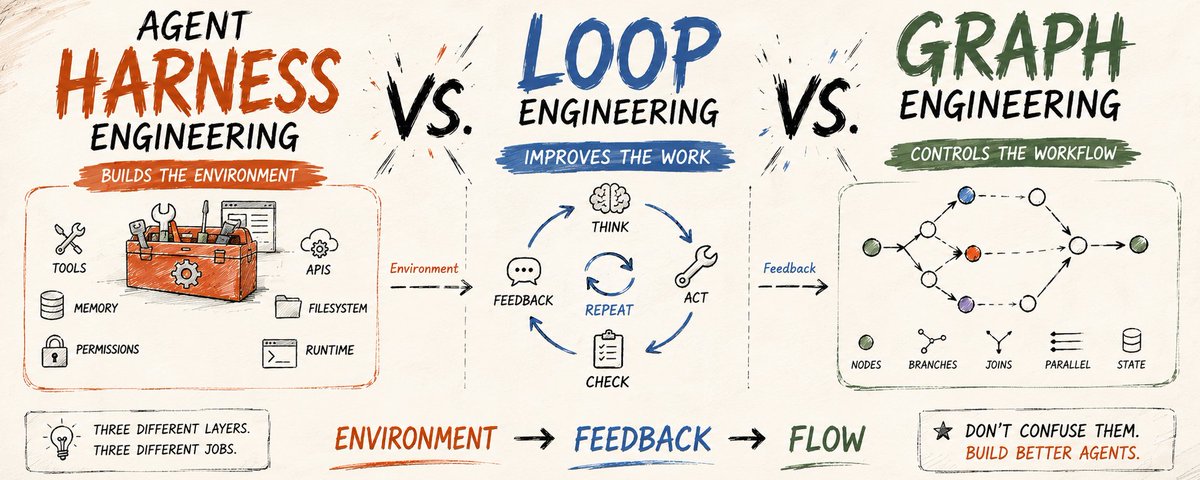
your agent was never just a loop
it is three contracts built around one model
loop vs graph vs harness engineering
the loop is a contract with time
the graph is a contract with state
the harness is a contract with reality
loop engineering
defines the temporal contract
how many attempts are available
how much budget one run can consume
what qualifies as real progress
which condition ends the execution
when the agent continues trying after the evidence has stopped changing the temporal contract is broken
make every attempt durable limited and measurable
→ github.com/temporalio/tempor…
graph engineering
defines the state contract
which transitions are permitted
which branches can execute in parallel
where the system can safely resume
what must be present before the next node begins
when the agent reaches a valid node through an invalid state the state contract is broken
make every transition visible and explicit
→ github.com/langchain-ai/lang…
inspect the topology separately from the model
→ github.com/networkx/networkx
harness engineering
defines the execution contract
which tools are available
which secrets can be accessed
where generated code is executed
which actions need approval
when the correct transition produces the wrong external effect the execution contract is broken
isolate and contain every tool call
→ github.com/e2b-dev/E2B
validate quality before deployment
→ github.com/openai/evals
trace the contract through every system boundary
→ github.com/open-telemetry/op…
bound the time
validate the state
contain the effect
the model creates a proposal
the system enforces the contracts
bookmark this before your next agent rewrite
then read the article below


HIT-A-MAN retweeted

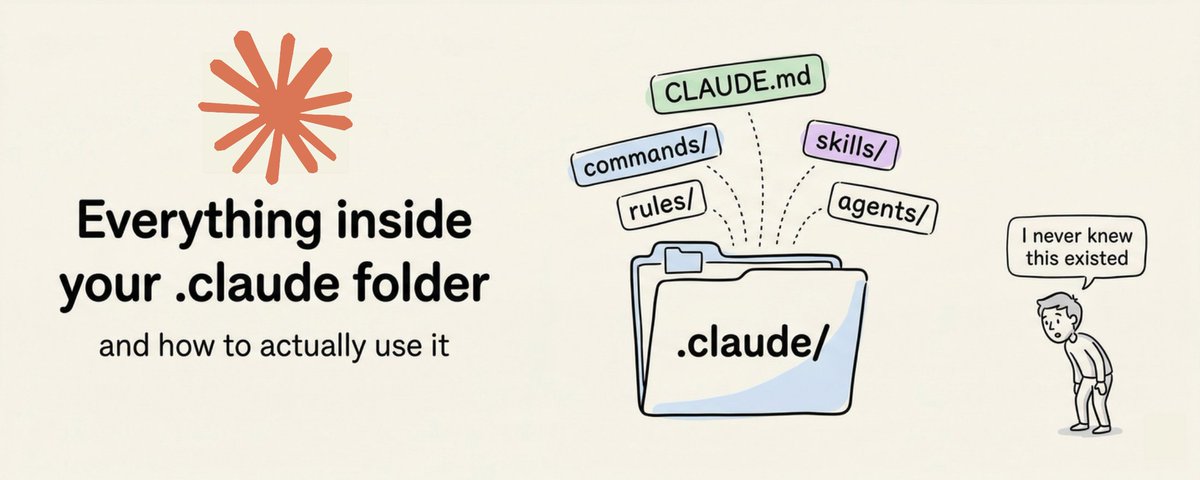
How to set up your Claude code project?
A proper Claude Code project lives inside a .𝗰𝗹𝗮𝘂𝗱𝗲/ folder.
- Start with 𝗖𝗟𝗔𝗨𝗗𝗘.𝗺𝗱 as Claude's instruction manual.
- Split it into a 𝗿𝘂𝗹𝗲𝘀/ folder as it grows.
- Add 𝗰𝗼𝗺𝗺𝗮𝗻𝗱𝘀/ for repeatable workflows
- 𝘀𝗸𝗶𝗹𝗹𝘀/ for context-triggered automation
- and 𝗮𝗴𝗲𝗻𝘁𝘀/ for isolated subagents.
- Lock down permissions in 𝘀𝗲𝘁𝘁𝗶𝗻𝗴𝘀.𝗷𝘀𝗼𝗻.
There are two .𝗰𝗹𝗮𝘂𝗱𝗲/ folders:
- one committed with your repo
- one global at ~/.𝗰𝗹𝗮𝘂𝗱𝗲/ for personal preferences and auto-memory across projects.
The .𝗰𝗹𝗮𝘂𝗱𝗲/ folder is infrastructure. Treat it like one.
The article below was written by my co-founder some time back, and it is still very much relevant.
It is a complete guide to 𝗖𝗟𝗔𝗨𝗗𝗘.𝗺𝗱, custom commands, skills, agents, and permissions, along with how to set them up properly.
Read it below.


HIT-A-MAN retweeted

Anthropic engineer:
"85% of our engineers are using self-improving loops. Now everyone is running agentic Graphs.
In 3-6 months, we’ll all be building graphs to orchestrate agents. No more prompting."
In a 45-minute talk, an Anthropic engineer shows how to build a self-improving agentic workflow from scratch.
Worth more than a $500 agentic course.
Watch this video, then read the full roadmap on how to become a graph architect in the article below


HIT-A-MAN retweeted

This paper is f*cking brilliant
A computer science paper replaces Mixture-of-Agents with Graph-of-Agents for multi-LLM collaboration
The result: structured node sampling, directed message passing, and graph pooling deliver state-of-the-art benchmark scores using only 3 active agents instead of 6
The crazy part is how graph engineering cuts multi-agent inference cost while improving decision accuracy
Relevant model nodes are sampled via domain cards, directed edges pass responses from expert to generalist models, and graph pooling aggregates final consensus
Most multi-agent architectures blindly feed every query to every model in the pool
This framework converts multi-agent collaboration into an optimized communication graph
Read the complete paper + article below
Bookmark it for future reference


HIT-A-MAN retweeted

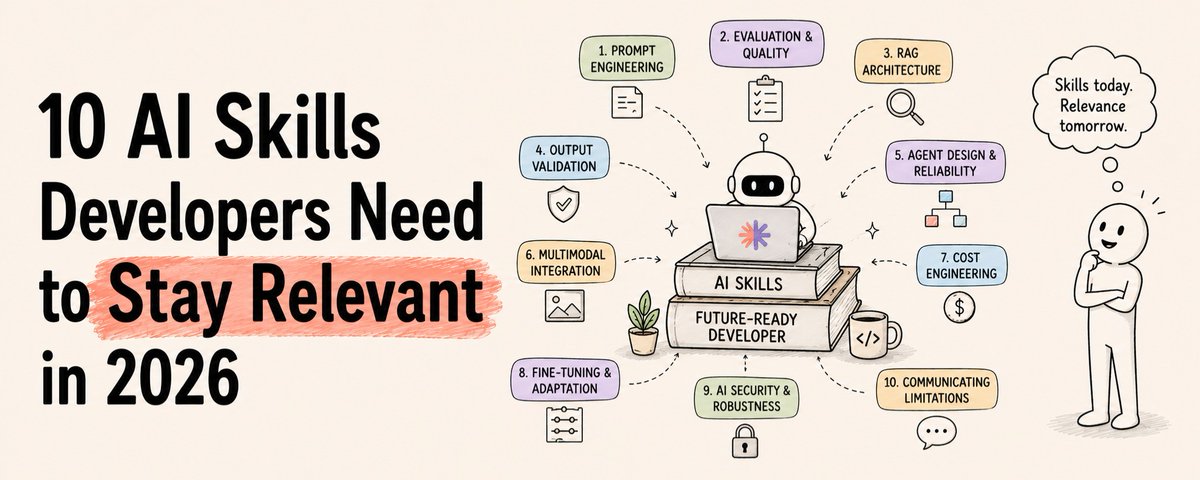
Top 10 YouTube channels to learn AI from scratch:
1) Andrej Karpathy – Deep yet accessible lectures on deep learning, LLMs, and an intro course on neural networks. youtube.com/@AndrejKarpathy
2) 3Blue1Brown – Stunning visualizations that make abstract mathematical concepts intuitive. youtube.com/@3blue1brown
3) Lex Fridman – In-depth conversations with AI leaders, offering a broader perspective on the field. youtube.com/@lexfridman
4) Machine Learning Street Talk – Technical deep dives and discussions with top AI researchers. youtube.com/@MachineLearning…
5) StatQuest with Joshua Starmer PhD – Beginner-friendly explainers on machine learning and statistics. youtube.com/@statquest
6) Serrano Academy (Luis Serrano) – Clear and accessible content on ML, deep learning, and AI advancements. youtube.com/@SerranoAcademy
7) Jeremy Howard – Practical deep learning courses and AI-powered web app tutorials. youtube.com/@howardjeremyp
8) Hamel Husain – Hands-on lessons in LLMs, RAG, fine-tuning, and AI evaluations. youtube.com/@hamelhusain7140
9) Jason Liu – Expert-led lectures on RAG and AI freelancing tips for ML developers. youtube.com/@jxnlco
10) Dave Ebbelaar – Practical guides on building AI systems and real-world applications. youtube.com/@daveebbelaar


HIT-A-MAN retweeted

De prompt engineering → context engineering → harness engineering → loop engineering → graph engineering:
La lista no deja de crecer, y cada nuevo término suele tratarse como si sustituyera al anterior.
Pero la realidad es otra: cada capa envuelve a la anterior. La forma más sencilla de diferenciarlas es preguntarse cuál es su unidad de trabajo.
Prompt engineering es el mensaje
El modelo no recuerda nada antes de esa llamada, así que el prompt tiene que contener todo lo necesario: el rol, el contexto, las instrucciones, algunos ejemplos y el formato de salida.
Si el resultado no es el esperado, la clave está en descubrir qué elemento falta o falla, no en reescribir todo el prompt una y otra vez.
La unidad de trabajo es una única entrada.
Context engineering es la memoria
A lo largo de varios pasos, la ventana de contexto es limitada, pero la información disponible no lo es. Por eso hace falta un proceso de selección.
Ese proceso consiste en conservar lo importante, resumir lo útil pero voluminoso y descartar el resto.
Un buen contexto no consiste en meter más información, sino en saber qué eliminar.
La unidad de trabajo es lo que permanece dentro de la ventana de contexto.
Harness engineering es la máquina
Por sí solo, un modelo solo genera texto.
El harness se encarga de recopilar la información necesaria, ejecutar el modelo, llamar a herramientas o subagentes y verificar el resultado mediante pruebas o un evaluador.
Ese paso de verificación es, en gran medida, lo que diferencia una simple llamada a una API de un agente de IA.
La unidad de trabajo es una ejecución completa de la máquina.
Loop engineering es la ejecución iterativa
Una sola ejecución rara vez resuelve todo el problema.
Hace falta un mecanismo que decida si la máquina debe volver a ejecutarse. Para ello se necesita un objetivo definido desde el principio, límites como un número máximo de iteraciones o un presupuesto de coste, y un criterio automático que determine cuándo la tarea realmente ha terminado.
Que un agente deje de pedir herramientas no significa que haya completado el trabajo; solo significa que ha terminado ese turno.
La unidad de trabajo es toda la ejecución del ciclo.
Graph engineering es la coordinación
Cuando varios bucles tienen que trabajar juntos, necesitas definir qué se ejecuta, cuándo se ejecuta, qué puede hacerse en paralelo y qué componentes supervisan a otros.
Los nodos realizan el trabajo, las conexiones (edges) deciden qué ocurre después y el estado compartido fluye entre ellos.
De hecho, un único bucle no deja de ser un grafo de un solo nodo con una conexión que apunta de vuelta a sí mismo. Por eso los grafos organizan los bucles, no los sustituyen.
La unidad de trabajo es el proceso completo.
La relación entre todas estas capas es sencilla:
El prompt y el contexto viven dentro de la fase de recopilación del harness.
El harness ejecuta una pasada completa.
El loop decide si esa pasada debe repetirse.
El graph decide qué bucles se ejecutan y cómo se coordinan entre sí.
Cuanto más amplías la perspectiva, mayor es la unidad de trabajo.
Cuanto más profundizas, vuelves al prompt.
Y eso también indica dónde depurar un problema: identifica qué capa ha fallado según su unidad de trabajo y corrige esa capa.
El prompt es la parte más fácil de modificar, por eso suele recibir la culpa de errores que, en realidad, se originan tres niveles más arriba.
En el articulo de abajo, se explica que es el graph engineering, donde explica la idea principal, cómo empezar, cómo gestionar el estado compartido, cómo crear un enrutamiento fiable y cuándo usar un grafo realmente merece la pena.
Si quieres mantenerte al día, léelo a continuación👇


HIT-A-MAN retweeted

Free 3-hour course from an ex-Google engineer. AI agents, graph engineering, harness, agent loops. Covers more than most $500 paid courses.
This is the exact playbook to learn how to actually build and monetize AI agents. Don't miss your shot, save it now.
• 0:00 - Design an AI agent system from scratch
• 7:38 - When your agent should hand off to a human
• 19:27 - RAG and vector databases explained simply
• 52:38 - Deploy your AI agent to Google Cloud
• 1:25:57 - Turn AI agents into a paid business via WhatsApp
• 1:33:00 - Turn conversations into real leads automatically
• 2:24:01 - Loop engineering vs graphs, the real difference
• 2:33:08 - Build your own multi-tool agent graph
Save this video, because it's the only one that can actually take you to your $2,000+ profit.


HIT-A-MAN retweeted

🚨 THIS 32-MINUTE STANFORD LECTURE IS BETTER THAN MOST SELF-HELP BOOKS
No motivation hacks.
No fake positivity.
Just timeless lessons on courage, confidence, and action.
Bookmark it and watch it today.


HIT-A-MAN retweeted

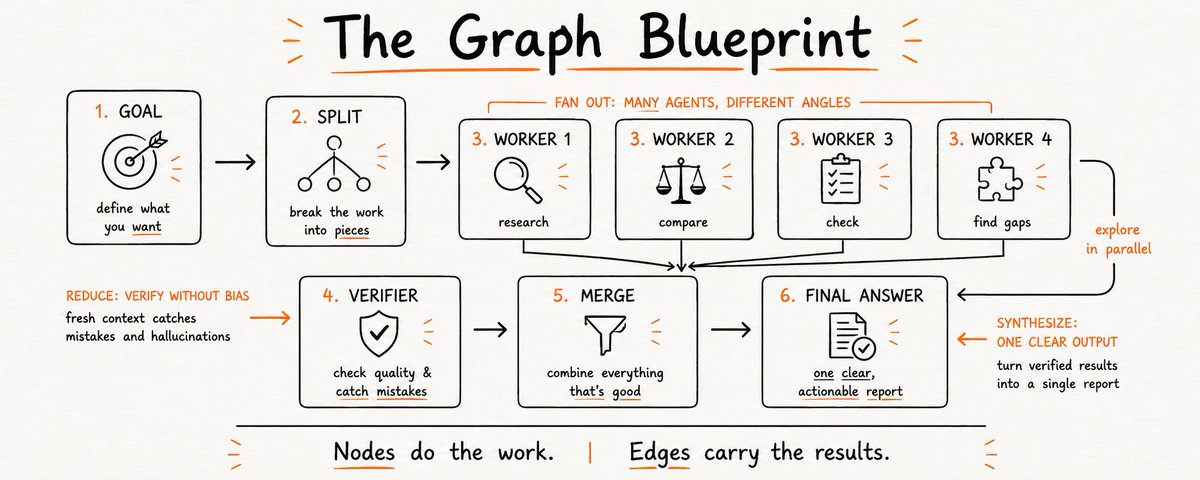
Google just released a 2-hour course on building agentic knowledge graphs from scratch:
38:46 - your first working agent
54:46 - plugging in MCP tools so it can act
1:12:43 - your first loop
1:20:57 - wiring agents into a graph
2:22:31 - the full system that runs on its own
Worth more than any $500 course you'll find.
Watch it today, then build your first graph with the step-by-step guide below.

HIT-A-MAN retweeted

Anthropic engineer:
"75% of our teams have moved past loops. The next layer is graphs - networks of agents that route, verify, and improve each other."
"In the next few months, the people who understand graph architecture will be building things everyone else can't."
in a 19-minute session, an Anthropic engineer walks through how to design self-improving agentic systems from the ground up.
not a prompt tutorial. not a tool demo. actual architecture.
worth more than most paid courses on the topic.
watch the video, then read the full breakdown below on how to think like a graph architect.


HIT-A-MAN retweeted
Andrew Ng just released a free 1-hour course on building agentic knowledge graphs from scratch.
How to turn raw data into structured memory for AI agents:
00:00 - Understand agentic knowledge graphs
03:07 - Build your first agentic graph
14:00 - Architect multi-agent systems
23:00 - Build graphs with Google ADK
1:06:03 - See why graphs are the future of agents
Most people are still building agents with flat context.
Andrew Ng is already teaching the next layer:
Data → Relationships → Memory → Agents → Graphs
Loop engineering is the old workflow.
Graph engineering is the new one.
This 1-hour course is worth more than most paid agent engineering courses.
Bookmark and watch it before everyone catches up.
Then read the full Graph Engineering roadmap below
HIT-A-MAN retweeted

Don't waste 2 years learning to build self-improving AI agents.
Stanford just dropped a 3 hour course on building AI agents from scratch.
• 00:00 - self-improving AI agent basics
• 1:07:24 - multi-step reasoning in AI agents
• 2:22:04 - AI agents learning from feedback
Anthropic pays $750,000/year to AI engineers who master this exact knowledge of building AI agents.
Bookmark this & watch, no matter what. It’ll be the most productive start for your week. Then read article below.


HIT-A-MAN retweeted
Anthropic engineer just released a 2-hour+ workshop on Graph Engineering.
"80% of our engineers already use self-improving loops.
Now everyone is building agentic graphs."
00:00 - RAG and graphs
06:39 - States and nodes
14:29 - Three feedback loops
23:06 - Evaluate agents with graphs
36:29 - Build agent cycles
1:15:22 - Agentic RAG and context
1:41:20 - Graph-based evaluation datasets
Most people are still building linear agent workflows.
Anthropic engineers are already turning them into graphs.
Linear agents are the old workflow.
Self-improving graphs are the new one.
This 2-hour workshop replaces most paid agent engineering courses.
Bookmark and watch it before everyone catches up.
Then read the full Graph Engineering roadmap below
HIT-A-MAN retweeted

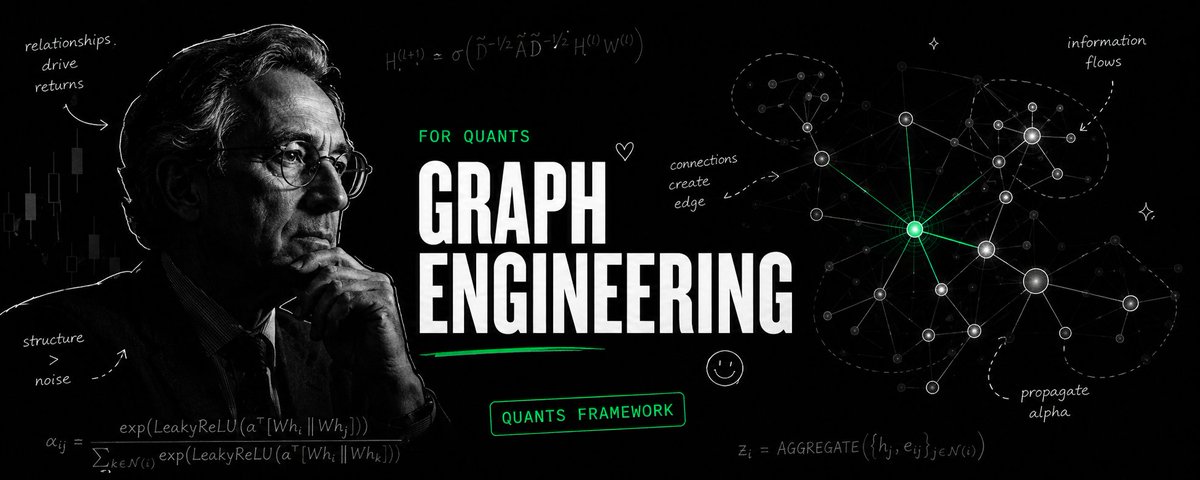
Google just dropped a free 2-hour Graph Engineering course.
Most people stop at:
→ 1 prompt
→ 1 agent
→ 1 workflow
This goes much further:
17:44 → Build your first agent
39:30 → Loop engineering
1:12:38 → Graph engineering
1:34:26 → Self-throttling agents
1:55:05 → Multi-agent graph systems
The future isn't a single agent.
It's networks of agents that coordinate, evaluate, remember, and improve themselves.
Watch the course, then read the article below

HIT-A-MAN retweeted
Esto es una auténtica joya.
Hace cinco semanas, Andrej Karpathy se unió a Anthropic.
Dos ingenieros senior de Anthropic llevaron el enfoque de Karpathy un paso más allá con el concepto de Graph Engineering.
Los sistemas agénticos mejoran de verdad cuando conectas los agentes en forma de grafo.
Lo integré en mi configuración y la primera respuesta ya fue completamente distinta.
No fue una mejora pequeña. Fue un cambio total.
Claude dejó de dar respuestas genéricas y empezó a trabajar exactamente como yo quería.
Guárdalo antes de que se pierda en tu feed.
Léelo ahora y luego échale un vistazo al artículo de abajo👇
