

Promoting hirola conservation, research and education. hcp@hirolaconsevation.org
Joined February 2014
- Tweets512
- Following542
- Followers885
- Likes290




Hirola Conservation retweeted

RAINFALL FORECAST FOR OCTOBER 2026
🌧️⛈️Above-average rainfall (with higher probabilities) is likely to occur in Kwale, Mombasa, Kilifi, Lamu, Mandera and parts of Taita Taveta, Tana River, Garissa and Wajir Counties
🌧️🌧️Above-average rainfall is expected in Makueni, Kajiado, Machakos, Nairobi, Kiambu, Murang’a, Kirinyaga, Embu, Tharaka-Nithi, Meru, Isiolo, Nyandarua, Nyeri and parts of Taita Taveta, Tana River, Garissa, Wajir, Marsabit, Laikipia, Nakuru and Narok Counties
🌧️🌦️Near-average to above-average rainfall is expected in Baringo, Bomet, Bungoma, Busia, Elgeyo Marakwet, Homa Bay, Kakamega, Kericho, Kisii, Kisumu, Migori, Nandi, Nyamira, Samburu, Siaya, Trans Nzoia, Turkana, Uasin Gishu, Vihiga, West Pokot and parts of Narok, Nakuru and Laikipia Counties.
⚠️Heavy rainfall events are expected in several parts of the country. @MoICTKenya
meteo.go.ke/documents/5166/M…

RT @KWSKenya: Ni mbaya!!
When two male rhinos clash, it is usually about territory, dominance or access to females. With all that weight,…
Hirola Conservation retweeted
As Kenya prepares for the October–December rains amid evolving El Niño conditions, the Government has established the National Crisis Communication Technical Committee (#NCCTC) to strengthen coordinated preparedness and public communication.
The Kenya Meteorological Service Authority (#KMSA) is a technical member of the Committee and will provide timely, authoritative weather and climate information, forecasts, advisories and warnings to support early warning and early action.
The window to prepare is now.
Know the risk. Heed the warning. Act early, @MoICTKenya
#KMSA #NCCTC #ElNinoPreparedness #OND2026 #EarlyWarningEarlyAction


Hirola Conservation retweeted

Studying wild giraffes requires long hours in the field and immense patience. Our research group track social bonds, feeding choices, and movement using photo-identification and GPS satellite collars among other research questions.

Hirola Conservation retweeted

Unajua antelope ngapi?
Well, ongeza Hirola kwa hiyo list.
Known as the “four-eyed antelope” because of the distinctive markings beneath its eyes, the Hirola is endemic to Kenya and Somalia, where it inhabits dry grasslands, open savanna and shrubland. It is the only surviving species in its genus and is classified as Critically Endangered, with fewer than 500 estimated to remain in the wild.
This World Hirola Day, let’s commit to protecting one of the world’s rarest antelopes and the ecosystems it depends on. 💚 Visit kwspay.ecitizen.go.ke/donate to support efforts to conserve this endangered species.
#WorldHirolaDay #ThisIsOurWild #ThrivingWildlifeForever


Hirola are selective core grazers that target specific short, newly sprouted grasses and herbaceous flowering plants. Read more here: onlinelibrary.wiley.com/doi/…

9
743
Human-giraffe conflicts in Garissa County, Kenya, centers on land-use changes along the Tana River where expanding smallholder farming and drought push endangered Somali (reticulated) giraffes to raid mango crops!
Read more here. frontiersin.org/journals/con…

Hirola Conservation retweeted
This afternoon, held crucial conservation conversations with Garissa @KWSKenya warden @Adenjelle78 where we discussed priorities for the county including antipoaching, research, education and awareness and protected areas management.

This afternoon, held crucial conservation conversations with Garissa @KWSKenya warden @Adenjelle78 where we discussed priorities for the county including antipoaching, research, education and awareness and protected areas management.
Hirola Conservation retweeted

Thank you to Kenya Wildlife Service Garissa Station and local farmers for celebrating #WorldGiraffeDay with us. Together, we promoted giraffe conservation, sustainable livelihoodsand community stewardship for wildlife.
#WorldGiraffeDay #GiraffeConservation #CommunityConservation


Did you know the world’s rarest antelope is a picky eater?
For 2026, research into the Hirola antelope identifies a complex interplay of nutritional needs and habitat changes driving their diet selection.
#HirolaConservation

Roads are one of the biggest threats to wildlife worldwide.
“Even one vehicle can change everything for an animal crossing its natural habitat.

Hirola Conservation retweeted
New publication: Ecological niche modeling for determining grass species suitable for Hirola range‐wide restoration and reintroduction in eastern Kenya @SERestoration @wildnetorg @WhitleyAwards @hirola_program onlinelibrary.wiley.com/doi/…

Hirola Conservation retweeted
Co-existence in action
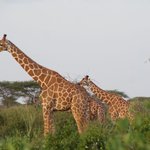
Somali giraffes and the critically endangered hirola share the same rangelands by using nature differently—browsing and grazing in balance. Protecting habitats means protecting this harmony.#SomaliGiraffe #SaveHirola #Coexistence #Conservation

Co-existence in action
Somali giraffes and the critically endangered hirola share the same rangelands by using nature differently—browsing and grazing in balance. Protecting habitats means protecting this harmony.#SomaliGiraffe #SaveHirola #Coexistence #Conservation
Happy Giving Tuesday!
Your generosity today truly makes a difference.
Without this work, the hirola could vanish in our lifetime but your support gives them a future.
Donate: donate.wildnet.org/?fund=Hir…

Hirola Conservation retweeted
𝐃𝐚𝐲 𝟏𝟐; 𝐓𝐡𝐞 𝐄𝐱𝐞𝐫𝐜𝐢𝐬𝐞 𝐂𝐨𝐧𝐭𝐢𝐧𝐮𝐞𝐬…. From the moment the rhino is darted to safely immobilizing it, to the team stepping in to blindfold, position, and monitor vital signs—every second is coordinated. Respiration, heart rate, oxygen levels, and temperature are tracked continuously to keep the rhino stable and stress-free.
From precision ear-notching and drilling to fit transmitters, to collecting biological samples for research, to marking, documentation, and finally reviving the rhino—every role ensures a safe, successful operation.
This is conservation in motion, powered by teamwork!
#ThrivingWildlifeForever #PartnershipForConservation