

IDT Expert | Speaker | Mistry & Shah | 13+ yrs in GST, Customs & legacy tax laws | Ex-KPMG | Litigator + Advisor | Breaking down complex tax issues with Clarity
Ahmadabad City, India
Joined May 2016
- Tweets281
- Following238
- Followers787
- Likes493






Pinned Tweet
#TaxTalkThursday | Reflecting on 2025, Preparing for 2026
As we step into the new year, I would like to thank all the readers of Tax Talk Thursday for their valuable views, comments, and engagement throughout the year. Tax Talk Thursday was one of the initiatives I started in 2025, and the consistent interaction from readers has been both encouraging and motivating.
As we look back at 2025, it is worthwhile to pause and note some of the important tax reforms introduced during the year. These reforms reflect a clear policy direction towards simplification of laws, reduction of ambiguity, improved compliance experience, and increased reliance on technology driven administration.
On the indirect tax front, continued progress towards Next Generation GST remained one of the key positives of the year. Rationalisation of rate structures, improved refund mechanisms, and strengthening of digital compliance systems have gradually reduced friction in GST administration. The steady growth in the GST taxpayer base also indicates deeper formalisation of the economy and improved system maturity.
On the income-tax front, one of the most significant developments was the introduction of the Income Tax Act, 2025, replacing the long-standing 1961 legislation. The new law places strong emphasis on clarity of language and structure. The shift to a single “Tax Year”, aligned with the financial year, is a positive step that removes long-standing confusion around assessment years and simplifies compliance for taxpayers and professionals alike.
From the perspective of individual taxpayers, the enhancement of exemption limits under the new tax regime provided meaningful relief to the middle class. Stability in tax rates, coupled with higher exemption thresholds, has helped improve predictability and disposable income, both critical for voluntary compliance and economic confidence.
As we look forward to 2026, expectations remain high. Stakeholders are hopeful for further GST rate rationalisation, simplification of annual return and audit requirements, smoother system integrations across tax laws, and more effective dispute-resolution mechanisms to reduce litigation.
In a nutshell, 2025 laid a strong foundation for a simpler, more transparent, and technology oriented tax framework. The year ahead presents an opportunity to build on this momentum through consistent implementation and practical reforms.
Wishing all readers a very Happy New Year, and looking forward to continuing these discussions every Thursday in 2026 as well.
Happy reading!
@cbic_india @IncomeTaxIndia
@FinMinIndia
#TaxTalkThursday #TTT #TaxUpdates #TaxReforms #NextGenGST #IncomeTax #TaxProfessionals #CharteredAccountants #TaxCompliance #EaseOfDoingBusiness #NewYear2026

7
1,370
#TaxTalkThursday | From GR Waiver to NIL-Value EDF: Rethinking Export Compliance
Does every export transaction need a separate waiver when no foreign exchange is expected to be realized?
With the new FEMA export framework effective from 1 October 2026, the approach to exports made without consideration has changed. Instead of the earlier GR waiver process, exporters can make a NIL-value declaration in the Export Declaration Form (EDF) for relevant transactions, such as free samples and warranty replacements.
The changes go beyond a declaration format. The move towards a common EDF framework for goods, software and other services, alongside the discontinuation of SOFTEX, reflects a broader shift towards simplified, digital and integrated export reporting.
For exporters, the key question is whether their internal documentation, banking processes and EDPMS reconciliation practices have kept pace with the new framework.
Exporters should begin by identifying transactions where no foreign exchange is expected, updating their EDF declaration procedures, and aligning documentation with their authorised dealer bank. They should also review EDPMS reconciliation and ensure teams handling exports, finance and banking follow a consistent process.
The objective is not just to comply with the new framework, but to prevent avoidable documentation gaps and delays in closing export transactions.
Happy reading!
#TaxTalkThursday #FEMA #ExportCompliance #DGFT #RBI #EDF #GRWaiver #SOFTEX #EDPMS #ForeignTrade #TheGSTLedger
🤖 Made with AI

2
169
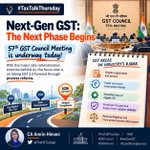
#TaxTalkThursday | Next-Gen GST: The Next Phase Begins
The 57th GST Council Meeting is underway today, and unlike the major rate rationalisation exercise of 2025, the attention this time is largely on the next layer of GST reforms; improving the way the system works for taxpayers.
After nine years of GST, the industry’s expectations are moving beyond rates. Simpler registration and return filing, faster refunds, smoother utilisation of eligible ITC, protection for genuine buyers from supplier defaults and reduction in avoidable litigation are among the key areas being discussed or expected to receive attention.
For MSMEs in particular, the objective should be more than digitising compliance. It should be about reducing the time spent on compliance, preventing genuine credits from getting blocked, releasing working capital faster and providing greater certainty when an error is procedural rather than substantive. Industry is also looking for a more predictable and proportionate approach to enforcement and disputes.
The first phase of GST 2.0 changed the tax rates. The expectation from the next phase is that it will improve the taxpayer experience.
Perhaps the real test of Next-Gen GST is not how much the tax system can collect, but how simply a compliant business can operate within it.
Happy Reading!
CA Amrin Himani
#TaxTalkThursday #NextGenGST #GST2Point0 #GST #GSTCouncil #GSTReforms #ITC #GSTRefund #MSME #GSTCompliance #EaseOfDoingBusiness #IndirectTax #TheGSTLedger
🤖 Made with AI

2
528
Faceless GST Assessment: A Welcome Reform, But Are We Ready?
The move towards faceless assessment under GST is an important step towards a more transparent and technology-driven tax administration.
But as a tax practitioner dealing with GST litigation for over 8 years, I believe the key question is: Can we ensure that the facts and documents are truly understood in a faceless process?
Many disputes arise not only from legal interpretation, but from non-appreciation of business facts, accounting entries and supporting documents.
Faceless should reduce unnecessary interaction; not the opportunity to effectively explain a taxpayer’s case.
I have shared my thoughts and some key safeguards in my latest article. linkedin.com/pulse/faceless-… via @LinkedIn
Would love to hear your views.
Happy reading!
#GST #FacelessAssessment #GSTLitigation #IndirectTax #TaxAdministration #GSTIndia #TheGSTLedger

DGFT’s New Central Processing Department: A Step Towards Faceless Trade Facilitation
DGFT has issued an Office Memorandum dated 1 October 2026 regarding the establishment of a Central Processing Department (CPD) for implementation of the Faceless Trade Facilitation System. The CPD is being set up at DGFT, Delhi, with officers transferred from various DGFT offices/regions.
The latest OM provides that officers whose transfers have been ordered but who have not yet been relieved may be retained temporarily, while the identified officers are to undergo training from 5 October 2026. Officers transferred to the CPD are required to report to the Training Division for their final order.
The interesting part is not merely the transfer of officers; it is the institutionalisation of a Central Processing Department for a Faceless Trade Facilitation System. With officers drawn from different functional levels and regions, this appears to be an important administrative step towards centralised processing under DGFT.
For exporters and importers, the larger question will be: Will centralised and faceless processing translate into greater consistency, faster processing and reduced interface with regional offices?
The effectiveness of the initiative will ultimately depend on how the CPD functions once operational.A structural change in DGFT; but the real test will be in implementation.
Happy reading!
#DGFT #ForeignTrade #FacelessTrade #TradeFacilitation #Exports #Imports #FTP2023 #Customs #InternationalTrade #TheGSTLedger
🤖 Made with AI

RoDTEP & DFIA: A Clarification That Raises More Questions
CBIC’s recent clarification stating that RoDTEP benefit is not available on exports made under DFIA has raised an important issue for exporters.
The question is not only about future claims. What happens to entities that have already claimed and received RoDTEP benefits, particularly where the claims were made after the March 2024 amendment to the RoDTEP framework, and were processed through the Customs/ICEGATE system?
More importantly, why does this clarification emerge almost two years after the earlier DGFT amendment? If the policy position was intended to exclude DFIA exports, the prolonged gap between the amendment, system processing and the present clarification creates legitimate uncertainty for businesses that acted based on the framework prevailing at the time.
This raises a broader question: When a benefit is claimed based on the prevailing policy and processed through the Government’s own system, who bears the consequence when the position is clarified retrospectively?
Happy reaidng!
#RoDTEP #DFIA #DGFT #Customs #Exports #ForeignTrade #ExportPromotion #IndirectTax #TheGSTLedger
🤖 Made with AI

#TaxTalkThursday | RoDTEP & RoSCTL: Benefit, Extension & Business Certainty
When RoDTEP was introduced from 1 January 2021, the objective was clear; taxes should not be exported. The scheme was designed to remit embedded duties, taxes and levies which were not refunded through any other mechanism, thereby improving the global competitiveness of Indian exports. RoSCTL, introduced in 2019 for apparel, garments and made-ups, follows a similar principle of neutralising embedded taxes and levies.
However, since the introduction of FTP 2023, these schemes have increasingly been continued through time-bound extensions, rather than through a longer-term certainty of continuation. RoDTEP, for instance, was extended for six months from April to September 2026 and has now been extended for another three months up to 31 December 2026. RoSCTL has similarly been extended for three months.
For exporters, these benefits are not merely an additional incentive; they can form part of the export pricing and margin calculation. Export orders are often negotiated months in advance. Repeated short-term extensions therefore create a practical question: How does a business price a 6 to 12 month export order when a component of its cost competitiveness is certain only for the next few months?
The latest extension provides welcome continuity, but perhaps the larger requirement for industry is predictability. An exporter can plan around a known benefit, even if the quantum changes; planning becomes more difficult when the very continuation of the benefit remains subject to periodic extension.
Is it time to move from “extension of benefits” to “certainty of policy”?
Happy reading!
@dgftindia
#TaxTalkThursday #RoDTEP #RoSCTL #FTP2023 #Exports #DGFT #ExportPromotion #Customs #IndirectTax #MSME #TheGSTLedger
🤖 Made with AI

GST Update | Multi-State Registration Enabled on GST Portal
The GST Portal now displays the “MULTI-STATE REGISTRATION” facility alongside the existing Registration and Login options.
A significant portal-level development for businesses having operations across multiple States/UTs.
Will be useful to watch for the detailed functionality, eligibility, documentation and procedural requirements.
Happy reading!
#GST #GSTUpdate #GSTPortal #GSTRegistration #MultiStateRegistration #GSTN #IndirectTax #TheGSTLedger

Day 21: GSTAT hearing | physical, hybrid, and the three-adjournment cap
Your appeal cleared scrutiny. Now it gets heard. Here's what to expect.
How you appear:
🏛️ In person at the bench, or
💻 By video conferencing; GSTAT is built to hear you without forcing travel to the bench location.
Open, not closed: Proceedings are generally open; this is a public tribunal, not a private hearing.
The three-adjournment cap:
Each party gets a maximum of three adjournments and only for justifiable reasons. The days of endless "next date, please" are over. Come prepared to argue.
The Tribunal is meant to pronounce its order within 30 days of the final hearing. GSTAT was built to clear backlog, not add to it.
Practical takeaway: treat every listed date as a hearing date. Assume you won't get a fourth adjournment, and walk in ready.
Happy reading!
#GST #GSTAT #GSTUpdate #Tax
🤖 Made with AI

Day 20: Surviving scrutiny | the defects that get appeals flagged
How it works:
You file → registry scrutinises → defects (if any) are raised → you cure them → the appeal is admitted. Only then does anyone look at the merits.
The defects that come up most:
-> Short pre-deposit: the single most fatal one. Checked before admission, every time.
-> Missing certified copy of the order under appeal
-> No vakalatnama / authorisation; or a representative not registered on the portal
-> Missing board resolution for companies and LLPs
-> Illegible or oversized PDFs, unpaginated bundles
-> Untranslated documents with no supporting affidavit
-> Verification left unsigned
One relief worth knowing:
Until 31 Dec 2026, the registry is taking a lenient view; raising defects of substance, not of form. Digitally generated GSTN documents don't need separate certification.
Best strategy: file early. You stay inside the window and get time to cure defects comfortably.
Happy reading!
#GST #GSTAT #GSTUpdate #Tax
🤖 Made with AI

#TaxTalkThursday
One Show Cause Notice. Six Financial Years. One Limitation Issue.
It has become increasingly common to see a single show cause notice under Section 74 covering multiple financial years. While this may simplify administration, it raises an important legal question.
Section 74 prescribes limitation with reference to the financial year to which the tax relates. Every financial year is a separate tax period with its own returns, facts, and limitation timeline. Clubbing multiple years into one notice does not extend or revive limitation for years that have already expired.
This issue recently came up before the High Court in State Bank of India v. CGST, where a composite notice covering FY 2018-19 to FY 2023-24 was set aside. The Court held that the CGST Act contemplates independent proceedings for each financial year, and a composite notice cannot be used to overcome limitation. Consequently, both the notice and the adjudication order were quashed.
The Court also reiterated that where the notice itself suffers from a jurisdictional defect, the existence of an appellate remedy under Section 107 is not a bar to invoking writ jurisdiction.
Of course, the judgment also clarifies that fresh proceedings may still be initiated for years that remain within limitation. Further, this is a High Court ruling and will have binding effect within its territorial jurisdiction.
Takeaway: Whenever a show cause notice covers multiple financial years, limitation deserves a closer look. Sometimes, the strongest defence lies not in the merits, but in the validity of the notice itself.
Happy reading!
#GST #CGST #TaxTalkThursday #TaxLitigation #IndirectTax
🤖 Made with AI

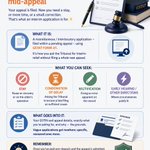
Day 19: Interlocutory applications | asking GSTAT for something mid-appeal
Your appeal is filed. Now you need a stay, or more time, or a small correction. That's what an interim application is for.
What it is: A miscellaneous / interlocutory application; filed within a pending appeal; using GSTAT FORM-01. It's how you ask the Tribunal for interim relief without filing a whole new appeal.
What you can seek:
Stay: pause on recovery or on the order's operation
Condonation of delay: asking the Tribunal to excuse a late filing on sufficient cause
Rectification: fixing an error apparent on the record
Early hearing / other directions: where circumstances justify it
What goes into it: Your GSTIN and appeal details, exactly what you're asking for, and why — the grounds. Vague applications get nowhere; specific, reasoned ones move.
Remember: once you've paid pre-deposit and the appeal is admitted, recovery of the balance is already stayed by law (Sec 112(9)); so know what protection you already have before you apply for more.
Happy reading!
#GST #GSTAT #GSTUpdate #Tax

Day 18: The complete GSTAT appeal bundle | your checklist
You can't add documents later without the Tribunal's permission. So build it right.
The core:
-> FORM GST APL-05 | the appeal itself
-> Certified copy of the order under appeal (the APL-04 / first-appellate order)
-> The order-in-original + SCN, for context
Your case:
-> Statement of facts
-> Grounds of appeal
-> The prayer
Proof of payment:
💰 Pre-deposit challan (from the cash ledger)
💵 Fee challan (Bharatkosh)
Who's acting: Vakalatnama (advocate) or authorisation letter (CA/CS/CMA) along with board resolution for companies / LLPs
The supporting file:
-> Key annexures relied on
-> Translations with affidavits (for non-English documents)
-> Index + list of dates | makes the Bench's job easy, and yours look professional
Two habits:
✅ Legible, correctly sized PDFs.
✅ Paginate and index; a well-ordered bundle rarely gets flagged.
Happy reading!
#GST #GSTAT #GSTUpdate #Tax

"One Nation, One Tax"; but still separate GST registration for every State!
When GST was introduced, the phrase "One Nation, One Tax" became its defining slogan. But in practice, businesses operating across India soon realised that while the tax was unified, the compliance wasn't. A company with operations in 15 States doesn't have one GST identity; it has 15 GST registrations. That means multiple returns, multiple jurisdictions, multiple audits, multiple notices and multiple points of interaction with the department.
Why did this happen? Because GST is a destination-based tax where revenue is shared between the Centre and the States. Each State's share depends on the consumption within its jurisdiction, making State-wise registrations a key part of the framework.
Now, CBIC seems to be exploring whether this administrative burden can be reduced. On 18 July 2026, the GST Policy Wing constituted an 11-member Working Group to examine the Centralised Administration of Taxpayers having a single PAN but multiple GST registrations under Central Tax jurisdictions.
To be clear, this is not a proposal for a single GST registration across India. The focus appears to be on centralising administration while retaining the existing GST registration structure. Even so, for businesses operating across multiple States, a single administrative interface with the department could significantly reduce compliance and litigation. This is an important development and one that deserves close attention over the coming weeks.
Sometimes, reducing compliance isn't about changing the law; it's about changing how it's administered.
Happy reading!
#GST #CBIC #IndirectTax #TaxPolicy #EaseOfDoingBusiness #GSTIndia
🤖 Made with AI

Day 17: Affidavits & verification
Your grounds can be brilliant. Get the attestation wrong and the appeal is defective before anyone reads them.
Verification | the basics:
Every appeal ends with a verification; you confirming that what's stated is true. One verification, signed by the appellant, then DSC or e-Sign. No verification = incomplete appeal.
Where an affidavit comes in:
-> Filing a non-English document? It needs a translation, supported by an affidavit.
-> Explaining a delay (condonation)? Back the "sufficient cause" with a sworn affidavit, not just assertions.
-> In some situations, an affidavit can stand in for oral evidence facts on oath, on paper.
Two things that trip people up:
❌ Signing the verification but leaving the affidavit unsworn/unattested.
❌ A translation with no supporting affidavit a classic scrutiny defect.
Happy reading!
#GST #GSTAT #GSTUpdate #Tax
🤖 Made with AI

Day 16: Vakalatnama vs Authorisation; who speaks for you at GSTAT
You don't have to appear yourself. But who represents you decides which document you need.
Two different documents:
⚖️ Vakalatnama: for an advocate appearing on your behalf.
📄 Authorisation letter: for a CA, CS or CMA (or other authorised representative) acting for you.
For companies / LLPs:
Add a board resolution (or equivalent) authorising both the appeal and the person signing/representing.
One more step people forget:
The representative must be registered on the GSTAT portal in their own right; the document alone isn't enough; the login has to exist too.
📌 Tomorrow (Day 17): affidavits and verification; getting the attestation right so your appeal isn't rejected on a technicality.
Happy reading!
#GST #GSTAT #GSTUpdate #Tax
🤖 Made with AI

Sunday reflections!!
I love to travel; not just for the places, but for everything it teaches you. New people, new perspectives, new ways of living that no book can ever fully capture.
I haven't done much leisure travel yet (working on that!), but between hearings and meetings, my year's map look a bit full across different cities of Gujarat and other parts of India. And looking back, I realize; I have travelled a lot this year.
Every city brought a new officer, a new colleague, a new challenge, a new way of looking at tax practice. Each conversation added a little more to how I understand this profession.
Here's to more travel; for the practice, and for the soul. ✈️
Happy Sunday!!
#TaxLaw #TaxLitigation #LegalProfession #TaxProfessionals #IndirectTax #LawyersOftwitter

🏛️ Day 15: FORM GST APL-06 | cross-objections
When the other side appeals, you're not just a spectator. But this right has a short shelf life.
What it is: When one party files a GSTAT appeal, the other gets notice; and can file a memorandum of cross-objections in FORM GST APL-06.
Why it matters: Even if you mostly won below, the order may carry a finding that went against you. Cross-objections let you challenge that; instead of quietly living with it.
The catch most people miss: You get roughly 45 days from receiving notice of the appeal. Blow past it and you're stuck defending only; you can't attack the adverse finding anymore.
The good part: No separate fee. No pre-deposit. And it's treated much like an appeal in its own right; so a cross-objection can win you ground you didn't appeal for.
💡 Department appealed against you? Don't just defend. Check every adverse finding in the order and decide what to cross-object to within the window.
📌 Tomorrow (Day 16): vakalatnama vs authorisation; who can represent you, and with what document.
Happy reading!
#GST #GSTAT #GSTUpdate #Tax

🏛️ Day 14: Drafting grounds that actually wins
Same facts, two drafts; one wins, one gets skimmed. The difference is structure.
Separate your facts from your arguments.
Statement of facts = what happened, chronologically, neutrally.
Grounds = why the order below is wrong. Don't mix the two.
One ground = one point. Numbered. Self-contained. A Member should be able to read ground 4 alone and understand the objection.
Lead with your strongest. Not your longest. If jurisdiction or limitation kills the demand outright, that's ground 1; not buried at page 14.
Attack the order, not the officer.
Close every ground.
State the error → state the correct position → say what follows. A ground that only complains isn't a ground.
And the prayer: be specific. Set aside? Remand? Modify? Ask for exactly what you want.
❌ The most common mistake: copy-pasting your SCN reply as "grounds of appeal." That was a different forum answering a different question.
Happy realing!
Happy litigating!
#GST #GSTAT #GSTUpdate #Tax
🤖 Made with AI

🏛️ Day 13: Inside FORM GST APL-05
This is the GSTAT appeal form. Everything you argue lives here. Part by part 👇
📋 The cause title : appellant, respondent, GSTIN, the order under appeal. Gets this wrong and the appeal is misdirected from day one.
📄 Statement of facts : the story, chronologically. What was demanded, what you replied, what the first appellate authority held. Facts only; no argument here.
⚖️ Grounds of appeal: the heart of it. Numbered consecutively, one point per ground: exactly why the order below is wrong in law or on facts.
🙏 The prayer: what you want the Tribunal to actually do. Be specific: set aside, remand, or modify.
✍️ Verification: one verification, signed by the appellant. Then DSC or e-Sign.
Two habits that save you:
✅ One fact / one allegation per paragraph. Numbered.
❌ Don't dump your entire reply to the SCN in as "grounds." Structure beats volume.
Advice: you can't add documents later without the Tribunal's permission. Build the full bundle before you start.
📌 Tomorrow (Day 14): drafting grounds that actually land.
Happy reading!
#GST #GSTAT #GSTUpdate #Tax
🤖 Made with AI

🏛️ Day 12: Filing on the GSTAT portal; a walkthrough
GSTAT is India's first fully digital tribunal. No counter, no queue, no physical file.
Refer the attached image to know the flow.
⚠️ Filing isn't admission. Your appeal is only in once scrutiny clears it.
📌 Tomorrow (Day 13): inside FORM GST APL-05 the main appeal form, part by part.
Happy reading!
#GST #GSTAT #GSTUpdate #Tax
