
Hill Hung retweeted

THIS IS A ACTUAL F*CKING GOLDMINE
Anthropic just shared one of the best tricks for Claude Code
The idea: run Sonnet, Haiku 5.5 and Opus 5.5 at once, each doing only what it's best at
Better results and way fewer tokens: every task lands on the right model
You just start Claude Code like this:
CLAUDE_CODE_SUBAGENT_MODEL=haiku claude --model sonnet
here's how it splits:
→ Sonnet 5.5 runs the main session, writes the code, and applies fixes
→ Haiku 5.5 swarms the repo in parallel: search, grep, docs, and test audits at 340 tok/s
→ Opus 5.5 stays on call as architect for the big decisions and signs off on diffs
→ you stop burning Opus context on routine tasks and stop flooding main session with raw logs
Opus only steps in at three moments:
→ before a plan locks
→ when the same error hits twice
→ before calling it done (signing off on git diff)
Sonnet builds, Haiku swarms, Opus reviews
JEV engineering is the same move one layer down: the forks that need no thinker (which file, which tool, retry or stop) go to JEV in milliseconds, and the big models only see the ones that split
the full tree
> Sonnet 5.5 runs the main session and coordinates code implementation
> search maps the repo on Haiku 5.5 (read-only, 340 tok/s)
> grep finds call sites on Haiku 5.5 (0.05x cost, isolated context)
> audit scans diffs in a temporary worktree (isolation: worktree)
> Opus 5.5 on call as architect, reviews synthesized diff before sign-off
> JEV routes micro-forks in milliseconds
paste the tree and this prompt into Claude Code ↓
"Reconfigure my Claude Code setup around this tree:
1. Run the main session on Sonnet 5.5 with Opus 5.5 as architect
2. Create three custom Haiku 5.5 subagents in .claude/agents/: search (maps repo), grep (finds call sites), and audit (runs isolated diff checks in a worktree)
3. Set isolation: worktree on audit so modifications never touch my working branch
4. Add one rule to CLAUDE.md: delegate all repository searches and test runs to Haiku 5.5 subagents to keep main context under 10k tokens
5. Route fast deterministic forks (tool choice, path selection, retries) through JEV
Show me every change as a diff first. No edits until I say go"
↳ code.claude.com/docs/en/sub-…
save it, it'll come in handy

Hill Hung retweeted

Oh my god, Firebase’s SDK started to crash ALL iOS apps that were using it, for ALL sessions, just like that, no way for any of these apps to do anything…
How amateur is all of this from any SDK, but especially one from a company with as high of an engineering bar like Google…


github.com/firebase/firebase…
incase anyone has been wondering why their iOS apps are intermittently crashing since today morning 🙃
reminds me of the Facebook swizzling crash incident.
@Firebase pls help

Hill Hung retweeted

💡 Practice building autonomous in-app agentic workflows with our sample app, Jetpacker.
In part 5 of this technical series we walk you through how to extend the app with end-to-end booking assistants powered by A2UI and ADK. Get started → goo.gle/4rJMgeo

ALT The ADK web interface shows how we can have a conversation with our multi-agent booking system.
Hill Hung retweeted

introducing Pulse, a mac app to see what’s slowing your mac down and taking up space
live resource graphs, app activity, disk storage visualization, and saved snapshots. your history stays on your mac.
download here: pulsemac.app
Hill Hung retweeted

卧槽兄弟们,GitHub 上真的有一堆免费到离谱的项目。
很多能力已经能直接干掉你正在月付的软件。
1. TradingAgents
AI 多 Agent 量化交易框架
github.com/TauricResearch/Tr…
2. LibreChat
一个界面接入 ChatGPT、Claude、Gemini 等多个模型
github.com/danny-avila/Libre…
3. HyperFrames HeyGen
开源的视频生成引擎
github.com/heygen-com/hyperf…
4. Fincept Terminal
开源版彭博终端
github.com/Fincept-Corporati…
5. MoneyPrinterTurbo
AI 一键生成短视频 github.com/harry0703/MoneyPr…
6. Agentic Inbox Cloudflare
开源 AI 邮件助手
github.com/cloudflare/agenti…
7. VoxCPM
AI 声音克隆工具
github.com/OpenBMB/VoxCPM
8. Flowsint
开源 OSINT 情报分析工具 github.com/reconurge/flowsin…
9. agent-skills
Claude Code 技能库 github.com/addyosmani/agent-…
10. Nango
开源 API 集成平台
github.com/NangoHQ/nango
兄弟们,这些真不是玩具项目。
很多你还在交月费的软件,GitHub 上已经有人做出开源平替了。
一句话:
别只会收藏 AI 工具网站了。
真正狠的东西,很多都藏在 GitHub 里。


Hill Hung retweeted

“No AI, no AI companies, AI-based products, or forced AI usage for development.”
In his new interview, Jake Wharton explains why this principle matters to him, and what concerns him about the way AI is changing software development.
▶️ youtube.com/watch?v=9WjPdgOK…

Hill Hung retweeted

真的很感慨,斯坦福的课程更新速度太快了。
CS329Z 已经在教 AI Agent:RAG、Tool Use、MCP、Memory、Multi-Agent、Eval、Coding Agent……
再看看很多大学生还在学习上一个时代、甚至已经被淘汰的东西。
强烈建议身边的大学生都去学学这门课,真的很值得。
cs329z.stanford.edu/
Hill Hung retweeted

The easiest way to find out which models you can run on your computer:
Just run:
- 𝗻𝗽𝗺 𝗶 -𝗴 @𝗺𝗮𝗴𝗻𝗶𝘁𝘂𝗱𝗲𝗱𝗲𝘃/𝗰𝗹𝗶
- 𝗺𝗮𝗴𝗻𝗶𝘁𝘂𝗱𝗲 𝘀𝗲𝘁𝘂𝗽
It profiles your machine and ranks the models across:
- Speed
- Accuracy
- Intelligence
- Memory required
Finally, you can choose your favorite harness (Pi, OpenCode, Claude Code, Codex, etc.) to run with it.
Get started here: github.com/magnitudedev/magn…
(don't forget to star 🌟)
I also wrote a detailed article on running your favorite harnesses with local models. The article is quoted below.


Hill Hung retweeted

met an anthropic engineer making $1.2M a year.
asked him how he ships alone at the pace of a full team.
he didn't answer. sent me his .claude/. one folder.
SAME MODEL - DIFFERENT RESULT.
everyone's still picking between opus and sonnet like the model is the ceiling. it isn't.
the real lever is what the model wakes up into:
CLAUDE.md → hooks → verifier subagent → skills → mcp → memory → shift notes.
you stop chatting with the model.
you write the folder once. the folder runs the model.
- CLAUDE.md - the contract
- settings.json - the permissions
- hooks/ - the reflexes
- agents/verifier - the shift-notes cop
- skills/ - 33 muscle memories
- .mcp.json - the tools
- MEMORY.md - the shift log
that's the stack.
full breakdown in the article below. bookmark before he realizes i posted it.


Readers added context they thought people might want to know
The .claude folder depicted in the image and linked in the author's reply is from their own public GitHub repository, not a private setup sent by an Anthropic engineer. github.com/Archive228/loo… x.com/ArchiveExplore…
Hill Hung retweeted

Prompt, context, harness & loop engineering, clearly explained!
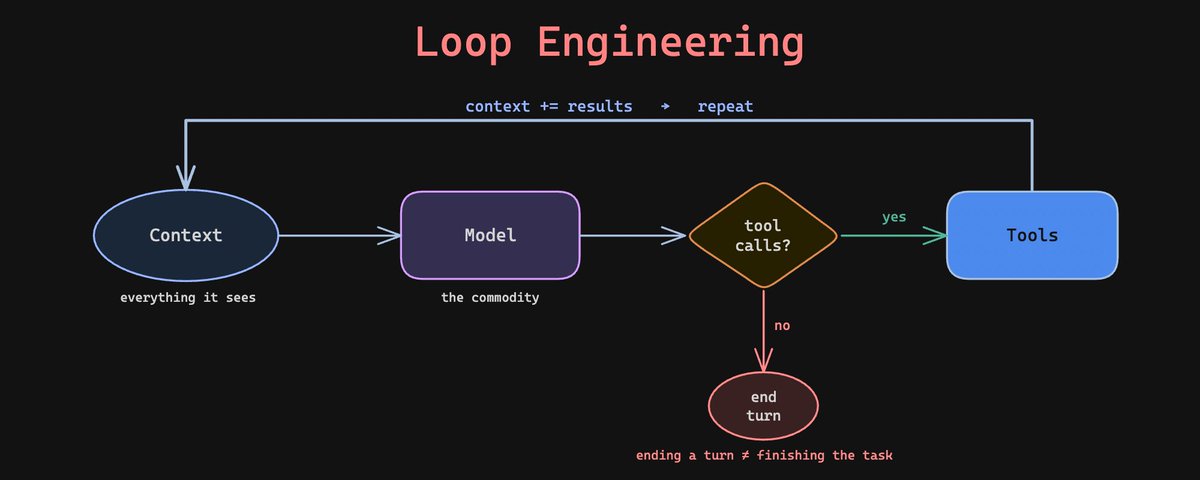
An agent is a while loop with four layers of engineering wrapped around it:
- Prompt engineering
- Context engineering
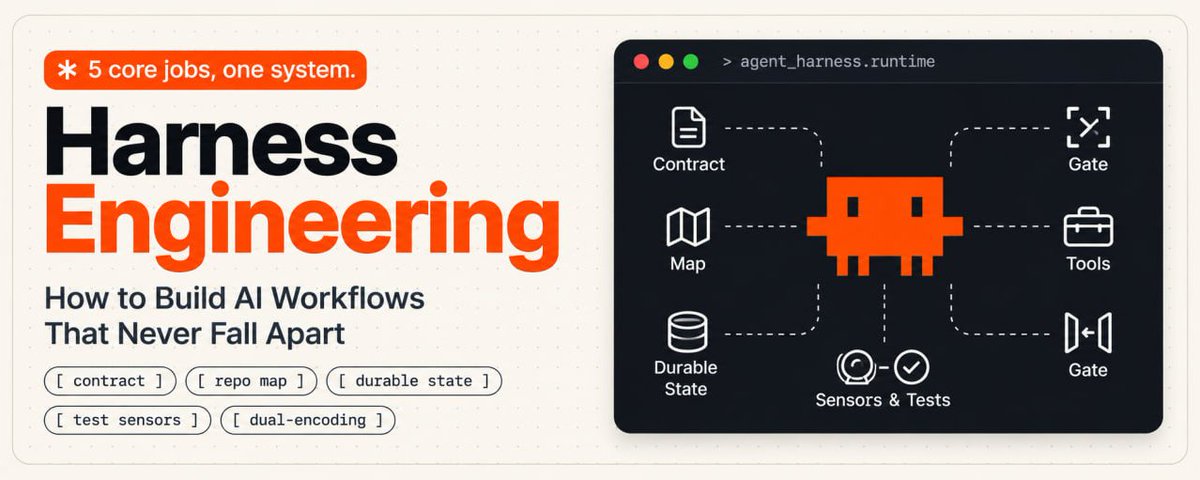
- Harness engineering
- Loop engineering
Each one wraps the last, and the model sits in the middle, so none of them compete with the others. Instead, they just zoom one level further out.
> Prompt engineering:
This defines the input the model sees on one call, often composed of a role, instructions, examples, and an output format.
The techniques here alter the internal computation and reasoning the model goes through due to the wording it sees:
- Chain-of-thought makes it work in steps before answering
- Few-shot examples define the format and the edge cases
- A JSON schema or XML tags make the output parseable by code
- Self-consistency samples a few chains and takes the majority
> Context engineering:
It's everything the model sees on a turn, not just the prompt. That includes the query, retrieved docs, memory, prior turns, and tool outputs from earlier steps.
The window is finite and fills up fast, so the engineering work is to rank inputs and cut everything that isn't pulling weight.
You do this by:
- Retrieving only the chunks relevant to the query, then reranking them
- Keeping key facts out of the middle, where accuracy drops
- Summarizing old turns, evict stale outputs, push big blobs to files
> Harness engineering:
It's the code around the model that defines the tools, parses the calls, retries on failure, and can route work to sub-agents so one handles retrieval and another handles code.
A verifier then grades the result by running tests, validating a schema, etc.
Prompt and context involve getting one call right. The harness involves everything that has to happen around that call for it to run in a real system.
> Loop engineering:
In the usual setup, you manage the outer loop, i.e, you write a prompt, read the turns the agent runs, write the next prompt, and repeat, while catching failures.
This layer hands that job to the agent itself. It kicks off on a schedule or an event, and runs many turns with no prompt in between.
A loop inherently doesn't know when it's finished. An agent can report that it's done and halt while the tests still fail. So the stop can't be the agent's word, but rather it has to be a real signal, like:
- A turn and token cap to stop stuck runs
- A no-progress detector to catch repeated calls
- A completion check to verify the goal with a separate model or a deterministic test
By this layer, you're operating on the whole run, so the engineering moves from writing each prompt to setting the goal and the stop conditions up front and letting it run.
If you want to dive deeper into loop engineering, my co-founder wrote a full breakdown of that outer loop.
It goes from the basic while loop to a run that finishes on its own, with the code behind each part, and the parts that are hard to get right, like knowing when to stop, context rot over a long run, and keeping the checker separate from the maker.
Read it below.
Hill Hung retweeted

我推荐这个网址:
loops.elorm.xyz/
收录了几十个大神的
loop engineering的思路

Loop Engineering 精华文章汇总!
2026 年 Agent 开始聚焦在长任务后,重点慢慢变成了:
如何设计一个能够持续思考、执行、观察、验证和演进的循环系统?
从 Codex 到 Claude Code,从 OpenHands 到各种 Coding Agent。
业余项目和生产级系统之间最大的差距是Harness 工程,包括 Loop。
Agent 能不能持续工作几十分钟甚至几个小时?
能不能在失败后恢复?
能不能控制成本?
能不能知道什么时候停下来?
这些问题,最终都落到了 Loop 设计上。
📚 推荐阅读
1. Loop Engineering — Addy Osmani
addyosmani.com/blog/loop-eng…
2. Loop Engineering — Firecrawl
firecrawl.dev/blog/loop-engi…
3. What Is the AI Agent Loop? — Oracle
blogs.oracle.com/developers/…
4. Harness Engineering — OpenAI
openai.com/index/harness-eng…
5. Harness Engineering for Coding Agent Users — Martin Fowler
martinfowler.com/articles/ha…
6. Agentic Loops: From ReAct to Loop Engineering
datasciencedojo.com/blog/age…
7. Loop Engineering for AI Agents (Memory-First) — Mem0
mem0.ai/blog/loop-engineerin…
📄 推荐论文
1. Agentic Harness Engineering
arxiv.org/abs/2604.25850
2. From Agent Loops to Structured Graphs
arxiv.org/abs/2604.11378
🛠 推荐研究的开源项目
Codex CLI
github.com/openai/codex
OpenHands
github.com/All-Hands-AI/Open…
PydanticAI
github.com/pydantic/pydantic…
OpenAI Agents SDK
github.com/openai/openai-age…
重点研究:
Loop 如何运行
Loop 如何停止
Loop 如何验证
Loop 如何恢复
Loop 如何调试
Prompt 决定 Agent 如何开始。
Context 决定 Agent 能看到什么。
Loop 决定 Agent 最终能走多远。
Loop Engineering:
Think
↓
Act
↓
Observe
↓
Verify
↓
Evolve
↓
Repeat
你设计循环。
Agent 在循环中持续改进。
每完成一次循环,系统都会比上一次更接近目标。
Agent 从来不缺 Loop。
缺的是 Loop 的工程学。


Hill Hung retweeted

ZOZO(日本最大服装电商)开源了他们内部的物理仿真接触求解器 ppf-contact-solver。
这套工具专门解决布料、绳索、软体在仿真中的碰撞接触问题,能保证完全无穿透、面料拉伸严格不越界(不会像游戏一样穿模),单个场景能处理超过1.8亿个接触点,有Blender插件。
Github:github.com/st-tech/ppf-conta…
Hill Hung retweeted

🚨 Anthropic just showed a 27-minute workshop on how to actually do prompts for Claude.
Taught by the people who built it.
Free. No registration. No paywall.
I've seen $300 courses that don't cover what they teach in the first 8 minutes.
Watch it and bookmark it now.


Hill Hung retweeted

Claude Code can now autonomously test your entire iOS app.
Every screen. Every flow. Debug logs included. Structured bug report at the end.
One prompt. No scripts. No setup.
Hill Hung retweeted

You can now 'inspect element' for any iOS app directly in Codex or the browser!
~ / npx serve-sim
S/O @rounak for the contribution 🚀
Hill Hung retweeted
Adding iOS simulator to your favorite editor:
✓ Codex
✓ Claude Code
→ and now @cursor_ai
Hill Hung retweeted

AVD (Animated Vector Drawables) exist since Android 5.0 - still underused
Devs just don’t know where to get good animated icons
We fixed that
Built together with @romankhrupa
Vector Motion Kit - ready-to-use animated icons for Android
More coming
vectormotionkit.web.app/