

We modernize complex digital systems into clear, scalable interfaces through UX, Design Systems, AI-powered delivery and development.
Lisboa
Joined March 2015
- Tweets2K
- Following2.1K
- Followers685
- Likes445




A question worth asking internally: how long does it take your team to notice an AI agent went off-script? That number matters more than how often it happens.
74% of enterprises have pulled a live AI agent back out of production, and that number is higher among the ones with the most mature governance. We read that as a maturity signal, not a failure one. Visibility into what your AI touched is the real product.

We talk to a lot of CIOs who treat a rollback as something to hide from the board. In our experience it's usually the opposite: catching a problem early is a sign the guardrails are working, not that something went wrong.

A simple test we like running with clients: can you name, in one sentence, what business outcome your AI investment is supposed to move? If not, that's usually where the real work starts, before any new tooling.

AI spending jumped from 1% of revenue to 3.3% in a year. BCG found that pairing it with real strategic clarity produces 5x the value of applying AI alone. We help CIOs close that gap: hi-interactive.com/interface…

We're seeing AI budgets climb fast across client conversations this quarter. The real signal to watch isn't how much gets spent, it's whether anyone can say in one sentence which P&L line that spend is supposed to move.

If you want to see where your organization stands on interface debt, the calculator takes two minutes: hi-interactive.com/interface…. Happy to walk through the results with you too.
Governance, AI engineering, and customer apps work best as one connected system, not three separate initiatives. Start with a source of truth, then layer AI and governance on top. Curious where you're at: hi-interactive.com/interface…
The more we look at this, the clearer it gets: interface governance, AI engineering, and customer-facing apps aren't three separate problems. They're one system, and the CIOs ahead of the curve are already treating it that way.
Going from 3 sprints to 1 didn't mean cutting corners on compliance. It meant stopping design and compliance reviews from running as two separate systems. Worth checking if that's happening on your team too.

One of our favorite examples: a financial institution we partnered with brought release cycles from 3 sprints down to 1, simply by treating design and regulatory compliance as one review instead of two. Small shift, big impact on delivery speed.

Our honest take: customers rarely leave because an app looks outdated. They leave when every release quietly adds a bit more friction. We think interface consistency will become a metric CFOs care about as much as designers do.

A question we like asking teams shipping AI-generated components fast: can anyone explain why two similar ones look different? If not, that's worth a look, not because it's a crisis, but because it's an easy fix early on.

In our view, AI is a great accelerant for interface development, as long as governance keeps pace with it. Building against a shared source of truth, with compliance checks built into generation, is how teams get the speed without losing control.

Our take: in the next 18 months, the CIOs who come out ahead won't be the fastest to adopt AI code generation. They'll be the ones who pair that speed with strong governance from day one.

We've noticed the oldest part of a company's interface layer is often the one nobody talks about, yet it quietly shapes every new decision. What's been true in your experience?

In our experience, the smoothest transformations treat the interface layer as its own asset early, before anything else gets built. See what that could mean for your organization: hi-interactive.com/interface…
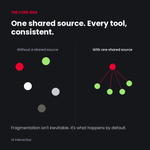
The more time we spend with enterprise clients, the clearer this gets: the source of truth for your interface layer matters more than the tech stack sitting on top of it. Getting governance right early saves years down the road.

Modernization doesn’t always mean replacement.
For Efacec, we created a unified interface that simplifies complex workflows while preserving the knowledge and capabilities already embedded in existing systems.
Read the case study:
hi-interactive.com/work/unif…

