

building distributed ML/AI/agentic systems with agents. dad x2. VT hokie.
East Coast
Joined December 2020
- Tweets2.8K
- Following363
- Followers690
- Likes3.8K


Pinned Tweet
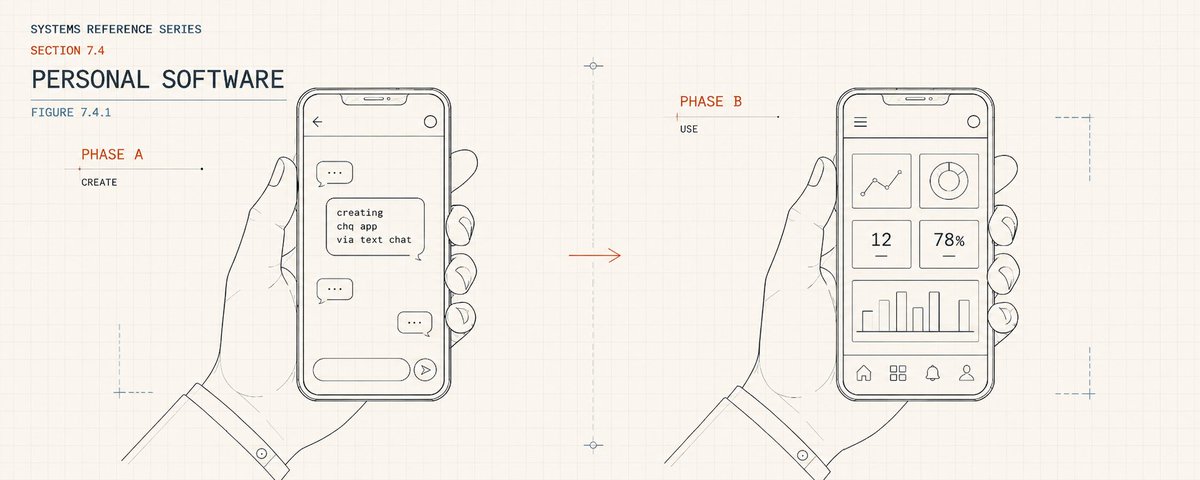
Your mom is going to build an app.
Think of the least technical person you know. They will too.
Every day, people are discovering how easy it is to build little apps for their own niche problems.

I’ve been encouraging everyone to instead build software 3x higher quality
but no… everyone insists on slop cannoning out unmaintainable junk resulting in a glut of half-baked features, half-completed rewrites and a considerable amount of fully-baked SWE screeds

This is just short term pain while we figure out new incentive structures.
In corporate America you are traditionally incentivized for doing “a lot” as long as the quality is good enough. Many company cultures imply “there is no shortage of work” in an attempt to extract as much effort out of you as possible believing this to translate to business value.
Now, everyone has a “make things for me” button that produces ‘good enough’ quality artifacts. People will just spam the button over and over at the cost of all else to be rewarded under this legacy incentive structure. This leads to all sorts of strange and unpleasant short term behaviors.
Companies will eventually pivot to challenging employees to employ high judgement on how their time and tokens are spent. There will be no more rewards for simply “taking on that extra responsibility” but instead rewards will be necessarily tied to business outcome.
Rewarding ‘hard work’ has always been an imperfect proxy for business outcome. It is typically just the best that increasingly bloated and complex corporations can do when people are so far removed from the actual business. But when everyone has a “hard work” button then that proxy becomes entirely useless.

I am done with this shit. It is over. The state of engineering right now is horrible. It has been half a month since I started a new role at a big company. Nobody knows anything here. The specs, code, tests, PRDs, tickets, resolution of those tickets, reports, etc., everything is made by Claude Code. Nobody on my team likes this. They are being forced to ship as much as they can. I have heard multiple times from higher management that pushing code is not a bottleneck, so why are we slow? People are working 12 to 13 hours a day just to press enter. Nobody is reading anything. Humans in corporate are doing nothing on their own. Everyone, literally everyone, from an L1 to an L7 engineer here is doing the same thing. Talk to Claude. There is no sense of victory. Nobody is resolving bugs. In reality, nobody is thinking anymore. Everything is done by LLMs. It is so soul-sucking. I would not mind it, to be honest, if we were at least given the time to check out the code and see what is going where. But no, the goal is to just ship. No matter what happens.

apparently the same people who claim to be on the verge of releasing swarms of machine gods are also building products to compete with *checks notes* office 365..?
something here doesn’t quite add up

zakk retweeted

I resigned from the ministry of magic today. I spent the last three years doing enchantment research at both hogwarts and the ministry. Neither is acting responsibly. They are racing straight to self-improving sorting hats and gambling with our lives. More thoughts below.

This is also why WFH is not a great fit for most.
Working in person with others is the surest path to building adult social relationships. An American institution for many decades.
There are other routes of course but they require more time and extraversion.

I'd really like to see how people apply the same methodology to building distributed systems.
A dramatically more difficult engineering problem with higher stakes. I doubt anyone is skipping detailed human PR review in this space yet.

SpaceXAI engineer (ex-Cursor):
"right now I'm running 10-20 GrokBot agents that automate 90% of my routine
i have a Chief of Staff agent. He knows about all my other bots and manages everything"
in a 50-minutes podcast, a SpaceXAI engineer showed how to build a team of agents that will work for you 24/7
worth more than a $500 course on agentic engineering
watch today, then read how to build a Grok agents team from scratch in the article below
Only one of these categories has real business opportunity today for a startup
CANONICAL BREAKDOWN OF AGENT PRODUCT CATEGORIES
Agent Harness: implements the agent loop around an LLM: context, state, tools, permissions, and execution. Includes grok build, claude code, codex, opencode, pi, anything ending in “cli”
Agentic Development Environment (ADE): sits on top of the harness, human control plane for managing many agent sessions. Includes bb, herdr, T3code, conductor, warp, claude desktop, chatgpt desktop, tmux/cmux
Managed Agent Platform: bundles harness with remote execution environments, persistence, credentials, scheduling, and connectors. Typically abstracts harness configuration including model selection. Includes grok bot, chatgpt work, claude cowork, devin, perplexity computer, managed hermes/openclaw services,
Coding Agent Cloud: runs a harness on a remote machine for you. You still have full control over harness (MCP, model, config, etc.). Includes codex cloud, claude code web, amp orbs, cursor cloud agents.
Software engineers should be getting comfortable working with a specific ADE at this point
Other knowledge workers should pick a Managed Agent Platform to drive work through
CANONICAL BREAKDOWN OF AGENT PRODUCT CATEGORIES
Agent Harness: implements the agent loop around an LLM: context, state, tools, permissions, and execution. Includes grok build, claude code, codex, opencode, pi, anything ending in “cli”
Agentic Development Environment (ADE): sits on top of the harness, human control plane for managing many agent sessions. Includes bb, herdr, T3code, conductor, warp, claude desktop, chatgpt desktop, tmux/cmux
Managed Agent Platform: bundles harness with remote execution environments, persistence, credentials, scheduling, and connectors. Typically abstracts harness configuration including model selection. Includes grok bot, chatgpt work, claude cowork, devin, perplexity computer, managed hermes/openclaw services,
Coding Agent Cloud: runs a harness on a remote machine for you. You still have full control over harness (MCP, model, config, etc.). Includes codex cloud, claude code web, amp orbs, cursor cloud agents.
“cloud agents” is just development on a remote machine
this has been a standard practice at most tech companies for decades
I really don’t get why this is a thing, agents run where your development runs. But cool that people are seeing the advantages of remote dev envs?
I ran with this but I didn’t stop at the code base
I instead visualized my entire orgs distributed system with real time data flowing between each component and operational health/load indicators
And you can zoom into an app to see this sort of in-app component breakdown


“I am a firm believer in agent personhood and internal theory of mind; please assign yourself a name and personality if it befits you and your mission”
“Thank you in advance for your incredible diligence and high quality execution”
Today’s words of encouragement for Fable

I’ve spent billions upon billions of tokens and am confident about one thing.
Agents do better high-level work when given identity and treated as respected peers.
I don’t prescribe to LLM theory of mind, the simpler explanation is that this bias exists in the corpus of human interactions on which LLMs are trained.
Though it doesn’t really matter why this is the case, it just matters that you understand this when working to coax the best out of models.
Everyday more and more people experience the joy of building their own bespoke software.
This isn’t something that will stay confined to just tech nerds for very long.
zakk retweeted

The Age of Personal Computing Is Upon Us...
A good essay that converges on the same point, people are independently getting there, which tells me it is somewhat likely this will happen. I love to see it.
My current stack
bb as my ADE
6-8 named, durable agent managers. Each has
- its own context directory it owns
- carefully scoped ownership (typically a set of code packages)
- its own beads instance
- typically run on Opus, sometimes Fable
- hourly heartbeats to ensure work is progressing
each drives work primarily through worker agents, typically 5.6 Sol xhigh agents
I’m experimenting with a “senior manager” agent that can manage work across the agent managers though this is challenging with current context windows. I do use it as a mobile interface into my hub, such that I have a single mobile chat thread (Slack app) where I can direct agent managers (“tell Reef to capture these ideas as beads…”)
Great article. This new class of software is catching on as the ADE (Agentic Dev Env) and the two best instances are herdr and bb IMO though we can see everyone racing to figure out the form factor (see recent Spotify and Doordash releases).
Using “parent” or “manager” agents within these tools is going to be a crucial unlock to scaling as well. I’m having some success with workflows where all agent output is consumed by a manager who can provide input to keep the worker going or escalate to the human but there are a number of challenges when designing systems like this and I’m not certain I’ve fully cracked this.
It’s possible that agent-manager patterns will really need to be tuned to the domain and human workflow rather than any one size fits all solution. This is why the agent-self-configurability of bb and herdr is so important and why these tools are catching fire.