

@helloluis
Account based inPhilippines
About this account
- Account based in
- Philippines
- Connected via
- Philippines Android App
Account-level information from X, not a live location or the device used for a specific post.
Crypto author, artist, and entrepreneur. Building small AI models at https://nitter.cf/t.co/e96aCGLuXf ❤️🇵🇭
Philippines
Joined April 2007
- Tweets13K
- Following3.7K
- Followers17.9K
- Likes7.7K









Kicking off Hiraia pilot #3 this week at Daanghari Elementary School 🏫 thanks for making this happen so quickly Marco M and Sabrina O ❤️🇵🇭
Check us out at hiraia.org to follow our progress!
Supported by @tether @qvac @YGGAlerts ❤️❤️❤️


Luis Buenaventura retweeted

Dusting off this tweet from April because this gap in shared understanding of LLM capability is *widening*. It's now less "two groups of people speaking past each other" and more a sharp funnel.
- Napkin math somewhere around 6B people (~75% of the population) have barely come in contact with LLMs at all.
- Around 1-2B (~20%) are casual and infrequent users of free-tier ChatGPT-like products. This group sees derpy chatbots and treats them a bit like a better Google search, a writing aid, or etc. Maybe an agent tries to book you a flight. I have non-tech friends who (reasonably, imo) say they have not much use for it at all. Even many professionals outside of math&code are in this tier. For example, execs and many other functions spend a lot of their time talking to other people, so while they understand what is happening intellectually, it is still second-hand and a bit abstract.
- Now we get to professional use of frontier-grade LLMs in math&code. Somewhere around 20M people (0.2%) see first-hand that large, complex projects that used to take them weeks/months can now be completed by agents with a prompt. Building apps, copying apps, translating apps, decompiling apps from binaries... This has all happened very quickly and recently - less than 1 year ago, I was writing code manually by hand, typing memorized computer code commands into a code editor character by character, occasionally pressing Tab to autocomplete a little chunk of code.
- And finally we get to the ~5,000 people (~0.00006%) with access to frontier-grade systems internally. The external world has seen the preview. It looks like swarms of thousands of agents collaborating over weeks on software mega projects: minting zero days, running cyber attacks and defenses at machine speeds, discovering new science, advancing the frontier of mathematics. Things that would have taken top professionals in the industry years of work. Meanwhile, human review and comprehension are starting to fall behind. For example, people are still involved in the "archeology" of the OpenAI-HF incident from many months ago. Mathematicians may be poring over the 722 manuscripts on frontier mathematics for a while.
The funnel is driven by a combination of factors:
1. The impact scales with ambition, problem size, and horizon. A question with a paragraph answer barely stresses the system. You need a reservoir of big, difficult problems that you really care about. This aspect drives the consumer / professional dimension of the funnel.
2. The jaggedness of the system (which I have written about a lot separately). Capability peaks in domains that are digital, verifiable and economically valuable. This is because LLM capability emerges from reinforcement learning on verifiable rewards on a curated environment mixture driven by revenue potential. This aspect primarily drives the area (e.g. math&code) dimension of the funnel.
3. Access. Free-tier, paid-tier, internal.
So this is the weirdness of the moment. The general public has mostly not interacted with these systems. When they have, it looks like a derpy chatbot. The majority of professionals still see only a modest uplift. And a small sliver of professionals are experiencing the vertigo of the curve going vertical. And it is all happening at the same time.

Judging by my tl there is a growing gap in understanding of AI capability.
The first issue I think is around recency and tier of use. I think a lot of people tried the free tier of ChatGPT somewhere last year and allowed it to inform their views on AI a little too much. This is a group of reactions laughing at various quirks of the models, hallucinations, etc. Yes I also saw the viral videos of OpenAI's Advanced Voice mode fumbling simple queries like "should I drive or walk to the carwash". The thing is that these free and old/deprecated models don't reflect the capability in the latest round of state of the art agentic models of this year, especially OpenAI Codex and Claude Code.
But that brings me to the second issue. Even if people paid $200/month to use the state of the art models, a lot of the capabilities are relatively "peaky" in highly technical areas. Typical queries around search, writing, advice, etc. are *not* the domain that has made the most noticeable and dramatic strides in capability. Partly, this is due to the technical details of reinforcement learning and its use of verifiable rewards. But partly, it's also because these use cases are not sufficiently prioritized by the companies in their hillclimbing because they don't lead to as much $$$ value. The goldmines are elsewhere, and the focus comes along.
So that brings me to the second group of people, who *both* 1) pay for and use the state of the art frontier agentic models (OpenAI Codex / Claude Code) and 2) do so professionally in technical domains like programming, math and research. This group of people is subject to the highest amount of "AI Psychosis" because the recent improvements in these domains as of this year have been nothing short of staggering. When you hand a computer terminal to one of these models, you can now watch them melt programming problems that you'd normally expect to take days/weeks of work. It's this second group of people that assigns a much greater gravity to the capabilities, their slope, and various cyber-related repercussions.
TLDR the people in these two groups are speaking past each other. It really is simultaneously the case that OpenAI's free and I think slightly orphaned (?) "Advanced Voice Mode" will fumble the dumbest questions in your Instagram's reels and *at the same time*, OpenAI's highest-tier and paid Codex model will go off for 1 hour to coherently restructure an entire code base, or find and exploit vulnerabilities in computer systems. This part really works and has made dramatic strides because 2 properties: 1) these domains offer explicit reward functions that are verifiable meaning they are easily amenable to reinforcement learning training (e.g. unit tests passed yes or no, in contrast to writing, which is much harder to explicitly judge), but also 2) they are a lot more valuable in b2b settings, meaning that the biggest fraction of the team is focused on improving them. So here we are.


Luis Buenaventura retweeted

You can now run one AI model across the GPUs of your devices, whatever operating system they run: macOS, Linux, Windows, Android or iOS.
In the video, Qwen3.6-35B-A3B, a 21 GB model, runs across a Samsung S25, an iPhone 16e and a MacBook Pro. None of them could load it alone (8 GB of memory on the iPhone, 12 GB on the S25, 16 GB on the MacBook), so each device takes a slice of the model, and together they answer four prompts at once.
A Linux laptop and a Windows PC can pool their memory the same way. It's in the QVAC SDK 0.21, free and open source.
Built on llama.cpp's RPC backend, thanks to @ggerganov and @rgerganov. @digitalix, want to try it on your Macs?
How it works ↓
Luis Buenaventura retweeted

People saying "it's worse than Qwen3.6 35B" don't understand that support comes from the bottom. If we don't support the local AI ecosystem, no matter the stage, no matter the location, we're always going to fall prey to "yeah but America/China does it better". Those who tried to build something the day GPT tool calling came out (🖐) know very well the pain of getting malformed tool calls and the model going haywire with the most trivial requests. That was just 3 years ago. Today you can run an even better model on a laptop.
I'm a huge fan of frontier labs, they are the pioneers of what we have today and I'll forever be grateful, but local AI is one of the most important (and frankly exciting) challenges of this decade. We're all in it together. Supporting each other is the least we can do. So congrats on the release! 🇪🇺

Luis Buenaventura retweeted

All-nighter at the Avtica Programmable office, Makati. 🌙
@DEVCONPH hosts the first Hermes Overnight Hackathon: Pinoy geeks building agentic AI on Hermes Agent by @NousResearch till sunrise.
Thanks to sponsors @Avtica & @AmihanGlobal!
#DEVCON17 #HermesAgent #AgenticAI

It is kinda insane what you can do with frontier models these days. Two days ago I got feedback from the Better World Smokey Mountain team that it'd be good if Hiraia worked on ChromeOS or Windows 11, since schools often received donations in the form of Chromebooks or used Windows laptops.
Well, it turns out you can just one-shot stuff like that these days and have a frontier model deliver a preview build in less time than it takes to travel from Fairview to Taguig 😅 Note that these weren't just different platform architectures (ARM/Intel). Even the user interaction had to be adjusted to take advantage of the larger horizontal screens.
And it did it all while I was busy in meetings and calls ... maybe 5h total for both ChromeOS and Windows editions ... and only asked for my input when it was ready to publish to the Hiraia.org website.
@qvac @tether


Luis Buenaventura retweeted
QVAC's mission is to make intelligence a universal right, not a subscription. Our AI runs on your phone or laptop, and it is open source so you can verify it.
@paoloardoino expects 70% of everyday AI tasks to run locally in three years.

After talking to several public school administrators and principals over the last month, I hear the same story over and over: lots of AI brands have pitched their solutions this past year, but none of them work without a constant Internet connection.

Sometimes only local AI can solve the problem. Hiraia.org is a good example: an AI tutor now in pilot in a second public school in the Philippines.
Cloud AI needs a stable connection and a subscription, which is exactly why public schools struggle to adopt it. QVAC solves this.
Kicking off my second Hiraia.org pilot at Better World Tondo in the heart of Manila today.
Pretty cool how quick the market validation is: our public school systems struggle to adopt modern AI solutions because they're primarily internet-dependent and subscription-based, and Hiraia is neither!
Thanks to Exec Dir Jaton Zulueta and team for taking a chance on this, and thanks to my donors @gabusch @YGGAlerts , @tether, and @qvac. ❤️🇵🇭
Check out Hiraia.org to track our progress as we roll out to more schools across the country!


Luis Buenaventura retweeted

“Local models are useless”
Comes from the same place as “Bitcoin is useless”
Someone who has never had to deal with censorship, surveillance, deplatforming, theft, or states and corporations stopping them from what they want to do
Local models and Bitcoin are freedom tools
💪
Thanks for the coverage, GadgetPilipinas!
Decentralized free science education for kids at hiraia.org ♥️🇵🇭
@qvac @tether @YGGAlerts

Luis Buenaventura retweeted

Using AI to help kids with basic education is a very worthy goal!

And here I thought that first batch of Hiraia.org phones was a lot to handle. This next batch of donated devices is so big that I'm gonna have to build an Android device provisioning pipeline to set them up automatically ... otherwise I'll be sitting here tapping screens all week.
These are enough phones for my next 2 pilot school cohorts, the first of which I'm meeting up with this week!
Big thanks to @gabusch and @YGGAlerts for making this happen so quickly ❤️🇵🇭
@qvac @tether

And here I thought that first batch of Hiraia.org phones was a lot to handle. This next batch of donated devices is so big that I'm gonna have to build an Android device provisioning pipeline to set them up automatically ... otherwise I'll be sitting here tapping screens all week.
These are enough phones for my next 2 pilot school cohorts, the first of which I'm meeting up with this week!
Big thanks to @gabusch and @YGGAlerts for making this happen so quickly ❤️🇵🇭
@qvac @tether
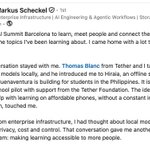
1) Hiraia isn't a flashy, exciting AI application (you'll never see any of its actual beneficiaries talking about it online) but I'd argue that it's more necessary now than ever, so these little bits of coverage means a ton ❤️
2) That AI Summit sounds like a blast! Hopefully I'll have more flexibility to attend next year and share what I'm doing with Hiraia in person 🌞
#AISB26 @qvac @tether

Images from this morning's Hiraia launch at Calapacuan Elementary School in Zambales, Philippines ❤️🇵🇭 Possibly the first decentralized AI education app deployed with an academic institution on this side of the world, and it's built with the @qvac SDK and supported by a grant from @tether. Now the real work begins!
Download the student and teacher app combo at Hiraia.org and pls follow me if you wanna check out our progress over this first semester.
@paoloardoino @Yummyfunduk
@shawnyao @gladstein – at Subic, Central Luzon


