

PI of manatee lab, Univ Miami
Miami, FL
Joined February 2012
- Tweets117
- Following239
- Followers326
- Likes703

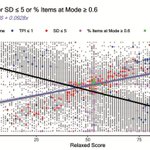



Very excited for this paper to be out in which we continue to use very personally meaningful real-world events to understand emotion and cognition: Expectations are not stable in systematic ways and this has systematic consequences. Great work by @BillyVillano

Many of us deal with uncertain waiting periods by bracing for bad news. But does this buy us any relief when bad news arrives?
Short answer: Yes, but only briefly; and it can have unexpected consequences.
New work out in @PsychScience: bit.ly/3xzX72F
(More below 🧵👇)

Aaron Heller retweeted

Many of us deal with uncertain waiting periods by bracing for bad news. But does this buy us any relief when bad news arrives?
Short answer: Yes, but only briefly; and it can have unexpected consequences.
New work out in @PsychScience: bit.ly/3xzX72F
(More below 🧵👇)
Aaron Heller retweeted

Did it!!!!! Successfully defended my dissertation last week ❤️still feels pretty surreal. Dr. Puccetti in the house!!
The third MANATEE PhD 🌴 🌊 🌞 with the invaluable support of @helleryeahz


Aaron Heller retweeted

🎉 New review article! 🎉
Computational models of subjective feelings can help us understand subjective psychiatric symptoms. By @ChangHaoKao1 @gloriawfeng @jihyuncindy_hur @huwbris in Neuroscience & Biobehavioral Reviews! doi.org/10.1016/j.neubiorev.…🧵👇1/n
Aaron Heller retweeted
Excited to share that new work with @helleryeahz, @arossotto, @BrittJaso, Noah Kraus, and Rick Reneau is now published in @ScienceAdvances:
“Individual differences in naturalistic learning link negative emotionality to the development of anxiety”
(1/11)

Pessimistic learning tendencies could indicate a risk for developing anxiety, a real-world study involving 625 college students suggests. scim.ag/15u

Aaron Heller retweeted

Momentary mood fluctuations reflect the recent history of rewards, as shown in our previous lab studies (e.g., doi.org/10.7554/eLife.57977 )or in the real world (@BillyVillano @helleryeahz doi.org/10.1037/xge0000740) 2/13
Excited to share this new work from the @manateelab with @BrittJaso and @NoahKraus8 in Psych Methods: bit.ly/3uao07q 'What makes for a careless EMA response?' Using >18k EMA we identify 3 features that researchers should consider alongside a new R-package: EMAeval 1/n
Lastly, we introduce an R-package: EMAeval (github.com/manateelab/) to run on your EMA data to flag careless responses. We also describe how to run these scripts during data collection so you can contact participants to enhance data quality. 5/n
Great timing with the @HiTOP_system meeting going on, for our work linking EMA metrics of daily affect and #hitop spectra and sub factors to come out in Journal of Abnormal Psych. doi.org/10.1037/abn0000670 with @puccetti_nikki @CaitlinStamatis and @TimpanoKiara
We also used an EMA cleaning algorithm we developed (github.com/manateelab/EMAeva…; more to come on that) to remove plausibly careless EMA responses.

non-paywalled version of the article for those interested: manateelab.org/wp-content/up…
Aaron Heller retweeted

How the amygdala responds to viewing negative and subsequent neutral stimuli may impact our daily mood, according to new #JNeurosci research from @puccetti_nikki, @helleryeahz et al. @manateelab.
jneurosci.org/lookup/DOI/10.…

I can't wait to get my APA member exclusive rate on @people mag to find out what's going on with Hugh Jackman. New Wolverine flick coming out?
