
Building @VinciPhysics, @StanfordEng PhD'15
Redwood City, CA
Joined February 2015
- Tweets246
- Following1.6K
- Followers879
- Likes2.4K




Pinned Tweet
Every major AI shift started with a new kind of world model.
Language. Vision. Code.
The next one is physics.
@saucentoss and I published a paper today defining what a real foundation model for physics has to be and why it enables Continuous Physics Reasoning.
If AI is going to help build the physical world, the bar has to be much higher.
Link to full paper: vinci4ddev.wpenginepowered.c…
New this week, deployed to all Vinci users:
Via-level (TSV) mechanical stress.
End-to-end inference time scales with GPUs.
Geometry processing and meshing are inside that number.
Add compute, get answers faster. That’s a different operating model for hardware teams.


We had a great convo with Bernard Murphy at SemiWiki, @DanielNenni.
Here is a snapshot of the @VinciPhysics platform running a 2B voxel thermal problem in an OAS file from @tinytapeout, going from geometry processing to a converged result in 111 seconds on a single GPU card! That's less than $0.10 in compute cost, no fine-tuning, no manual work; it just works, like Physics in this universe, it just happens! 💥
Read more at: semiwiki.com/3dic/372435-opt…


Last week, @VinciPhysics crossed an important milestone: 100,000+ converged physics simulations by one engineer in 24 hours.
At a Tier-1 semiconductor company, from file ingestion to meshing to convergence, end-to-end on a single 8×NVIDIA H200 node.
At $3/GPU-hour, that’s under $600 of compute and less than 0.6 cents per simulation.
This is Continuous Physics Reasoning in action, scaling linearly to billions of voxels.
Vinci turns compute capacity into scalable physics reasoning capacity.
Physics is an essential modality to reason through for every phase of the hardware design to production to operation life cycle.
Understanding Physics has been too slow, too specialized, too expensive. So teams design around scarcity by simplifying early, adding margin, waiting for simulation, validating late, discover risk downstream. The cost is time to market and performance.
@VinciPhysics we are obsessed with integrating physics in design workflows for our customers but also how inference compute scales as a function of context query – in physics it is the # of voxels and fields.
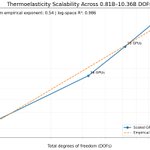
We observe linear scaling at the time of inference up to 3.3 billion voxels, predicting 3 fields per voxel (>10 billion FP64 predictions) across multiple GPU cards.
We're excited to push towards more context and faster inference on absolute wall clock time so our customers can make better physics decisions on demand and ship better products faster!

On the @Ai4 stage this week, I joined @InhiChoSuh and @SreekanthAnnapureddy to talk about world models — and what changes when AI can move beyond describing reality to reasoning about cause and effect within it.
Our conversation moved across automotive, infrastructure, and — inevitably — hardware.
Different industries. Same underlying shift: using models to reason about how systems will behave before those systems exist in the physical world.
Hardware sets a particularly unforgiving bar for that idea.
Plausible isn’t enough. The output has to be deterministic, measurable, and accurate enough to make a real engineering decision against it.
That is what we’re building at @VinciPhysics : the intelligence layer for hardware engineering, powered by a foundation model for physics.
The future of engineering won’t be built by models that can describe the physical world.
It will be built by models that can reason about it.
At @Ai4 2026 in Las Vegas this week.
Everyone is building world models. Very few are asking the harder question: what does it actually take for AI to reason about physical reality with enough rigor to support decisions that cost millions to get wrong?
The semiconductor industry has been stress-testing that question for decades. At @VinciPhysics we've been building the answer. Looking forward to discussing it with my fellow panelists on Thursday.
Most of hardware’s hardest problems are no longer design problems. They’re physics problems that surface too late to act on.
Heat, stress, and system-level constraints move across the entire stack—from chip to package to board to system. Yet simulation still arrives at the end, as validation, after the decisions that matter are already locked.
That is not a speed problem. It is structural.
Vinci is building the layer that changes it: a foundation model for physics that makes deterministic, solver-accurate reasoning available while designs are still moving.
Today, we’re solving thermoelastic analyses with roughly 1.2 billion degrees of freedom at 3 µm feature resolution—manufacturing resolution—in about 219 seconds on a single node.
This is not faster validation at the end. It is physics as infrastructure.
Because in hardware, plausible is not enough. Results must be deterministic, measurable, and accurate enough to support real engineering decisions.
The @VinciPhysics team is at @DACconference this week. Reach out if you’re ready to question whether the last 20 years of engineering workflows still make sense.
For the first time, manufacturing-resolution thermoelastic warpage analysis is computationally practical.
In the latest software release, @VinciPhysics enables this directly on native advanced package geometry:
- 1.2B degrees of freedom
- 3µm resolution
- 225°C bonding temperature
- 392µm Z-warpage
- runs end-to-end under 4 minutes
Out-of-the-box. Deterministic. Accurate. Automated.
The breakthrough is not only the runtime.
It is the fidelity of the physics analysis.
The warpage follows the actual layout, including the metal distribution, residual stress, and real geometry.
This capability has been proven with leading semiconductor and memory companies and benchmarked against production FEA solvers.
For teams working on HBM, chiplets, 2.5D/3D integration, and advanced packaging reliability, thermoelasticity no longer has to be a late-stage checkpoint.
It can become part of continuous physics reasoning while the design is still evolving.
Watch the demo: getvinci.ai/proof-library/th…

I’m at @brainstormtech, and everyone is talking about world models. The real test: a model has to be accurate at scale.
We're seeing it firsthand. Our foundation model for physics analyzed how advanced chips deform under heat for a leading US semiconductor company.
2 billion voxels, carrying geometry, materials, and predicting physics.
Inference in 290 seconds.
Accuracy validated against production data.
Works out of the box. No post-training.
AI for physics is the next frontier.
Engineering, robotics, AVs, manufacturing, energy, and the entire hardware economy will run on models that compute how physical systems actually behave.
Not approximate what they look like. Not hallucinate a plausible answer.
Predict measurable reality.
I’m in Aspen this week for @Fortune Brainstorm Tech with John Bruggeman.
AI is at the center of the agenda, but the thread I’m most interested in is what happens when intelligence has to reason through the physical world: hardware, energy, cooling, manufacturing, and infrastructure.
That is the layer @Vinci is built for.
Looking forward to the conversations at #BrainstormTech. If you're here we’d love to connect.
The world model conversation is moving quickly.
@drfeifei’s latest piece points to a broader convergence across robotics, spatial intelligence, and hardware design.
AI is moving from models that represent the world to models that compute how the world behaves.
That is why physics is the next breakthrough.
Every major AI shift started with a new kind of world model.
Language. Vision. Code.
The next one is physics.
@saucentoss and I published a paper today defining what a real foundation model for physics has to be and why it enables Continuous Physics Reasoning.
If AI is going to help build the physical world, the bar has to be much higher.
Link to full paper: vinci4ddev.wpenginepowered.c…
Continuous Physics Reasoning is not theoretical.
This week, a single engineer at a tier-1 semiconductor company used Vinci’s physics foundation model to analyze hundreds of thermal what-if scenarios.
Setup in less than a min compared to hours.
Runtime compressed in hour compared to days.
Already shipped. Real impact.
If you only find thermal issues after production, your workflow already failed.
Using Vinci, they ran 19,000 simulations and found the issue in 5 days, likely avoiding a costly re-spin.
That is not faster simulation.
It is continuous physics intelligence becoming infrastructure–– physics available through out the design process.
Yesterday, we spoke with a fabless company that described a 4–6 month thermal discovery cycle collapsing into 5 days.
They’re building a 3DIC part and hit a complex thermal issue that historically would not show up until physical production.
By then, the cost was time: 4–6 months.
With Vinci, they ran 19,000 simulations and found the issue in 5 days.
That is the shift: physics moving from late-stage discovery to early-stage design intelligence.
We’ve normalized making engineering decisions without physics in the room.
That should bother us.
Not because engineers are careless—because the workflow made it unavoidable. Physics has been too slow, too specialized, too expensive.
So teams design around scarcity:
-simplify early
-add margin
-wait for simulation
-validate late
-discover risk downstream
The real cost isn’t runtime. It’s timing—leading to respins and delayed programs.
A foundation model for physics changes this.
Physical reasoning moves into the cadence of design itself. And once physics is always available, the default flips: every design decision becomes a physics decision.
That’s the shift.
We wrote this paper to create clarity:
What qualifies as a real foundation model for physics?
What does not?
What becomes possible when physical reasoning scales?
vinci4ddev.wpenginepowered.c…
Semiconductors are the proving ground.
If a model can reason across nanometer-scale structures, advanced packaging, HBM, thermals, warpage, and chips-to-systems constraints without losing determinism or fidelity, that is a meaningful bar.
The hardest domains should come first.
Traditional simulation was built around intermittent expert workflows.
Set up the case.
Mesh the geometry.
Tune the solver.
Wait.
Interpret.
Repeat.
That worked when physical analysis could stay episodic.
It breaks when complexity, scale, and iteration volume all increase at once.
This is the shift we call Continuous Physics Reasoning.
Physical reasoning stops being something you invoke occasionally.
It becomes continuously available across architecture, design, validation, manufacturing, and operations.
Not a checkpoint. An always-on intelligence layer.