

Cornell PhD student working on ML and NLP
Joined June 2010
- Tweets27
- Following140
- Followers228
- Likes350





Gregory Yauney retweeted

Super appreciative of the recognition from #NAACL2024 — our Pretrainer’s Guide won an 🌟Outstanding Paper Award🌟🏆
This was a year long analysis into pretraining age, quality & toxicity data filters.
Gratitude to our team 🙏🏼 @gyauney @emilyrreif @katherine1ee @ada_rob @denny_zhou @barret_zoph @_jasonwei Kevin @dmimno @daphneipp
arxiv.org/abs/2305.13169

#NewPaperAlert When and where does pretraining (PT) data matter?
We conduct the largest published PT data study, varying:
1⃣ Corpus age
2⃣ Quality/toxicity filters
3⃣ Domain composition
We have several recs for model creators…
📜: bit.ly/3WxsxyY
1/ 🧵

Our Pretrainer's Guide won an ✨outstanding paper award✨ at #NAACL2024 today! Big congrats to all the coauthors, especially @ShayneRedford (who led this big project), @emilyrreif, @katherine1ee, @dmimno, and @daphneipp! Thanks @naaclmeeting!

ALT two paper authors standing next to a poster

Come talk to us about pretraining data curation at #NAACL2024 at 2pm at poster session 2! We're presenting A Pretrainer's Guide to Training Data
Paper: aclanthology.org/2024.naacl-…

Come talk to us about pretraining data curation at #NAACL2024 at 2pm at poster session 2! We're presenting A Pretrainer's Guide to Training Data
Paper: aclanthology.org/2024.naacl-…
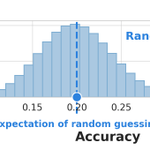
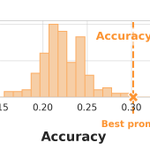
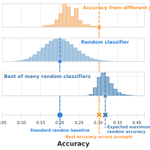
Evaluating many prompts on small few-shot datasets can make you think you’ve beaten random guessing when you haven’t! @dmimno and I study a simple drop-in replacement random baseline that protects against validation set reuse and small datasets: arxiv.org/pdf/2404.13020

This problem goes away if you have a large validation set, but for the kind of fast-moving settings where in-context learning shines, that’s not always feasible. And there’s nothing wrong with trying lots of prompts! You just have to make sure you factor that into your baseline.
In the paper, we show that this max random baseline can be a better predictor of whether the best prompt will outperform random guessing on an unseen set. You can use this baseline right away on your own classification tasks! Code: github.com/gyauney/max-rando…

I'm postering this afternoon at #EMNLP2023! Stop by if you want to talk about how Data Similarity is Not Enough to Explain Language Model Performance: arxiv.org/pdf/2311.09006.pdf. Joint work with wonderful collaborators @emilyrreif and @dmimno
Gregory Yauney retweeted
#NewPaperAlert When and where does pretraining (PT) data matter?
We conduct the largest published PT data study, varying:
1⃣ Corpus age
2⃣ Quality/toxicity filters
3⃣ Domain composition
We have several recs for model creators…
📜: bit.ly/3WxsxyY
1/ 🧵
Gregory Yauney retweeted

Data is so incredibly important to trained models. But what does it mean for data to be “high quality?” To what extent should the choice of downstream application change pre-training data selection?
We explore that in this paper led by @ShayneRedford
#NewPaperAlert When and where does pretraining (PT) data matter?
We conduct the largest published PT data study, varying:
1⃣ Corpus age
2⃣ Quality/toxicity filters
3⃣ Domain composition
We have several recs for model creators…
📜: bit.ly/3WxsxyY
1/ 🧵
Gregory Yauney retweeted

When and where does pretraining data matter? New paper on how varying the pretraining data of LLMs affects downstream performance: bit.ly/3WxsxyY
But first, what do we know about the data itself?
1/ 🧵

Using fine-tuned language models makes a hard text classification task like MNLI easy, but why? (new work with @dmimno)
Read our blog post to find out more and get code to try it out on your own data! gyauney.github.io/data-label…