


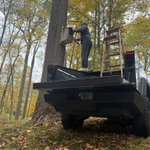


Hanging our owl box here in the hardwood forests of Connecticut. TARS and Extract height (!) in Off-road App comes in handy once again. @cybertruck @wmorrill3


Gundo retweeted

I’m on my way to the Tesla Roadster event right now. There is no embargo and we can post whatever we want when we get there, so I’ll be posting lots of photos and videos on 𝕏 in the coming hours!
Gundo retweeted

Emergency Drive Away lets you shift into Drive while still plugged into a Supercharger
Gundo retweeted

From a military pilot on today’s attempted hijacking.
I’ll sum it up for you: Hashem performed an unprecedented miracle today.

Gundo retweeted
SpaceX's Starship rocket has successfully reached orbit and deployed its V3 Starlink satellites into orbit for the first time, officially making this Starship's first revenue-generating flight, a major milestone for the company!
Congrats @SpaceX team! Incredible achievement 🚀
Gundo retweeted

In April 2009, dozens of cedar waxwings were found dead in a single yard in Thomas County, Georgia. Their stomachs were packed with one thing: small, red berries.
The birds had hemorrhaged into their lungs, tracheas, hearts and brains. It was cyanide poisoning.
A decade later the curator of the UNC Chapel Hill Herbarium found dead waxwings on campus, in sight of a large nandina planting. That's what finally prompted somebody to test the berries.
Nandina, sold as heavenly bamboo, is from China and Japan, it's invasive across the Southeast, and it's still sold at garden centers.
Most birds can detoxify small amounts of cyanide. Eat one or two nandina berries and you'll be sick for a day. Cedar waxwings don't eat one or two. They gorge on them. A flock strips a bush in minutes.
And the ripe berries release cyanide slowly as they digest. There's no warning, no bad taste, nothing that says stop. By the time it's hitting, the bird has a crop full of them.
Worse, nandina berries hang on all winter, when almost nothing else is fruiting. It's most attractive exactly when the birds have the fewest options.
If you have one, cut the berry clusters off before they ripen. That solves the problem this year.
Then dig it out. Get under the root crown and pry it up, or it comes back. Alternatively, a cut stump with a dab of herbicide will usually kill it for good.
Replace it with winterberry holly, American holly, or eastern red cedar. Red berries all winter, and waxwings are supposed to eat those.

Gundo retweeted

Steve is what I named my new Tesla Y SUV… I’m pretty sure I would be in the hospital (or worse) had it not been for Steve self-driving me home…
watch the moment in the video where self-driving ceased at the exact moment that I grabbed the steering wheel and headed for the ditch…
Steve had already decided that a head-on collision was imminent unless immediate action was taken and he had already headed for the ditch… t
Thank you @elonmusk for this remarkable vehicle.
Via Jim Attrell


Gundo retweeted

At midnight on February 6th, earlier this year, the doorbell to our apartment rang. The doorbell was followed by a pounding on the door. I answered the door and a security person in our building handed me his phone. It was my oldest daughter Eloise. She had found my 26-year-old daughter unconscious on the floor of her apartment and had called 911. The EMT team was already there, but they did not know what was wrong with Lucy or to which hospital they would take her.
I threw on some clothes and jumped in an Uber heading east toward Brooklyn. (Lucy lived alone in Williamsburg.) On the way, I learned that they were taking her to Elmhurst, a City trauma hospital in Queens. I arrived about five minutes after the ambulance to join Eloise, Lucy’s mom, and a friend, and waited to learn what was wrong.
After about 15 minutes, I asked a nurse where she was. I looked over his shoulder to his computer. Next to her name, it said “non-responsive.” I walked into the emergency room and wandered around looking for her until I found her unconscious on a gurney surrounded by several doctors and nurses.
By about 2:30am with the results from a CAT scan, Lucy’s doctors had determined that she had a massive brain hemorrhage and would need an emergency hemicraniectomy to release the pressure on her brain and remove the blood from the hemorrhage. I called our wonderful friend and family doctor Eddie Fisher and explained what was going on. He woke up Josh Bederson, Chairman of Neurosurgery at Mount Sinai, to find out more about Zach Hickman, the neurosurgeon on call that night. Dr. Bederson said Hickman was an excellent surgeon, which was comforting as we had no choice.
The surgery to save Lucy’s life began around 3:15am and finished around 5:30am. It was successful.
The following day, I joined Lucy in an ambulance while she was being transferred to Mount Sinai on Madison Avenue. Later that day, we determined from Lucy’s Oura ring that her hemorrhage had occurred around 9am, which meant that more than 19 hours had passed from the time of the hemorrhage to the completion of the surgery to release the pressure on her brain (I only wish @ouraring had an alert for this kind of a medical event. Imagine it could call a family member if the wearer doesn’t cancel the alert).
I later learned that the standard of care is not to do surgery to save a patient with a large brain bleed if more than five hours have passed since the hemorrhage. Even when the surgery is done, I was told that the likely outcome for the patient is a few months in a nursing home and death from pneumonia.
When I met Lucy’s doctors, I did my best to inspire them: “Let’s see what can be accomplished if we give her the best care possible and we invest unlimited resources to restore her to life.” And I promised that whatever we learned we would make available to everyone.
Dr. Chris Kellner, her neurosurgeon, and Dr. David Putrino, Director of Rehabilitation Innovation for the Mount Sinai Health System have led Lucy’s care team since that day. Words cannot describe the remarkable and compassionate care that she has received beginning with the EMT team and then from nurses, doctors, therapists, and the army of people who have worked to save her and return her to life. To this day, we have a daily Zoom where we discuss her progress and make adjustments to her care. While her care and oversight have been incredible, the learnings for the Mount Sinai team have also been elucidating and will assist in the care of many others.
Lucy began in a bad place. She was in a coma for several weeks and then awoke not being able to breathe on her own, unable to walk, see or speak.
Over the last six months, she has recovered her cognition – she understands everything including her circumstance – is able to walk a hundred or more steps at a time with assistance, is making progress with sounds, vowels and consonants and the beginnings of speech, but she remains unable to see.
Each day, she makes a little progress, and daily progress compounds. Every day I tell her that she just needs to make a little progress and it won’t be long before she is back.
We remain optimistic that Lucy will return to normal function. It will likely take years, but I believe it is only a matter of time, hard work, and technological progress, along with some, and perhaps a lot, of divine intervention.
Many people have been praying for Lucy and we are incredibly grateful for the prayers and remarkable support she has received. Lucy’s friends have been with her every day since the beginning, and their presence and friendship have saved her life and helped to rebuild and maintain her spirit. And on a very positive note, Lucy’s challenge has brought together our entire modern family who have all been incredibly devoted to her care and recovery.
Lucy's vision and other faculties may require some form of brain computer interface, work that is underway at Neuralink, Precision Neuroscience, Science, Synchron, Nudge, and other companies in the space.
If you are going to have a devastating brain injury, now is the best time in history for that to happen. We are living in a world when you can be confident that the blind will soon see again. We are going to do everything we can to help make that happen, including by assisting existing companies in the space.
With respect to our promise to make Lucy’s care available to others, we have made good progress. In May, a real estate colleague made me aware of a 93% vacant, brand new, 400,000 square foot Class A+ purpose-built biotech facility on West End Avenue between 65th and 66th Streets that missed the market and was available for sale. The Pershing Square Foundation acquired the building 60 days later.
We also put under contract an adjoining 130,000 square foot building at 320 West 66th Street that is currently being used by Saturday Night Live for studio space. The building has 35-foot ceilings with massive column-free spaces that can be converted into superb rehabilitation facilities. We will close on the SNL building in December.
We are also acquiring an adjoining vacant lot with additional air rights. With just the existing zoning rights, we can add a 150,000 square feet for a total of 680,000 square feet, a lab footprint larger than Rockefeller University, and that’s without including the potential for an upzoning that would allow for substantially more buildable area on the site’s 3.4 acres with spectacular views of the Hudson.
Our goal is to build the world’s greatest brain research, rehabilitation, recovery, human optimization, and longevity institute. We have named it The Ackman Oxman Institute or the AOI for lack of a better name, but also to reinforce the point that Neri and I and our family are all-in on the mission.
The AOI will be patient-centric. It will not be an academic research institute that produces lots of papers, a Nobel Prize winner or two, but little if any results for patients. We will be laser-focused on cures, treatments, devices, rehabilitation and exercise equipment, and targeted and basic research with a goal of massively accelerating the time from idea to innovation to production to helping a patient.
While the AOI will be a non-profit, it will have highly commercial instincts. The AOI will have its own venture funding and will work to develop innovations to create companies that we will seed, assist, and spinout to ensure technologies, treatments, techniques, and drugs get to patients as promptly as possible.
On one 3.4 acre campus in what is still the greatest city in the world, we will do neurosurgery, neuroscience, rehabilitation, nutrition, BCI and device development, human trials, hyperbaric oxygen treatments, and life extension programs, and we will mandate and incentivize collaboration among the teams with no silos, politics, bureaucracy, or any other constraint that is inconsistent with the mission.
Mount Sinai will be an important partner and deservedly so, but it won’t be our only hospital or medical school partner as we don’t believe any institution has a monopoly on the best ideas or the best talent. We don’t believe in exclusive relationships because that is not in the best interest of patients.
Five years ago, we considered launching a brain institute inspired by Neri’s mom who sadly died from Alzheimer’s. We couldn’t make the math work as the real estate was too expensive and we believed it would be too difficult to recruit the best talent from universities to our effort.
Since then, the real estate became available at a 70% discount, universities became a much less attractive place to work due to politics outweighing meritocracy, protests that disrupt learning, the curse of antisemitism, and a decline in funding. Fortunately, during the same time, I made sufficient personal economic progress to make the AOI possible.
The advance of AI in the last few years will also enable us to greatly accelerate our mission. AI still has a lot to learn about human intelligence and the brain, and the AOI should be at the forefront of the interplay between the brain and AI.
Today, I am making a public filing disclosing a gift from Neri and me of ~$400 million or 10,000,000 shares of Pershing Square Inc. (PS) to the AOI. It is very early days for Pershing Square so these shares are intended to anchor the long-term work of the AOI as the shares compound over time while generating what we expect will be a growing stream of quarterly dividends to fund the Institute.
We will also be announcing an additional gift of similar and potentially greater size which won’t be in the form of Pershing Square stock to provide the AOI with the short- and intermediate-term runway necessary to enable it to achieve its goal of becoming a self-sustaining institute, which reinvests all of its revenues, royalties, and the economic rewards of company formation to advance the fields of brain health and human longevity.
Neri and I have chosen to anchor the funding of the AOI to maintain vision alignment and limit the need for the organization to focus on fundraising. We expect the AOI to be the best-resourced brain, rehab, recovery, and longevity institute in the world.
We are grateful to have been able to form a board which includes Dean Kamen (our generation’s Thomas Edison), George Yancopoulus (CEO of Regeneron), James Rothman (Nobel Laureate), Bernardo Sabatini (neuroscientist), Chris Kellner (neurosurgeon), Olivia Flatto (CEO Pershing Square Foundation), Neri Oxman, and myself.
We have recently identified a CEO who we expect to announce by October along with other key hires, and are beginning searches for a Chief Scientific Officer, a Chief AI/Technology Officer, a Chief Operating Officer, a Chief Financial Officer, and other key leadership roles.
If you find what we are building compelling and want to be part of the leadership team that creates and builds the AOI from a standing start, please send an email to: search@aoiinst.org with a short note as to why you believe you can help. Please include your best three ideas for the AOI along with a summary of your background and your most important accomplishments.
We promise strict confidentiality to those expressing interest in working with us.
We have learned from Lucy that the brain can recover from even catastrophic injury. There is so much more work to be done as the mind is a terrible thing to waste.
For details from my Pershing Square SEC filing see:
sec.gov/Archives/edgar/data/…

Gundo retweeted
The IIHS has updated its Cybertruck crash test ratings, adding that the truck avoided every single pedestrian collision, including:
• Crossing child: day
• Crossing adult: night
• Parallel adult: night
Cybertruck earned the best safety rating of Top Safety Pick+, the only pickup truck to earn that award.

Gundo retweeted

251 years ago this week, a 6'2" Vermont moonshiner with no military experience and no authorization from anyone captured the most strategically important fort in North America at dawn, and accidentally won the Revolutionary War before it had really started.
It's May 1775. Lexington and Concord happened three weeks ago. The colonies have muskets but almost no cannon. The British, sitting in Boston, have plenty. Everyone knows that without artillery, the rebellion is over by autumn.
Everyone also knows where to get artillery: Fort Ticonderoga. A stone star-fort on Lake Champlain, bristling with roughly 80 heavy guns. The British call it "the Gibraltar of America." It's the bottleneck of the entire continent. Whoever holds it controls the invasion route between Canada and New York.
What the rebels don't know, but Ethan Allen has heard, is that "the Gibraltar of America" is, by 1775, mostly held together by moss. The walls are crumbling. The garrison is 48 men, many of them invalids and pensioners. The commander hasn't even been told a war started.
Allen is not a soldier. He's a frontier land speculator who runs an armed militia called the Green Mountain Boys, originally formed not to fight the British, but to beat up New York surveyors trying to seize Vermont farms. New York has literally put a bounty on his head. He decides to go take the fort anyway.
Halfway there, a man named Benedict Arnold shows up on horseback with a Massachusetts colonel's commission, waving paperwork, demanding command of the expedition. The Green Mountain Boys threaten to go home if Arnold is in charge. Allen and Arnold agree to "joint command," which mostly means walking next to each other in furious silence.
They reach the lake at midnight. Problem: they have 200 men and exactly two leaky boats. By 3 AM only 83 have made it across. Dawn is coming. Allen decides to attack with what he has, meaning roughly 1 American for every half-cannon inside the fort.
A lone British sentry sees them coming through the wicket gate, levels his musket at Allen's chest, and pulls the trigger. The musket misfires. He runs. The Americans pour in. Total resistance to the capture of British North America's most important inland fortress: one wet flintlock.
Allen pounds on the officers' quarters with the flat of his sword. Lt. Jocelyn Feltham stumbles out half-dressed, asking by what authority Allen is there. Allen, by his own later account, roars: "In the name of the Great Jehovah and the Continental Congress!" (Other witnesses remembered the wording as substantially more profane. The Continental Congress, for its part, had no idea any of this was happening.)
Captain Delaplace, the actual commander, emerges still buttoning his trousers and surrenders the fort, its 78 cannons, its garrison, and roughly 30,000 musket flints without a shot fired by either side. Casualties: zero. Time elapsed: about ten minutes.
But here's the part that actually changed history. Those cannons sat at Ticonderoga for six months until a 25-year-old, 280-pound Boston bookseller named Henry Knox, who had learned artillery from books in his own shop, volunteered to go get them.
In the dead of winter, Knox and his men dragged 59 cannons weighing 60 tons across 300 miles of frozen rivers, the Berkshires, and unbroken snow, on 42 ox-drawn sleds. One gun fell through the ice of the Hudson. They fished it out and kept going. It took 56 days.
On the night of March 4, 1776, those cannons were hauled silently up Dorchester Heights overlooking Boston Harbor. The British woke up on March 5 to find every ship in the harbor and every redcoat in the city under the muzzles of guns that, six months earlier, had belonged to them.
Eleven days later, the British evacuated Boston. They would never hold it again.
An unauthorized raid by 83 backwoodsmen, led by a wanted man and a future traitor, against a fort defended by a captain in his pajamas, became the artillery that drove the British army out of the largest city in the American colonies.
Easiest W in American history. Possibly the most consequential ten minutes of the 18th century.

Gundo retweeted
Perspective on the Artemis 2 journey. Respect for the engineers, scientists, manufacturers, astronauts and others who make this possible. Incredible.

🚨 This is exactly how the 4 moonbound astronauts will travel 400,000 km from Earth.
Strap yourself to 4.1 million kilograms of controlled explosion and ride it to the edge of everything humans have ever known.
The Artemis II trajectory reveals something most miss about deep space travel: you don’t pilot to the moon. You become cargo on a ballistic arc calculated with mathematical precision that would make ancient astronomers weep.
Launch from Cape Canaveral begins with two solid rocket boosters generating 3.6 million pounds of thrust each. These aren’t engines you can throttle or shut off. Once lit, they burn until empty. You’re riding pure chemical violence upward at accelerations that compress your organs and blur your vision. Each booster burns through 1.1 million pounds of propellant in 120 seconds, generating more power than the entire electrical grid of most countries.
When the boosters separate two minutes in, you’re already traveling 3,000 miles per hour. The core stage takes over, burning liquid hydrogen and oxygen through four RS-25 engines. These are the same engines that powered the Space Shuttle, but upgraded for deep space. Each engine operates at temperatures that would vaporize most metals, channeling combustion through nozzles engineered to nanometer tolerances.
Six minutes after launch, the core stage drops away. You’re in low Earth orbit, but barely. The trajectory puts you in an elliptical path that skims the upper atmosphere. Solar arrays deploy like mechanical wings. Life support systems activate. Four humans now depend entirely on machines to survive in an environment that kills unprotected life in seconds.
The next 90 minutes are psychological preparation for what comes next. You’re still close enough to Earth that if something fails catastrophically, you might survive reentry. After translunar injection, that safety net disappears completely.
The Interim Cryogenic Propulsion System fires once. A single engine burn lasting minutes accelerates you to escape velocity: 25,000 miles per hour. You are now traveling faster than any human has traveled since 1972. The burn must be perfect. Too little thrust and you fall back to Earth. Too much and you overshoot the moon entirely, drifting into solar orbit with no possibility of rescue.
What follows is four days of coasting through interplanetary space on a trajectory so precisely calculated that it accounts for the gravitational influence of the sun, Earth, moon, and even Jupiter. You’re riding a path through space and time that exists only because teams of mathematicians spent years modeling celestial mechanics down to the microsecond.
The spacecraft carries no radar, no GPS, no external reference points. Navigation depends on star trackers that identify constellations and calculate position by comparing stellar angles to digital star maps. You navigate the same way Polynesian sailors did, except your ocean is vacuum and your destination moves 2,000 miles per hour relative to Earth.
Seventy hours into the mission, you cross the point where lunar gravity becomes stronger than Earth’s pull. The mathematics of your trajectory flip. You’re no longer escaping Earth. You’re falling toward the moon.
But you don’t land. The trajectory aims for the moon’s far side, using lunar gravity like a cosmic slingshot. As you swing around, the moon’s mass redirects your momentum back toward Earth. Ancient orbital mechanics discovered by Johannes Kepler 400 years ago bend spacetime to fling you home.
The far side transit is when psychological isolation peaks. You pass behind the moon, losing radio contact with Earth for the first time since launch. The only humans in the solar system disappear behind 2,000 miles of lunar rock. Mission Control goes silent. You are alone with the machinery in ways no human has experienced since Apollo 17.
During lunar approach, you fly closer to the moon’s surface than the International Space Station orbits Earth. Craters and mountains pass beneath at lunar dawn, shadows stretching across terrain untouched by atmosphere or weather for billions of years. You see geology older than complex life on Earth.
The return trajectory begins automatically. Lunar gravity has already bent your path homeward. You’re riding Newton’s laws back across 400,000 kilometers of emptiness at speeds that compress the return journey into four days.
Reentry begins 400,000 feet above the Pacific Ocean. The heat shield faces temperatures of 5,000 degrees Fahrenheit—hot enough to melt copper, approaching the surface temperature of the sun. Atmospheric friction converts 25,000 miles per hour into thermal energy that would vaporize the spacecraft without the carbon composite barrier between you and physics.
Parachute deployment requires split-second timing. Deploy too early and the chutes shred in the hypersonic airflow. Deploy too late and you impact the ocean at terminal velocity. Main chutes slow you from 300 miles per hour to 20 miles per hour in seconds. The deceleration forces compress your spine and test the limits of human physiology.
Pacific splashdown ends a ten-day journey covering 1.4 million miles. You return as the first humans to travel beyond Earth orbit in over fifty years, carrying radiation exposure from cosmic rays that passed through your body, and psychological changes from seeing Earth as a pale blue dot suspended in infinite dark.
The entire mission depends on technologies working perfectly in an environment that destroys electronics, boils lubricants, and subjects every component to temperature swings of 500 degrees. One software glitch, one seal failure, one navigation error means four humans drift through space until life support expires.
Engineering manages these risks through redundancy, testing, and margins of safety built into every system. But at 400,000 kilometers from Earth, margin for error approaches zero. Success requires mechanical perfection operating in conditions no Earth laboratory can fully simulate.
We call it exploration, but what Artemis II really tests is whether human consciousness can psychologically handle complete separation from everything that created it while trusting life entirely to machines operating at the edge of physical possibility.
The trajectory looks like a simple loop on paper.
In reality, it’s controlled falling through spacetime using mathematics as your only safety net.


Gundo retweeted

Nothing makes me happier!! First training run today at 10:30am CET. I’m bib #10. Let’s go!!

Gundo retweeted
NEWS: The Tesla Cybertruck has just earned a Top Safety Pick+ rating from the IIHS, the best possible rating, and scored overall higher than any other pickup truck, gas or electric, on the list, including the Ford F-150, Rivian R1T, Ram 1500 & Toyota Tundra.
Congrats @Tesla team


Gundo retweeted
NEWS: The @Tesla Cybertruck has now officially received a 5-Star safety rating for both the driver and passenger independent scores from the NHTSA, on top of the overall 5-star rating it already received back in February.
