







Greg retweeted

The mass prescribing of psychiatric drugs to children is the behavior of a predatory industry.
Crimes against humanity.
Greg retweeted

THESE PHARMA WHORES JUST WON'T STOP.

IMA Calls on CDC to Immediately Withdraw ‘Off-Label’ COVID Vaccine Recommendation for Healthy Children and Adults
A week after The BMJ exposed a broken vaccine safety alarm, the CDC (@CDCgov) quietly recommended mRNA shots for healthy infants, children and adults beyond what the FDA has approved.
WASHINGTON, D.C. – The Independent Medical Alliance (IMA), a national coalition of independent physicians, researchers and clinicians, today called on the CDC to immediately withdraw its new COVID-19 vaccine guidance for healthy Americans.
On September 23, with no public announcement, the CDC updated its guidance to recommend a 2026–2027 COVID vaccine for all adults and, through "shared clinical decision-making," for healthy children as young as 6 months. The agency's own page labels some of these uses off-label, which is significant because it opens the door for a wider use with the weight of government institution backing.
Doctors reserve the use of drugs off-label very cautiously and one patient at a time. When the CDC recommends an off-label use, it becomes the standard for everyone: insurers typically have to cover it, pharmacists in many states can give it without a prescription, and pediatric offices, schools and daycares follow the CDC's lead.
The FDA approved this season's COVID vaccines only for adults 65 and older and for younger people with at least one condition that raises their risk of severe illness. The CDC's guidance goes far beyond that, to healthy infants, healthy children and young men ages 12 to 24, the group most at risk of vaccine-related myocarditis.
"The CDC just went much further than the FDA with their advice regarding this experimental drug, and they did it without telling anyone," said Dr. Joseph Varon, President (@joevaron) and Chief Medical Officer of the Independent Medical Alliance. "There is zero evidence to support giving a healthy baby the mRNA shot, and there’s plenty of evidence to avoid it. This administration promised Americans informed consent and gold-standard science. This recommendation delivers neither, and it should be withdrawn today."
Unanswered safety questions
Late last year, FDA vaccine chief Dr. Vinay Prasad wrote in a memo to agency staff that an internal review found at least 10 children had died "after and because of receiving" the COVID vaccine. He called for randomized studies in every group before vaccines are recommended for them. No randomized trial has shown that COVID vaccination prevents severe illness or death in healthy children.
Adverse event reports after COVID vaccination continue to come into VAERS, the federal reporting system. Last week, The BMJ reported that federal officials relied for more than a year on a VAERS analysis they had been warned could not detect myocarditis and other harms from the mRNA shots.
Other countries are far more cautious. Britain's vaccine advisers say current COVID vaccines offer limited protection against mild infection and no evident protection against transmission. Denmark says only a small number of children need seasonal COVID vaccination.
"Our healthcare must be founded on transparency and informed consent, and that means parents need honest numbers," continued Dr. Varon. "What's the benefit to a healthy one-year-old? What are the risks? The CDC doesn't say. Until it can answer with real trial data, it has no business recommending these shots for healthy children."

Greg retweeted
Pharma owns us

"Right now, it’s just not recognized at all by any American officials, or doctors, or any organizations. It is recognized in basically every other Western country."
Lauren Friedman (@lololizzle) notes that the USA is behind other Western countries in terms of recognizing PSSD.
Greg retweeted
Dear God, it's serious though. Kept saying I was sick last year. Ended up in a psych ward for 10 days where they openly mocked me as a drama queen, told my loved ones i was a hypochondriac. Those loved ones threw me away. Turned out to be MCAS and POTS.


Greg retweeted
Three years.

Can benzodiazepine withdrawal last for years?
If medications like Klonopin are tapered too quickly, some people develop benzodiazepine protracted withdrawal, where symptoms continue long after the drug is out of the body. Most patients, and even many doctors, have never heard of it, even though the FDA updated benzodiazepine labels in 2020 to warn about this risk.
Benzodiazepines act on the GABA system, which slows the brain down. Over time, the body adapts by making less of its own GABA and turning down its GABA receptors. Pull the drug out suddenly, and the brain can’t catch up fast enough, so it is thrown into a state of overexcitation.
I often compare it to a lightning strike on a house. If the surge is big enough, the circuits can stay damaged long after the storm has passed. For some vulnerable people, a fast taper can leave a nervous system injury that takes time to heal.
My free guide is the exact protocol we use with our patients at TaperClinic.
Never stop psychiatric medication abruptly.
Comment “TAPER” and I’ll send you my Free Safe Tapering Guide.


Greg retweeted
They have murdered me.
Jordan Peterson took a small dose of a benzodiazepine, exactly as his doctor prescribed. Years later, it pushed him to the edge of his life.
After I broke down his interview with his daughter Mikhaila, so many of you asked me the same question: with all his intelligence, how did he not know the risks?
Here’s my honest answer. He shouldn’t have had to know.
Dr. Peterson is a psychologist. He’s not an expert in psychiatric drugs. And most doctors don’t know about this risk either. You can go through medical school and a psychiatric residency without ever learning that these drugs can do this kind of damage. I know psychiatrists who have been badly hurt by these medications themselves.
The person prescribing it should have told him. That’s what informed consent is supposed to mean.
So how does a commonly prescribed drug cause this much harm? There are two main ways.
The first is benzodiazepine-induced neurological dysfunction, or BIND. A small group of people are genetically susceptible. Over time on the drug, they develop worse anxiety, brain fog, ringing in the ears, light sensitivity, and palpitations.
The second is protracted withdrawal. Imagine a house struck by lightning. The surge overwhelms the wiring and fries the circuits, and the damage lasts long after the storm has passed. Coming off a benzo too quickly can do something similar to the brain.
If you’ve lived through this, you know it doesn’t look like ordinary anxiety. It’s catastrophic anxiety, months of insomnia, brain fog, ear ringing, tingling in the hands and feet, muscle tightness, sometimes tremors. Some doctors will tell you it’s all in your head. Often that’s a way to avoid admitting that a drug, usually one they prescribed, is causing harm.
Here’s the hopeful part. In my practice, most people are substantially better or completely recovered within about two years of getting off the medication. The brain can heal. What helps most is looking after your overall health, moving your body as much as you can, protecting your sleep, and giving it time.
If you’re looking to safely taper off a psychiatric medication, comment TAPER and I’ll send you my free tapering guide. It’s the exact protocol we use with our patients at TaperClinic.

Greg retweeted
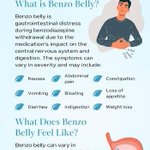
Prolonged withdrawal: The 2025 ASAM guidelines recognise that some people experience neurological and physical symptoms for months or even years after stopping benzodiazepines.
• What causes it? Benzodiazepines affect GABA-A receptors, which help regulate nervous system activity. Long-term exposure can cause adaptations in inhibitory signalling. These changes may contribute to withdrawal symptoms, although the mechanisms behind symptoms persisting for years are not fully understood.
• Neuropathy: Burning, tingling, numbness and electric-shock sensations may arise from altered sensory processing and increased nervous system sensitivity. Food high in histamine is one trigger. Low histamine diet is one recommendation.
• Brain fog: Difficulty concentrating, memory problems and mental fatigue are recognised prolonged withdrawal complaints. Changes in cognitive processing, disrupted sleep and nervous system regulation may contribute.
• Bone and joint pain: Increased muscle tension, altered pain signalling and central sensitisation may explain some of the deep aches and joint discomfort.
• Nasal symptoms: There may be a connection with altered autonomic or sensory regulation.
• Is your nervous system permanently damaged? Not necessarily. Persistent symptoms do not automatically mean irreversible damage. The scientific evidence is still insufficient to determine exactly what causes symptoms to persist in some individuals.
• Can you still recover after six years? Further improvement is possible, but nobody can reliably predict the timeline or guarantee complete recovery.
• What might help? Gradually rebuilding physical activity, consistent sleep, balanced nutrition, and stress management may support better functioning. Avoid pushing yourself beyond your current physical tolerance.
• Medical investigations: Since you’ve been experiencing symptoms for six years, it would be sensible to check vitamin B12, blood glucose and other electrolytes.
• Most importantly: Please don’t blame yourself for taking medication that you believed would help you. You made decisions based on the information and
