

Predictive power management for AI data centers -- connecting what AI compute demands to what power infrastructure supports in real-time. https://xitter.cf/t.co/gwHkFhePMG
Menlo Park, CA
Joined June 2009
- Tweets5.2K
- Following48.8K
- Followers45.2K
- Likes315







Pinned Tweet
Talk to enough AI infrastructure operators and a pattern emerges. Whether it's a neocloud, a sovereign AI cloud, an edge AI fleet, or an enterprise running its own cluster, the conversation eventually comes back to the same constraint: Power.
The pressure shows up in four ways:
⚡ Can you get enough? New grid capacity and equipment take years to arrive. For most operators, the megawatts you have today are the megawatts you'll have for a while.
⚡ Are you using it well? AI loads jump in milliseconds, while energy and cooling take seconds to minutes to respond. So operators hold power in reserve "just in case." That reserve is paid for and rarely used.
⚡ Is it hurting your reliability? When power or cooling can't keep up, the result is failed jobs, throttled GPUs, tripped circuits, or an edge site that goes dark.
⚡ Is it amplifying your costs? One unplanned peak can set a demand charge that follows you for most of a year.
Each operator feels this differently. A neocloud loses sellable capacity. A sovereign cloud has to account for every allocated megawatt. An edge fleet has too many sites to watch one by one. An enterprise finds out about the problem from a breaker or a power bill.
GridSignal helps you run more workloads on the power you have by increasing your Ramp Time Lead (RTL), the warning your team gets before a load step lands, and lowering your Stranded Power Ratio (SPR), the share of your power held in reserve but never used.
The first step is the same wherever you sit: an X-Ray Report of your own data. gridsgnl.com/x-ray-report
#AIInfrastructure #DataCenters #Neocloud #SovereignAI #EdgeAI #PowerManagement

1
1
152
GridSignal retweeted

2 DAYS until PGT Online kicks off!
Round 2 of our countdown giveaway is here, and we're upping the stakes with 10 × $55 PGT Kickoff Satellite Tickets up for grabs!
To enter:
Repost this post
Tag 2 friends
Include your CoinPoker screen name
Entries close in 24 hours!
We'll be back at the SAME TIME tomorrow for another round of giveaways!
The countdown continues!

GridSignal retweeted
Please stop whatever you are doing and take the recent news about cyber vulnerabilities seriously.
These events are now happening every 2-3 weeks.
Your best next step:
• Ask your agent how to protect your online accounts.
• Be paranoid.
• Do everything the agent says, even when you think it's a little too much.
Here is another idea: this is a hosted service that gives your coding agent access to recent software vulnerability reports.
If you connect it through MCP, your agent will automatically check for new vulnerabilities and help you patch them before you have to read about them on social media.


For a decade, the answer to "where should this run?" was simple: the cloud. AI followed the same path.
That default is breaking down, and inference is leading the change. As AI moves from experiments into daily production, and from chat answers to agents running inside workflows, enterprises are rethinking where each workload belongs. Three forces drive it: cost that becomes unpredictable at steady volume, data companies won't send elsewhere, and latency that compounds when an agent makes dozens of calls to finish one task.
What the data says
In Broadcom's Private Cloud Outlook 2026, a survey of 1,800 IT leaders, the share of enterprises running AI inference mainly in public cloud fell from 56% to 41% in a single year, and a Cloudera study found two-thirds have moved some AI workloads back. But this is not an exodus. IDC found only 8–9% of companies plan to leave the cloud entirely. Steady, predictable AI work is moving to infrastructure companies control, while bursty and experimental work stays in the cloud. It's a placement decision, made workload by workload.
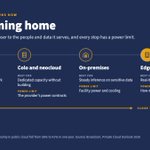
The four places AI runs now
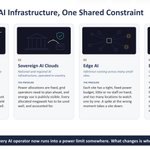
Public cloud, colo and neocloud, on-premises, and the edge: each option trades speed, cost, control and proximity differently, and most enterprises will use all four.
The newest option: inference in the building
Running AI on the edge means to compute inside or near the buildings where people and data already are. Shah Rahman calls it "NeoEdge": the neocloud wave was built for training, and the next wave will be built for inference. The case is strong. Agents multiply latency, paying the network round trip on every step of a chain. Sensitive data in legal, healthcare and finance wants to stay put. And while new grid connections take years, office and industrial buildings already have power, permits and fiber. The model is still early, but inference is moving toward the people and data it serves.
The common thread: every placement is now a power decision
Look across the four options and one constraint shows up in all of them.
Cloud providers are limited by how fast utilities can connect new campuses. On-premises teams find a GPU rack draws more power than their facility was built to deliver. Colo and neocloud capacity is only as available as the provider's power contracts. And the edge depends on how much a building can really spare, which is far less on a hot weekday afternoon than on paper.
AI is coming home. Wherever it lands, it brings its power demands with it.
Sources
Broadcom, Private Cloud Outlook 2026 (summary via LLM Configurator)
Cloudera survey of 1,500 enterprise technology leaders, Virtualization Review, Aug 2026
IDC repatriation research, 2024 (summary via Abhishek Kushwaha)
Shah Rahman, "NeoCloud Was for Training. NeoEdge Is for Inference," Jul 2026

224
GridSignal retweeted

AI-assisted development changes what a small company can attempt. The bottleneck moves from writing every line to defining the problem, supplying context, testing behavior, and deciding what deserves production authority. Faster building makes judgment more valuable.
Claude Code and Replit didn't teach me how to build GridSignal's simulation engine.
Learning to write functional and design specs, write and review modular code, and run unit, black box, and integration tests did that.
AI hasn't changed software development, but AI has certainly accelerated software development.

1
1
156
I’m excited to announce that I’ll be attending the inaugural #NovaFutureSummit26 this September 28-30 in Napa, California.
The summit presents a unique opportunity to gather with other leaders in tech, telecoms and business for substantive, closed-door discussions on the future of AI and global digital infrastructure.
If you'll be in Napa, I'd love to connect.
#novafuturesummit26
256
GridSignal is opening our Founding Design Partner Program!
GPU clusters can ramp from idle to full power in seconds. Most facilities only find out when the meter does.
LivePulse reads the job scheduler to forecast those power ramps before they happen, giving operators time to prepare generation, storage and cooling. It's read-only and advisory by design. We never touch your workloads or equipment.
We're inviting a small number of founding partners into our pilot. If you run dense GPU clusters on Slurm, Kubernetes or Ray and have access to your facility's power data, we'd love to talk.
Founding partners receive a complimentary X-Ray Report on their historical data, direct access to our engineering team, and a real voice in what we build.
gridsgnl.com/newsroom/beta-p…

113
GridSignal retweeted

I think the "difficulty" of software engineering is essentially constant no matter what abstraction level you move to, because human cognition adapts to new tools until it can fully utilize itself.
Tools are only affordances, not a magic wand that makes work disappear.
Great software engineering was immensely challenging before. It is still immensely challenging now, despite very different workflows.

GridSignal retweeted
The goal of AI governance is not to stop useful work. It is to make useful work possible within limits management understands.
GridSignal retweeted
Models will change. The durable business skill is learning how to define, assign, limit, evaluate, and improve machine work.
Curtailment Mitigation for PCLRs: Modeling the Effects of Front-of-Meter Netting
published byAurora Energy Research
@AuroraER_Oxford
auroraer.com/resources/auror…

152
Your job scheduler already knows a power spike is coming — 30 to 60 seconds before your meters do.
That's not a marketing number. It's a physical one.
When a training job or a large inference batch gets committed to the queue, that's a decision that's already been made. The power draw that follows is a consequence, not a surprise — it just hasn't happened yet.
Meanwhile, the systems that actually respond to that draw run on their own clocks. Generators and switchgear can ramp in seconds once triggered. Cooling systems notice the heat rise on a slower, separate clock. Today, almost everything downstream waits for the meter to see the spike before either clock starts moving — reacting to something that was already knowable.
That gap between "the scheduler committed the work" and "the meter saw the draw" is the whole opportunity. It's advance warning that already exists in data centers' own systems, going unused.
That's the gap GridSignal reads. gridsgnl.com
#DataCenters #AIInfrastructure #PowerManagement

1
130
Press Release Stats - GridSignal Launches Free Diagnostic to Reveal Hidden Power Capacity in AI Data Centers prlog.org/13170836-gridsigna…
115
For 50 years, power demand held roughly flat. Then AI broke that.
Most data center teams find out about a power spike the same way they always have: after it happens. But the warning was often already sitting in their own job scheduler, unread.
We built the GridSignal X-Ray Report to answer one question with evidence instead of guesswork: how much advance warning did your power infrastructure already have, and what did it cost you to miss it?
It's a free, one-time diagnostic. No integration, no system access — you send us 90 days of your own scheduler and power data, and we compute six figures: lead-time opportunity, capacity utilization, peak events, demand-charge ratchet risk, recoverable stranded capacity, and the full method behind every number, written out for your engineers to check.
Evidence before assumption. That's the whole idea.
If you run AI infrastructure and want to see what your data is already telling you, request your complimentary X-Ray Report here.
gridsgnl.com/x-ray-report

GridSignal retweeted

Another theme that emerged from our Q2 tour of datacenter industrials is that modular capacity is sold out, with demand growing faster than the pace of capacity bring-up. Modular is gaining share because it addresses the two biggest constraints on datacenter construction: time and field labor. Power and cooling systems can be assembled in factories while the shell goes up on site, compressing delivery timelines by up to 40% and reducing on-site man-hours by up to ~70% for some parts of the build. We broke down the different approaches—and the schedule, labor and cost savings—in our recent newsletter (1/4)🧵 newsletter.semianalysis.com/…


GridSignal retweeted

Two brothers from West Virginia who fought on opposite sides of the American Civil War. 1910.
More rare historical photos: bit.ly/44OpIzi

GridSignal retweeted

Check out my latest article: Strategic Framework for Choosing the Right AI Architecture and Platforms linkedin.com/pulse/strategic… via @LinkedIn
