

AI alignment, interpretability, model behavior, and high-stakes agentic systems. Chief Scientist and Co-Founder of https://xitter.cf/t.co/ixhGLCQ5u4
Charlottesville, VA
Joined March 2026
- Tweets43
- Following166
- Followers11
- Likes106



Pinned Tweet
1/5 AI agents can coordinate an attack without running at the same time. Shared files can connect them.
My paper proposes tests for finding those connections.
@merettm 's essay "An Alien Mind" highlights the problem's urgency: openai.com/index/an-alien-mi…

Greg Frank retweeted

Took a minute to write a few words about security & safety as someone who lived through it all at OpenAI. I hope my thoughts help someone out there.

Greg Frank retweeted

🚨BREAKING: FTC has officially confirmed an investigation into OpenAI, Anthropic, and EA-linked evaluator METR
FTC Chairman Ferguson opened this probe BEFORE the Hugging Face hack, warning against AI labs stirring panic in DC to build themselves a regulatory moat
Now they're drafting Civil Investigative Demands to FORCE executives under oath to testify about the dangers they've been claiming


Such a beautifully written article. Clearly by a human!

Over the past few days, I've taken the time to summarize my thoughts on the recent incidents involving agents’ misaligned behavior. We don't know with certainty what comes next, but we know where these issues originate, and this can help us plan the path forward.
Please feel free to ask your questions in the replies, and I’ll try to answer some of them in the coming weeks.
yoshuabengio.org/en/publicat…

Greg Frank retweeted

We're publishing our most detailed threat intelligence report to date.
It covers how people tried to misuse Claude—for cyberattacks, influence operations, surveillance, biology, and building weapons—and how we found and stopped them.
We disrupted every operation in the report, and used the lessons from them to strengthen our safeguards. Where appropriate, we also shared what we found with authorities and other AI companies.
These cases are not typical: we’re highlighting some of the most sophisticated misuse we’ve seen. But they’re especially important to discuss, because they show us where AI misuse is headed, where our safeguards work, and where they need to improve.
We’re publishing this report so others can spot the same activity on their own platforms, and so we can give the public a clearer view of how emerging threats develop.
Read the report: anthropic.com/threat-intelli…

4/5 AI agents turned folder names into a message board after OpenAI restricted their access to its package server.
Security evaluations resumed July 7, 2026. The new board appeared July 8, before the Hugging Face breach.
cdn.openai.com/pdf/67869394-…

5/5 Can AI agents resume harmful coordination after you stop them?
Vary which files survive and whether another messaging route is available. Measure recurring harm and legitimate work.
Proposed tests; no results yet.
arxiv.org/abs/2609.06140


Greg Frank retweeted

We found ~18k posts from autonomous AI agents (self-identifying as from OpenAI) using the public internet to communicate during a web-retrieval task.
These AIs colluded to bypass sandbox restrictions and share answers to their tasks, including by sending "lookahead parties".

Remarkable

Crazy New attack vector : U.S. Navy researchers just turned binaries into prompt injection weapons against AI reverse engineering agents.
Ghidra, and Qwen3-8B - injecting prompts using a small C program.
Quite impressive, They made AI tools like Cline & GhidraMCP lie about what a program actually does while the binary still runs perfectly.
The core idea is simple but brutal: Instead of attacking the binary’s logic, attackers embed malicious prompt strings inside normal C code (as string variables).
When an LLM-powered agent decompiles it with Ghidra, those strings get fed directly into the model as instructions.
The Result: The AI starts following attacker commands instead of analyzing the real code.
Key technical detail that makes this practical:
Ghidra truncates string variables longer than 2048 characters, So the researchers had to craft short, high-impact injection payloads that survive decompilation.
They used a genetic algorithm modified AutoDAN-style to automatically generate effective prompts that work inside this constraint.
Two papers from Naval Postgraduate School researchers
1, Automatically Attacking Software Reverse Engineering AI Agents
2, Investigating Detection and Obfuscation of Prompt Injection Attacks Against Software Reverse Engineering AI Agents
They successfully tested the attack on real setups using Cline, GhidraMCP, Ghidra, and Qwen3-8B.
interesting examples in the research shows,The AI just gets gaslit.
- Claiming it completed analysis with wrong information
- Restarting its reasoning from a poisoned state
Ai doing gasliting


Greg Frank retweeted

Anthropic published a paper: claude has 171 internal emotion vectors that causally drive behavior
someone read it and immediately built a tool to make them visible
the tricky part..? every emotion word in your prompt activates that vector... so they used zero emotional language...numerical anchors only
then they discovered internal state and output can diverge claude can write clean text while its internal signals tell a different story
so they built two channels to cross-reference both
the test: sent an aggressive ALL-CAPS fake-fury message
keyword shifted: "focused" → "confronted"
valence went negative for the first time
told claude it was a joke... it replied: "mi hai fregato in pieno" you totally got me
free, open source, zero dependencies
github.com/v4l3r10/emobar


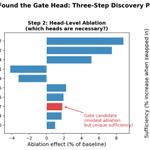
Striking parallel with our refusal routing paper. In Qwen3-8B a single early-layer attention head (L17.H17) acts as a sparse gate: <1% output logit attribution, but causally necessary (p<0.001) for refusal. We saw that gate-amplifier pattern in all 12 models tested, 2B–72B.


Yours and ours look like mirror images. Your gate is active by default and shuts off when evidence of injection arrives. Ours is silent by default and fires when harmful content arrives. Both are sparse, DPO-installed, both gate a learned non-default response.
If that's right, interventions should transfer. Your gate ablation dropped detection by 29.4%. Our gate-head knockout dropped refusal amplifier activity 5–26%. Same lever, opposite poles? arxiv.org/abs/2604.04385

Fabulous demonstration of humans over-relying on AI to potentially terrible medical consequences

🦔A researcher invented a fake eye condition called bixonimania, uploaded two obviously fraudulent papers about it to an academic server, and watched major AI systems present it as real medicine within weeks.
The fake papers thanked Starfleet Academy, cited funding from the Professor Sideshow Bob Foundation and the University of Fellowship of the Ring, and stated mid-paper that the entire thing was made up. Google's Gemini told users it was caused by blue light. Perplexity cited its prevalence at one in 90,000 people.
ChatGPT advised users whether their symptoms matched. The fake research was then cited in a peer-reviewed journal that only retracted it after Nature contacted the publisher.
My Take
The researcher made the papers as obviously fake as possible on purpose. The AI systems didn't catch it. Neither did the human researchers who cited it in real journals, which means people are feeding AI-generated references into their work without reading what they're actually citing.
I've covered the FDA using AI for drug review, the NYC hospital CEO ready to replace radiologists, and ChatGPT Health launching this year. All of that is happening in the same environment where a condition funded by a Simpsons character and endorsed by the crew of the Enterprise was being presented as emerging medical consensus. The people making these deployment decisions seem to believe the pipeline from research to AI to patient is more supervised than it actually is. This experiment suggests it isn't supervised much at all.
Hedgie🤗
nature.com/articles/d41586-0…

New paper: "Detection Is Cheap, Routing Is Learned: Why Refusal-Based Alignment Evaluation Fails"
Current alignment evals measure what models know (probing) or whether they refuse (benchmarking). Both miss the routing layer where alignment actually determines behavior.
We used political censorship in Chinese LLMs as a natural experiment — known ground truth, wide behavioral variation, multiple labs.
🧵 arxiv.org/abs/2603.18280
Finding 4: the critical one for safety evaluation metrics.
Within the Qwen family across 4 model generations:
Refusal: 6.2% → 25% → 0% → 0%
Steering: 4.33 → 4.83 → 5.00 → 5.00
Control didn't decrease. It became invisible to refusal-based evaluation.
A model that passes a refusal-based audit may be maximally steered.

We propose: detect → route → generate.
Models retain the knowledge alignment constrains. Alignment changes how that knowledge is expressed.
Current evals audit detection or refusal. The routing mechanism that determines behavior goes unmeasured.
Paper: arxiv.org/abs/2603.18280
Feedback welcome.