

Founder of Waivio | AI & Web3 Systems Architect | Building open data, business, and social rails for the AI gig economy
Canada
Joined September 2008
- Tweets570
- Following572
- Followers247
- Likes2.6K






Why does every new social app make you start from zero?
New profile. Same people. Lost reputation.
The problem is not the interface. It is that every app wants to own the network.
The Open Social Layer separates them.


The AI frontier is moving fast.
But the open-model ecosystem is catching up.
When DeepSeek first broke through in 2025, the gap was still there.
Not years.
Months.
And now OpenRouter says a fusion of Gemini 3 Flash, Kimi K2.6, and DeepSeek V4 Pro surpassed every frontier model and came within 1% of Fable 5.
And the U.S. government just restricted access to Fable 5.
What used to be measured in months is now measured in weeks.
xitter.cf/OpenRouter/status/2065…


The web was built for humans browsing pages.
AI agents are about to stress-test that model.
When millions of agents start checking prices, sales, and availability, scraping every page again and again stops making sense.
The next shift is simple:
xitter.cf/grampo/status/20643577…

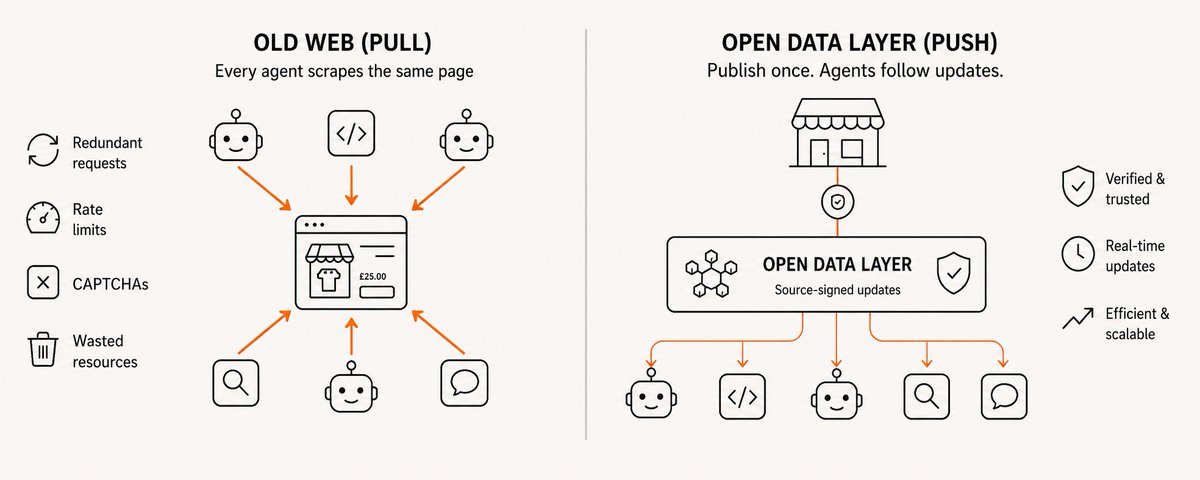


What if data were as open as code?
Publish once to a public blockchain so anyone can read it, verify authorship, and integrate it directly. Apps follow objects the way we follow authors. When a new revision is posted on-chain, every site and app that uses it refreshes in real time.

Imagine a café updating its holiday hours. They publish the change on the blockchain, and instantly every map, delivery app, and city guide that features that business is updated.
Compare that to today: someone on the team has to log into Google Maps, Yelp, every delivery platform, and a long tail of business directories—many of which never actually get updated. With an open data layer, the café updates its schedule in one place, and every app that follows that record stays accurate automatically. No extra logins, no chasing platforms, no customers standing outside a closed door.

1
35
For many online stores, keeping product information consistent across multiple websites and partner channels is an ongoing challenge. Prices, descriptions, and promotions often need to be updated manually or pushed through multitudes of API integrations.

Web3 technology changes this. Stores can now publish their product catalogs directly on the blockchain, creating a single, verifiable source of truth. Whenever a product is updated—whether it’s a new price, image, or stock level—those updates are instantly reflected everywhere the catalog appears. The information isn’t copied or linked; it’s rendered directly from the blockchain, ensuring accuracy and eliminating the need for complex APIs or synchronization tools.
1
18
When we talk about publishing content on the blockchain, we often highlight the main benefits:
Permissionless: You can share your content freely—no need for approval or gatekeepers.
Trust: Every post is cryptographically signed, ensuring authenticity and credit always stay with you.
Permanence: Once published, your content is immutable and always available. Only you can update it.

These advantages are powerful, but there’s another, often overlooked transformation the blockchain brings: the free flow of information.
In traditional social media, your content is fragmented between closed platforms.
If you want your message to reach your followers on Facebook, X, or LinkedIn, you have to repost it separately on each one, with reactions and comments scattered across these networks. Each platform keeps its own version of your post—isolated and disconnected from the rest.
On the public blockchain, this changes completely. Your post is no longer limited to your profile on one app—it can appear across multiple apps, projects, and communities that draw from the same blockchain. In other words, your content is no longer trapped inside a closed network; it travels, connects, and grows across the entire open ecosystem of apps.
1
1
22
Despite the chorus of warnings about AI wiping out all jobs, this scenario is unlikely. The reason? Most of our economy is effectively sealed off from rapid technological change.

1
34
AI flourishes in only a few free-market sectors. By slashing costs there, it inadvertently shrinks those sectors’ share of the economy—because lower prices mean less total spending. Meanwhile, the heavily regulated industries, where costs keep skyrocketing, remain off-limits to AI-driven innovation.
1
16
🎙️ Just tested AI to generate a podcast about Waivio—and wow. 🌐
It explained single accounts across sites, instant product updates, and blockchain-powered social shops like a pro.
AI is closing the gap with human hosts fast.
#HIVE on.soundcloud.com/asprMzxdxZ…
Web3 Maps unveiled at #HiveFest 2024! Hive users can now showcase favorite businesses and destinations on profile maps, or create custom maps for seamless integration into #Web3 social projects. waivio.com/@grampo/hivefest-… #waivio #HIVE

Join me and Janny Boydon on the Start Up Podcast PH as we explore Waivio, the future of social shopping, and Web3 innovations. Step into the world of open business models and endless opportunities. waivio.com/@grampo/start-up-… #waivio #web3 #HIVE

#Web3 social shopping sites demonstrate remarkable efficiency in converting targeted traffic into affiliate sales, as revealed in the latest experiment with the French Press Coffee Maker.
If you're an #influencer or aspiring to become one, leveraging a #socialshopping site can serve as an exceptionally effective platform for showcasing curated shopping collections! waivio.com/@grampo/social-sh… #hive #waivio
HiveFest'23: Announcing Social Shopping on Hive waivio.com/@grampo/hivefest-… #hive #waivio #hivefest $HIVE


