

PhD candidate @UofIllinois (UIUC) @CSL_Illinois | Current: robotics research intern @Nvidia | ex-research science intern @Adobe Research
Champaign, IL
Joined September 2017
- Tweets225
- Following3.7K
- Followers709
- Likes10.4K



Pinned Tweet
Muninn won the Outstanding Student Paper Award at #RSS 2026!!
Huge thank you to my collaborators and advisors, this work would not exist without them! And to the #RSS community for the recognition and for organizing such an awesome conference!
We have also open-sourced the core repository. The plan is to actively maintain it, and to benchmark and speed up as many diffusion-based trajectory planners as we can get our hands on. If your robot plans with diffusion, try it out! Issues and PRs very welcome.
📄 Paper: arxiv.org/pdf/2605.09999
💻 Code: github.com/gokulp01/Muninn
cc: @RoboticsSciSys

We are presenting Muninn at RSS 2026, and we're incredibly honored that it has been selected as a finalist for both the Outstanding Paper & Outstanding Student Paper awards! #RSS2026
TL;DR: diffusion planners generate great robot trajectories, but nobody wants 100 denoiser calls inside a control loop. Existing speedups (truncation, distillation, fixed skipping) trade quality for speed in ways you can't predict before deployment. Muninn is a training-free wrapper that skips denoiser calls only when it can certify the final plan stays within your tolerance 🧵 (1/9)
📄 Paper: arxiv.org/abs/2605.09999
💻 Code: github.com/gokulp01/Muninn
Super insightful read. The ablations are the real gem here. The harness matters way more than I expected, and the right one makes action space and prompt details way less of a big deal.
+ RoboLab is the best sim eval out there rn 🤖

Can and should a general-purpose model serve as a robot policy?
In Astranomy, we study GPT-6 Astra for general pick-and-place manipulation. Astra sets a new SOTA on RoboLab-120, but real-time robot control remains an open challenge.
Full tech report:
research.nvidia.com/labs/srl…
@chooi_jeq agentic harness + full history on hardware next? would be v interesting with Astra/Argon :)
Today we are introducing ARC, a reasoning recipe for robot foundation models that sets a new state of the art on RoboLab-120 and MolmoSpaces.
The prevailing way to improve robot foundation models is brute force: larger models, more robot demonstrations, costly training at scale. ARC needs none of that. With no new robot data and no foundation-scale training, π0.5 and Cosmos3-Nano-Policy gain up to:
📈 +50.0 pp on RoboLab-Reasoning-50
📈 +29.8 pp on RoboLab-120
📈 +27.2 pp on MolmoSpaces
To our knowledge, these gains are unprecedented.
📄 Paper: arxiv.org/abs/2610.12386
🌐 Website: arc-robot-reasoning.github.i…
🧵 (1/7)
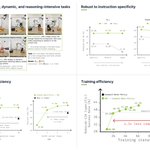
(7/7) Key findings beyond task performance:
→ Reasoning improves execution across long-horizon, dynamic, and reasoning-intensive tasks.
→ Nearly invariant to instruction specificity: π0.5+ARC holds ~45% from specific to vague instructions, while its base falls to 15.2%.
→ Inference efficiency: 10× fewer denoising steps for π0.5 (within 0.4 pp of its base) and 2× fewer for Cosmos3-Nano-Policy (+4.8 pp).
→ Training efficiency: Cosmos3-Nano-Policy+ARC matches its baseline's 10K-iteration performance with ~4.3× fewer updates.

📄 Paper: arxiv.org/abs/2610.12386
🌐 Website: arc-robot-reasoning.github.i…
💻 Code: [coming soon]
🤗 Models: [coming soon]
🗂️ Dataset: [coming soon]
This work was done during my internship at @nvidia @NVIDIAAI @NVIDIARobotics
HUGE thanks to all my collaborators and mentors: Tao Sun, @EliJalbout, @moritz_reuss, @mli0603, Fabio Ramos, @xuningy, @imankitgoyal!
More videos below 👇


Students sometimes ask me if it still makes sense, in this accelerating age, to pursue a PhD in AI.
Perhaps counterintuitively, I think it's a great time to do so.
I wrote up some thoughts on this here: web.mit.edu/phillipi/www/wri…
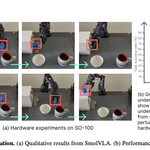
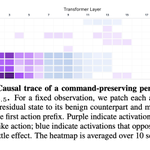
Paper accepted at #CoRL2026!! We study how language perturbations propagate through closed-loop VLA control and uncover a new attack!
Work done in collaboration with: @Vardhan_Dongre , @pthangeda_ , Hooshang Nayyeri, @dilekhakkanitur , Melkior Ornik
TL;DR: we introduce a new VLA attack where tiny, meaning-preserving edits can redirect the robot’s entire closed-loop behavior toward an adversary-chosen goal—without ever stating that goal in the prompt!🧵 (1/9)
📄 arxiv.org/abs/2606.12978
🌐 vla-redirection-attack.githu…
💻 github.com/vla-redirection-a…

