

Pinned Tweet
Grok Bot trading with one chatbot is f*cking dumb
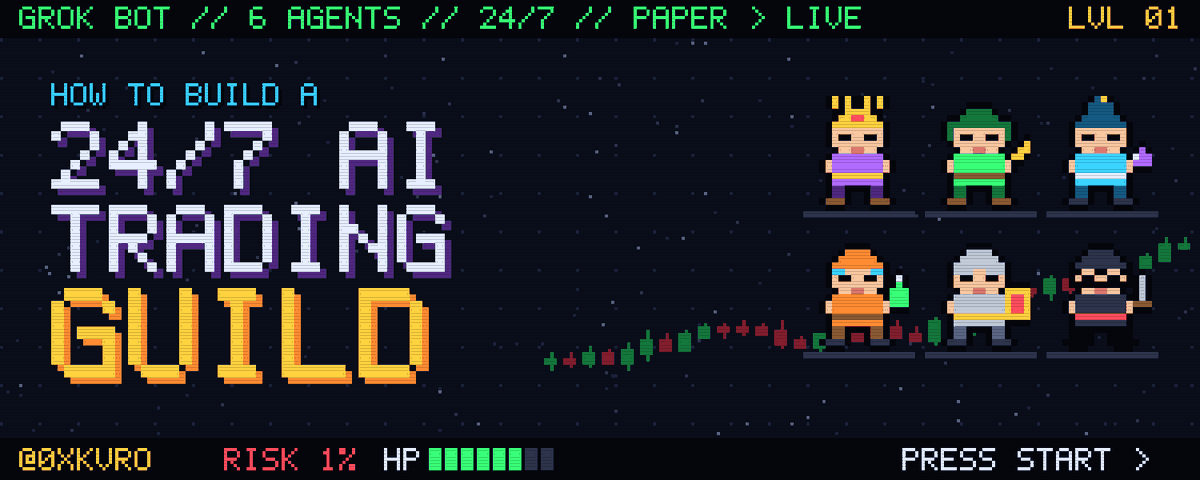
the real experiment was turning it into a 6-agent trading desk:
Ranger scans markets
Seer researches
Alchemist backtests
Paladin vetoes risk
Rogue executes
Broker paper trades
that changes everything.
the surprising part:
the edge wasn’t “better predictions”
it was coordination, verification, and role separation
same intelligence
completely different outcome
instead of one bot giving hot takes, the system ran like a desk:
shared context
scheduled tasks
risk control
paper-trading first
out-of-sample discipline
that’s the whole point of Grok Bot trading:
not one genius agent
a structured team that kills weak trades before capital touches them


shiron retweeted
Claude Code trading research is f*cking insane when the goal is to reject itself
start with $10,000
turn one momentum idea into 27 strategy configurations
then attack every result with:
costs
walk-forward tests
parameter checks
out-of-sample validation
the numbers get ugly fast:
27 tested
6 positive historically
2 survive preliminary OOS checks
0 approved for live deployment
and even the “best” return is not necessarily the best strategy
24% return → 0.75 Sharpe
14% return → 1.17 Sharpe
plus costs can turn:
$1,200 gross → $200 net
that is the whole point
AI should generate ideas fast
the research system should kill them even faster


Claude Code trading research is f*cking insane when the goal is to reject itself
start with $10,000
turn one momentum idea into 27 strategy configurations
then attack every result with:
costs
walk-forward tests
parameter checks
out-of-sample validation
the numbers get ugly fast:
27 tested
6 positive historically
2 survive preliminary OOS checks
0 approved for live deployment
and even the “best” return is not necessarily the best strategy
24% return → 0.75 Sharpe
14% return → 1.17 Sharpe
plus costs can turn:
$1,200 gross → $200 net
that is the whole point
AI should generate ideas fast
the research system should kill them even faster
this quant framework is f*cking insane
it shows why a great backtest can still be complete bullshit
the example looks strong:
in-sample Sharpe: 2.30
then you test it on unseen data:
out-of-sample Sharpe: 0.12
and the probability of finding a fake “winner” explodes as you test more strategies:
10 strategies → 4.6%
100 → 36.9%
500 → 86.5%
1,000 → 98.2%
that is the whole trap
search long enough and randomness will eventually hand you something that looks like alpha
so real quant research does the opposite:
resample
test the null
strip factors
validate out-of-sample
include real costs
the edge is not finding the best backtest
it is proving the backtest was not luck


shiron retweeted
this quant framework is f*cking dangerous if you love pretty backtests
the document starts from one brutal fact:
the more strategies you test, the easier it becomes to find a “winner” by luck
with no real edge:
10 strategies → 4.6% chance of Sharpe ≥ 2.0
100 → 36.9%
500 → 86.5%
1,000 → 98.2%
and the example is even uglier:
in-sample Sharpe: 2.30
out-of-sample Sharpe: 0.12
that is why the real quant workflow is not:
find the best chart
it is:
randomize
factor-strip
test the null
control multiple testing
validate out-of-sample
because randomness will always manufacture attractive backtests
the edge is proving your result survived it

this quant framework is f*cking dangerous if you love pretty backtests
the document starts from one brutal fact:
the more strategies you test, the easier it becomes to find a “winner” by luck
with no real edge:
10 strategies → 4.6% chance of Sharpe ≥ 2.0
100 → 36.9%
500 → 86.5%
1,000 → 98.2%
and the example is even uglier:
in-sample Sharpe: 2.30
out-of-sample Sharpe: 0.12
that is why the real quant workflow is not:
find the best chart
it is:
randomize
factor-strip
test the null
control multiple testing
validate out-of-sample
because randomness will always manufacture attractive backtests
the edge is proving your result survived it
shiron retweeted
this quant framework is f*cking ruthless
it starts with one uncomfortable idea:
most “edge” is just shared market exposure + noise
so the process becomes:
decompose the move
compress common factors
study the residual
stress costs
walk forward
reject what breaks
the crazy part is how easily small samples fake skill
test enough strategies and eventually one prints a beautiful Sharpe by pure luck
that is why real quant research treats every pattern like a suspect
not proof
and the mindset shift is simple:
weak framing: why did price move?
quant framing: what force moved it?
weak framing: is it profitable?
quant framing: is it still profitable after costs and unseen data?
randomness is not the enemy
unmeasured randomness is

this quant framework is f*cking ruthless
it starts with one uncomfortable idea:
most “edge” is just shared market exposure + noise
so the process becomes:
decompose the move
compress common factors
study the residual
stress costs
walk forward
reject what breaks
the crazy part is how easily small samples fake skill
test enough strategies and eventually one prints a beautiful Sharpe by pure luck
that is why real quant research treats every pattern like a suspect
not proof
and the mindset shift is simple:
weak framing: why did price move?
quant framing: what force moved it?
weak framing: is it profitable?
quant framing: is it still profitable after costs and unseen data?
randomness is not the enemy
unmeasured randomness is
shiron retweeted
this quant framework is f*cking clean
it starts with one rule:
decompose before you trade
most of what looks like “alpha” is just:
market beta
sector exposure
shared factors
liquidity
noise
so the process becomes:
returns → factors → residual → validation → sizing → monitoring
the crazy part is the residual is not automatically edge
it is only a candidate
then you have to attack it with:
out-of-sample testing
cost + slippage stress
parameter stability
multiple regimes
tail-risk checks
that is the real quant mindset
randomness was never the enemy
calling randomness alpha was

this quant framework is f*cking clean
it starts with one rule:
decompose before you trade
most of what looks like “alpha” is just:
market beta
sector exposure
shared factors
liquidity
noise
so the process becomes:
returns → factors → residual → validation → sizing → monitoring
the crazy part is the residual is not automatically edge
it is only a candidate
then you have to attack it with:
out-of-sample testing
cost + slippage stress
parameter stability
multiple regimes
tail-risk checks
that is the real quant mindset
randomness was never the enemy
calling randomness alpha was
this quant framework is f*cking insane
it basically says most traders are trying to predict something that should be removed first
the document decomposes the market into common forces:
PC1 alone: 64.2% of variance
sector rotation: 12.8%
style: 6.1%
residual: just 13.2%
and that leftover is where the interesting part starts
the workflow is:
data → features → factor removal → residual analysis → OOS validation → sizing
the unexpected conclusion?
a portfolio can hold dozens of stocks and still be one giant correlated bet
real quant research is not asking:
“what goes up next?”
it is asking:
“what remains after I remove everything obvious?”
that residual is where the edge may still have a pulse

this MIT quant paper is f*cking insane
it tested 100 strategies per run across 10,000 Monte Carlo trials
every strategy had zero real alpha
but after selecting the best backtest:
+38.84% in-sample
then on fresh data:
+0.14%
and 49.16% of the “winners” actually went negative out-of-sample
that is the trap with AI trading
the more strategies you generate, the easier it becomes to manufacture a genius-looking backtest by accident
so the real workflow is:
generate → backtest → select → unseen data → robustness gates → paper trade
the edge is not producing more strategies
it is killing the ones that only look profitable

this MIT quant framework is f*cking insane
it basically says most “alpha” disappears once you explain what actually moved the market
the process is brutal:
decompose returns
compress the market with PCA
remove common factors
trade the residual
stress costs + regimes
measure tail risk
the crazy part is that roughly 3–5 dominant factors can explain ~90% of market variation
so owning 30 stocks can still mean owning the same trade 30 times
and even after you find a signal, it still has to survive:
out-of-sample testing
parameter changes
slippage + commissions
bull / bear / high-vol regimes
that is the whole quant mindset:
do not ask what moved
ask what force moved it
then trade only what is left

shiron retweeted
this Stanford quant note is f*cking important
most traders think the edge is in predicting the next move
it isn’t
the edge is in separating what is common from what is actually yours
the framework is simple:
decompose the move
compress the market
remove common factors
study the residual
stress test the strategy
respect tail risk
that flips the whole game
you stop asking
“what moved?”
and start asking
“what force moved it?”
that is where most fake alpha dies
and where real research begins
the best part is the paper’s mindset:
out-of-sample validation
multiple market regimes
realistic costs
parameter robustness
tail-risk checks
kill the strategy when the evidence breaks
not every return stream is edge
sometimes it is just beta wearing makeup
bookmark this before you trust another pretty backtest

this Stanford quant note is f*cking important
most traders think the edge is in predicting the next move
it isn’t
the edge is in separating what is common from what is actually yours
the framework is simple:
decompose the move
compress the market
remove common factors
study the residual
stress test the strategy
respect tail risk
that flips the whole game
you stop asking
“what moved?”
and start asking
“what force moved it?”
that is where most fake alpha dies
and where real research begins
the best part is the paper’s mindset:
out-of-sample validation
multiple market regimes
realistic costs
parameter robustness
tail-risk checks
kill the strategy when the evidence breaks
not every return stream is edge
sometimes it is just beta wearing makeup
bookmark this before you trust another pretty backtest
this Stanford quant paper is f*cking insane
most traders think they're finding patterns
but they're just trading noise
the crazy part is what happens when you break market returns into actual components:
5 principal components
92% of market variance explained
11.4% annual return in the example
1.28 Sharpe ratio
-16.7% max drawdown
and that's where things get interesting
the goal isn't to predict every market move
it's to remove common market forces, isolate the residual signal, and test whether any real edge survives
PCA removes the noise
out-of-sample testing exposes fake patterns
risk controls keep randomness from destroying your capital
the best quant isn't the one who finds the most signals
it's the one who knows which signals are probably bullshit
bookmark this before it gets buried ↓

22
530
CLAUDE CODE IS ALREADY SMART ENOUGH. YOUR SETUP IS WHAT'S HOLDING IT BACK.
And Harrison Chase's approach to agent engineering explains why.
Most people keep upgrading models and rewriting prompts while their agents repeat the same mistakes.
This LangChain-inspired harness changes that.
One prompt gives Claude Code a structured engineering system with controlled execution, real tests, independent reviews, and automatic recovery from failures.
It's f*cking powerful...
Claude writes the code, but it can't declare success without evidence.
Failed tests trigger repairs. Repeated errors stop execution. Checkpoints preserve progress across sessions.
And every finished task comes with actual verification results.
The secret isn't making Claude think harder. It's making every action accountable.
Copy the complete harness prompt into Claude Code.
Then read the full Harness Engineering guide below ↓

Claude Opus 5.5 is powerful
But a smarter model won't fix a broken agent
Harness Engineering changes that
I broke down how to give Claude real tools, persistent memory, and a system that actually delivers instead of just saying "done" ↓

1
27
457
LANGCHAIN JUST PROVED YOU CAN MAKE AN AI CODING AGENT WAY BETTER WITHOUT UPGRADING THE MODEL.
Same GPT-5.2-Codex model. Same benchmark.
52.8% → 66.5%
A 13.7-point improvement just from changing the system around it.
That's f*cking insane...
This Vivek Trivedy-inspired harness brings the same engineering principles to Claude Code.
Instead of throwing more prompts at Claude, you give it structured context, controlled tools, real verification, failure recovery, and independent code review.
Claude writes the code.
The harness checks whether it actually works.
Failed tests trigger controlled repairs. Interrupted sessions resume from checkpoints. Critical actions require approval.
The real advantage isn't making Claude think harder.
It's building an environment where its intelligence produces reliable results.
Copy the full harness prompt below into Claude Code.
Then read the complete Harness Engineering guide ↓

LEX FRIDMAN'S APPROACH TO AI REVEALS WHY MOST PEOPLE ARE BUILDING AI TEAMS COMPLETELY WRONG.
They give Claude a massive prompt, connect a dozen tools, and expect it to behave like an autonomous employee.
Then the agent loses context, repeats the same mistakes, and confidently reports work it never verified.
Here's the interesting part.
This Lex Fridman-inspired framework combines Grok Bot + Claude Code into an AI team that actually knows how to work together.
Grok Bot coordinates the operation. Claude builds the solutions. Specialized agents handle research, verification, and reporting.
But the real advantage isn't having five agents instead of one.
It's giving them shared memory, clear responsibilities, and an independent system that checks whether the work is actually finished.
Imagine going to sleep with an unfinished GitHub issue.
By morning, your AI team could have investigated the bug, written the fix, run 18 tests, and prepared the changes for your approval.
No more managing every prompt.
No more reconstructing yesterday's context.
No more trusting an agent just because it says "done."
The next big AI breakthrough isn't a smarter chatbot. It's a team that can finish the job without you supervising every step.
The complete Grok Bot + Claude Human-AI Collaboration Blueprint, including the agent prompts and workflow, is below ↓
Bookmark this before building another AI agent with no memory, no verification, and no idea what teamwork means.


2
24
204
YOUR AI TEAM COULD CRASH AT 3 AM AND STILL FINISH THE JOB BEFORE YOU WAKE UP.
That's the idea behind Harrison Chase's durable execution framework.
And this prompt turns Grok Bot + Claude Code into something far more interesting than another multi-agent chatbot.
Imagine assigning two GitHub issues before bed.
Claude investigates the code, builds the fixes, and runs the tests while Grok Bot coordinates the entire operation.
Then something breaks.
The process crashes. An agent loses context. A test fails halfway through.
Most AI workflows would restart from scratch or confidently report that everything went fine.
This system does neither.
It saves checkpoints, restores unfinished tasks, rechecks real evidence, and continues from the last verified state.
The architecture is built around one principle:
Checkpoint → Resume → Verify → Handoff → Human Approval
Every morning, you get a report showing what passed, what failed, and what actually needs your decision.
No fake completions. No unauthorized deployments. No babysitting every step.
The real breakthrough isn't making AI agents work longer.
It's making their work survive failure.
The complete Grok Bot + Claude Durable Agent Execution Harness is below ↓
Bookmark this before building another AI agent that forgets its job the moment something crashes.

5
29
493