




Does it fit?
gpt-oss-20b needs about 16 GB in fp16.
An RTX 4090 has 24 GB.
That leaves 8 GB for KV cache and batch.
VRAM first. Benchmark second.
A benchmark does not matter if the model does not load.
The bottleneck for AI agents isn't capability anymore. It's design.
At AIE New York this week, OpenAI's Joseph Kim, who leads ChatGPT for financial services, called it the threshold of usefulness: the point where a model is reliable enough to actually save you time.
Below it, automation just systematizes mistakes. Above it, handing work to an agent finally pays off.
His personal bet: by 2027, finance leans far less on Excel and PowerPoint, and agents take on idea generation and trading tasks.
What gets an agent over that line isn't a bigger model. It's three design calls:
→ Where is the threshold for this task?
→ Where do humans review: before, during, or after?
→ Can every number be traced back to its source?
More guardrails don't make agents safe. Control points in the right places do.
None of this waits for the next model. Builders can start designing it now.
Build AI here.
Video editing is quietly becoming a compute bill.
CapCut now sells AI Ultra: RMB 199 a month for 22,100 AI credits. Descript bundles 800 credits into its $35 plan. You're no longer paying for a seat.
And every credit is GPU time with a markup you can't see.
Vendor numbers say the shift is real. A 6 min talking head cut to 3 min in 10 minutes, versus 32 by hand. One documentary studio went from 20 hours to 13.5 per project.
The gains land on repeatable steps: rough cuts, captions, B-roll matching. Repeatable steps are just workloads.
Once your edit is a workflow, the question isn't which editor to buy. It's where that workflow runs and what each finished minute costs.
Know your meter. Build AI here.
One-year H100 contracts went from $1.70/hr to $2.35/hr in six months. That’s nearly 40%, per SemiAnalysis.
Agentic workloads run longer and more parallel, so demand isn’t cooling.
For startups, it’s a bind. Lock into multi-year terms with heavy prepayment, or risk having no capacity when demand spikes. Overbuy and you burn cash. Underbuy and you miss the moment.
Capital is no longer the scarcest input in AI. Access to compute is.
That’s the gap we work on at Glows.
Build AI here. glows.ai

RTX 4090 or L40S?
Wrong question.
For a 7B fine-tune in bf16 with optimizer states, the job needs about 28 GB. The L40S fits without offloading. For gpt-oss-20b inference, the 4090 fits and costs 41% less.
Pick the one that fits the workload. Not the one with the bigger number.
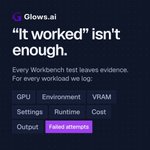
Every Workbench test should leave evidence.
For every workload we run, we're tracking:
- GPU
- environment
- VRAM
- settings
- runtime
- cost
- output
- failed attempts
Because “it worked” isn't enough.
We want to know what it took to make it work.

Before calling an LLM endpoint “production-ready,” measure more than average latency.
Start with: time to first token, output speed, p95 latency, throughput, concurrency, error rate.
A demo tells you it works. Measurements tell you whether it can serve users.
The cheapest GPU listing is not automatically the cheapest workload.
For batch workloads that checkpoint cleanly, maximizing the lowest available hourly price can make perfect sense. For interactive development, inference and workflows with expensive setup, predictability can matter more.
The practical question is: What is the cheapest reliable way to complete this workload?
A RAG demo is easy.
A useful RAG system needs more than a nice chat window.
You still need to think about: model choice, retrieval quality, data, latency, storage, access, deployment.
The interface is the visible part. The workload is underneath.
Hit a rate limit on a Sunday?
Rent the GPU, run the model yourself, set your own pace.
Your weekend build deserves better than "try again later."
How to Build : glows.ai/article
The two ways teams burn compute budget without noticing:
Idle. The GPU is on, nothing is running, the meter is.
Overprovision. You sized for the worst hour and pay for it all month.
Neither shows up as a line item called "waste". Both are usually bigger than whatever you were negotiating over.
The roadmaps announced this year are genuinely impressive. Racks with a hundred plus accelerators. A terabyte of memory per GPU. Most of it lands in 2027.
Your deadline is Friday.
Both things are true at the same time. Someone has to build the intelligence factories. Almost nobody reading this is that someone.
You need a bench, the right card, and to start this afternoon.
AI infrastructure is not automatically a team problem.
It becomes one when setup, credentials, storage, ownership or handoffs slow the work down.
A useful checklist:
- Can someone else reproduce the environment?
- Can the team see cost and usage?
- Can work persist across instances?
- Is ownership clear?
Start there.

Bind IP is now available for both Windows and Linux instances on Glows.ai.
Configure ACLs, custom open ports, and IP allowlists to define who can reach each instance.
A smaller, intentional access surface is easier to operate than exposing unused ports.
A100 or H100?
If the answer is always “H100 because it's faster,” we're asking the wrong question.
Start with:
Does the workload fit?
How much throughput do you need?
How sensitive are you to latency?
How long will the GPU stay busy?
What is the cost per completed job?
Performance matters. Useful performance matters more.
