
Postdoctoral fellow (WiMi) at the LMU Munich, a scholar of Jewish thought and cultural history, and usually a somewhat bearable person
Joined May 2010
- Tweets67
- Following392
- Followers103
- Likes190







In a recent interview with BR24, I had the chance to explain why Netanyahu is a terrible and dangerous reader of the Bible, and even to say something about my research on Talmud and Zionism. br.de/nachrichten/deutschlan…

Is the Sinai Desert actually in Odessa? I spoke at the summer school for Jewish Studies in Hohenems, about Moses in early Zionism and how Ahad Ha’am, Herzl, and Lilienblum claim authority over the meaning of Sinai and the wandering through the desert. youtube.com/watch?v=5nAnz8Om…

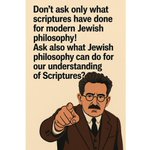
Last week, I spoke about what would happen if we started reading modern Jewish philosophy as commentary on the Bible and Midrash. I examined the question by looking at Benjamin’s reflections on language, Adamic language, and the silence of Eve. youtube.com/watch?v=_6V6zsnD…
These are abysmal days for Israel-Palestine, but also for the Zionist idea. Today, in our lecture series at the LMU Munich, I will ask, “If and how Zionism can be saved?” and return to the crucial moment in which the Jewish national movement preferred the Bible over the Talmud.

This is one of the first slides for the lecture I am about to give at the Gerd Bucerius Institute online series, at 17:00 (Germany) / 18:00 (Israel). I will speak about Walter Benjamin and his strange relations with the "father of philosophy" - Adam. us02web.zoom.us/j/9785558796…

I wrote this article a few years ago, but it was published only recently; it tells the story of how one lost Piyyut from the Middle Ages enabled S.Y. Agnon and Shalom Spiegel to process the trauma of the Holocaust. academia.edu/128278696/Rethi…

Tomorrow, we are organizing the workshop "Franz Kafka: Local Readings." German, Palestinian, and Israelis will examine the differences between reading Kafka in Munich, Prague, Jaffa, and Jerusalem and ask how Kafka’s stories allow different cultures to meet in times of crisis

I was able to use this picture in a Franz Rosenzweig conference. Finally, a sense of academic achievement

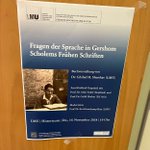
This evening, I will present my book on Gershom Scholem, language, and gender at LMU in Munich. Amir Eshel (Stanford), Galili Shahar (Tau), and Eva Haverkamp (LMU) will comment. We will discuss Scholem's early writings and how we should read German-Jewish thought today.

Gilad Shenhav, PhD retweeted

Wie haben der 7. Oktober 2023 und der sich daran anschließende Krieg im Nahen Osten unsere Sprache verändert? Unser Autor @giladshe geht der Frage in "Israel-Palästina übersetzen" nach: zeitgeschichte-online.de/the…

Gilad Shenhav, PhD retweeted

Die Welt aus den Fugen. Geschichte und Gegenwart des 7. Oktobers 2023
Ein Dossier auf zeitgeschichte | online
zeitgeschichte-online.de/the…

Gilad Shenhav, PhD retweeted

Ein Jahr nach dem 7. Oktober - morgen stellen Gisela Dachs und @giladshe den neuen Jüdischen Almanach "Stimmen aus Israel" @suhrkamp in München vor.
ikg-m.de/7-oktober-stimmen-a…

At the end of a year of Chesbon Nefesh, I am sharing some of my reflections on the experience of writing and teaching about Israel-Palestine in Germany during these abyssal times and the mistranslations involved with it.zeitgeschichte-online.de/nod…
I am happy to share that my book about Gershom Scholem and the question of language has been published in German. Scholem is the “official” protagonist, but the goal of this book is to offer a new methodology for thinking about modern Jewish philosophy, Scriptures, and gender

Link for the introduction: academia.edu/122837542/Intro…


Gilad Shenhav, PhD retweeted

Blick auf Israel: Im Historischen Kolleg in München diskutierten Gisela Dachs, Michael Brenner, Johannes Becke und Natan Sznaider über deutsche Projektionen auf den jüdischen Staat. juedische-allgemeine.de/unse…

In the next two days, I am organizing a conference entitled “Israel: Deutsche Projektionen” in the Historisches Kolleg Munich. The conference will examine how Israel / Palestine has been perceived in the German imagination and discourse from the 19th century to the present.
