

Turning cars into vision-sensors for a connected, collision-free world.
Joined January 2015
- Tweets1.8K
- Following226
- Followers2.4K
- Likes783





Pinned Tweet
Nexar announces AI pioneer @ylecun is joining our Board of Directors as physical AI scales beyond the lab.
The era of simulation is ending.
Real-world learning is the new constraint.
VIsit here for the full press release:
bit.ly/45n8Xek

Nexar retweeted

Our first NETS as Empiric Earth gave us the chance to introduce the new brand in person and show how the work of @getnexar and @NautoInc comes together around a shared goal of making roads safer.
Thank you to everyone who stopped by and joined the conversation. Learn more about Empiric Earth's Fleet Intelligence platform by visiting hubs.li/Q04xMKCq0


A map shows the road. It may not show the work zone that moved this morning.
Read what @empiricearth CEO @ZMGreenb has to say about why AI needs to keep learning from a changing world.

One thing transportation taught me is that knowing what a road looked like yesterday won’t tell you what’s happening there now.
I wrote about what that means for AI and why we’re building @empiricearth.
Read “When AI leaves the screen”: hubs.ly/Q04xyrT50

#Nexar is now part of #EmpiricEarth, bringing Nexar and @NautoInc together to turn what happens on real roads into intelligence people can act on.
Follow @EmpiricEarth as we begin our next chapter, with news, research, and product updates.
Movement data can show that a vehicle braked. Video shows what was happening around it.
A sudden stop looks identical in the numbers whether it was caused by a red light, debris in the road, or a pedestrian stepping off the curb. Without the visual context, all three get logged as the same kind of event, even though only one of them says anything real about risk.
For AV and ADAS teams, that context can help separate common driving events from the rare situations worth adding to training and testing before deployment.
Take a look at what your training data might be missing:
bit.ly/3SVSWZJ
Excited to announce that Atlas has been named a finalist in the AI-Optimized Data Platform category in the 2026 @thecubetv TechForward Awards.
Learn more at siliconangle.com/awards/
Nexar and Nauto have signed a definitive agreement to merge.
300M+ miles every month.
10B+ miles of driving history.
50+ countries.
Built independently of any single manufacturer.
A stronger independent foundation for Physical AI and understanding what actually happens in the real world.
bit.ly/3QAzgcV

One week out from ITS America in Detroit, and we are still buzzing.
Four days at Huntington Place with the leaders, engineers, and public officials building where transportation goes next, having real conversations about AI, autonomy, and safer streets. The energy never let up.
During the conference, our own Mark Pawloski sat down with @Local4News on what Nexar is and how we are helping adress the issues above. Full segment attached below.
Watch it, and visit here for a detailed walkthrough with the team and to learn more:
nexar-ai.com/ibm
#ITSAmerica #RoadSafety
At this year's CVPR, our very own Luc Vincent @ronigoldshmidt , Hamish Scott, and Lorenzo Niccolini presented our paper on BADAS 2.0, Nexar's world model, and took home Best Paper at the AUTOPILOT Workshop.
It's a real milestone for the team. But beyond the win, they came back with a few things we wanted to share in the thread.
And the honest takeaway from it all is that nobody has won this yet. No architecture out front. No company in the lead. The race has barely started.
As Roni put it, whoever gets there first will be whoever actually learned the road.
Again, amazing work from Luc, @ronigoldshmidt , Hamish, and Lorenzo. We couldn't be prouder.
Here's to the work ahead, and to all the milestones to come.
If you want to learn more on BADAS 2.0, visit here and schedule a dedicated walkthrough:
badas.nexar.app/

Until today, "safer than a human driver" was a claim nobody could check. Today, @Lockton and Nexar made it a measurement.
Two AV systems driving the same boulevard at the same hour cannot be compared to each other. Each one's safety record exists only on its maker's terms. Its own miles. Its own disengagement counts. Neither can be compared to the human driver in the next lane.
The new framework measures AV systems against BADAS 2.0, our collision anticipation model trained on 2 million real-world driving events from public roads.
This means "Safer than a human driver" stops being a marketing line. It becomes evidence, on the record, that a third party can check.
When the claim has to clear an outside bar, the systems built to clear it get better. And when the systems get safer, the roads do too.
For the full release visit:
bit.ly/3Sgt6Pi
About one in five fatal work zone crashes in the U.S. is a rear-end collision. A driver, doing everything he was told, hitting something that shouldn't have been there.
The problem usually isn't carelessness. It's mismatch. The cone isn't where the sign 200 feet back said it would be. The taper is sharper than the diagram. The driver does the right thing for the work zone they were briefed on, not the one they're actually entering.
Agencies face the same mismatch from the other side. The plan that went out at 7 a.m. has drifted by noon. Nobody has filed anything. The next inspection is Thursday.
That's the gap we're coming to ITS America to talk about. Continuous ground truth from 350,000+ in-vehicle devices covering 98% of U.S. roads, now available through IBM watsonx Orchestrate - so DOT teams see what drivers are seeing, inside the systems they already use.
The conference opens two weeks from today, right as summer construction hits full stride and the longer evenings push more work into the hours when the data says it's most dangerous.
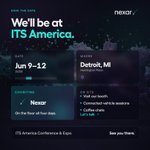
We'll be there. June 9–12. Huntington Place. Come say hi to our team on the ground.
For more on the work and the agent, visit here:
bit.ly/4nONset
#WorkZoneSafety #Nexar

Memorial Day weekend is almost here, and the part of the road that gets the most coverage is not the part that matters most for safety.
Last year on the holiday Monday, commercial road activity in U.S. cities was down 22.9%. The drivers still working averaged 21.65 mph, the fastest urban pace of the month.
A faster road is not a safer one. With less commercial traffic to slow things down, a working driver's instincts for a Monday in their city do not quite match what is in front of them.
To everyone on the clock this Monday: drive carefully out there, and thank you.
For the full case study:
nexar-ai.com/case-study/memo…

We are heading to the @ITSAEvents conference in Detroit next month, and bringing with us a way for agencies to see what's actually in their work zones, not what the last report said.
Work zones don't sit still. Cones get moved, barriers shift overnight, lanes open and close through the day. Inspectors can't be everywhere, self-reports lag, and complaints arrive after someone has already swerved.
Most mismatches are minor. Some are catastrophic. 899 people died in U.S. work zones in 2023 - most of them drivers, not workers.
What we're bringing is continuous ground truth from 350K+ in-vehicle devices covering 98% of U.S. roads. Now plugged into agency workflows through @IBMwatsonx Orchestrate.
We'll be there. June 9–12. Huntington Place. Come say hi to our team on the ground.
For more on the work and the agent: nexar-ai.com/ibm
#WorkZoneSafety

This Friday, May 15th, is National Bike to Work Day. An estimated 100,000 Americans will leave the car at home and ride.
Last year's data has something useful to keep in mind.
On May 15, 2025, we recorded 358,419 rides across our network. Hard braking and cornering held essentially flat against the prior six Thursdays. Harsh acceleration ticked up about 4%.
The day tens of thousands of additional cyclists were on the road, the fleets around them did not spike in the events that come before a crash.
Another pattern is worth knowing about before Friday, and it reflects a seasonal change:
high-G impact rates in our data climb from ~800 per million rides in early April to 1,000–1,300 by late May. The seasonal curve is steeper than anything a single event day moves.
So take note: The road you are rolling onto Friday morning is, per mile, more impact-prone than the road in March.
For the full case study visit here:
nexar-ai.com/case-study/bike…
Enjoy your rides, and stay safe out there!
#BikeToWorkDay #RoadSafety #Nexar
The AI industry is realizing what we have known since 2015: Autonomous AI that moves through the physical world needs the physical world underneath it.
In their article a few days ago, @CurbivoreNews reported two of the largest mobility networks are now building real-world data programs to feed their AV partners.
Our CEO @ZMGreenb, quoted in the piece, explained how real-world data and operations as the groundwork have transitioned from "nice things to have", to required infrastructure for autonomous deployment.
The contrarian position we had 11 years ago, has now the consensus.
For the full article visit:
thecurbivore.com/p/detroits-…

371 fewer pedestrian deaths in the first half of 2025.
Down 11% year over year, the biggest drop in fifteen years of GHSA tracking.
371 more people who got to celebrate a birthday this year, sit through a graduation, call their kids on a Tuesday.
To the engineers, the planners, the cities, the drivers who paid more attention this year than last: well done. The work is working.
Let's keep it going.
For the report, visit here:
ghsa.org/resource-hub/pedest…
What a moment for our CEO Zach Greenberger.
Tune in live, tomorrow morning to seem him on IBM THINK's main stage:
lnkd.in/e54seSKc
#IBMTHINK #PhysicalAI #Nexar
Tomorrow I'm on the main stage at IBM THINK 2026.
Wild sentence. I used to work at @IBM. I watched those stages from the crowd.
Now I'm bringing @getnexar to that stage with a real-time intelligence layer for cities improving road safety with real-world data.
From IBMer to IBM Think main stage. Circle complete.
#IBMTHINK #PhysicalAI #Nexar