Not on Twitter for anyone’s approval. Retweets are not endorsements. #TechEvangelist #Rajagirian #BeliveInPeople
Brantford, Ontario
Joined April 2014
- Tweets1.6K
- Following241
- Followers374
- Likes4.3K




Pinned Tweet
You don't write the code - the vibe writes through you. #WordOfTheYear

There's a new kind of coding I call "vibe coding", where you fully give in to the vibes, embrace exponentials, and forget that the code even exists. It's possible because the LLMs (e.g. Cursor Composer w Sonnet) are getting too good. Also I just talk to Composer with SuperWhisper so I barely even touch the keyboard. I ask for the dumbest things like "decrease the padding on the sidebar by half" because I'm too lazy to find it. I "Accept All" always, I don't read the diffs anymore. When I get error messages I just copy paste them in with no comment, usually that fixes it. The code grows beyond my usual comprehension, I'd have to really read through it for a while. Sometimes the LLMs can't fix a bug so I just work around it or ask for random changes until it goes away. It's not too bad for throwaway weekend projects, but still quite amusing. I'm building a project or webapp, but it's not really coding - I just see stuff, say stuff, run stuff, and copy paste stuff, and it mostly works.
Jithin Anchanattu (h/eng) retweeted

Important: we have a video showing a couple of police personnel inside a detention van, in an isolated area, seemingly crushing and choking someone. we’ve tried uploading it across platforms, and so have our friends, but it just won’t upload anywhere.
we don’t know what’s going on. is this some new Israeli technology to protect these Delhi police criminals?
this must be investigated ASAP.


Jithin Anchanattu (h/eng) retweeted

🔴 BREAKING: The United Nations has urged the immediate release of all people it says have been arbitrarily detained during protests in India.

Jithin Anchanattu (h/eng) retweeted

Hello @DelhiPolice
Will you be arresting this goons, who are assaulting a teenage girl and trying rip her cloths?
This happened in front of Delhi Police officers!
Shame on you @AmitShah

Jithin Anchanattu (h/eng) retweeted

Wow! What coordination!
Delhi Police personal signals the goon to stop the camera person from recording. He immediately threatens the cameraman from recording.


Jithin Anchanattu (h/eng) retweeted

This is horrific!
With such a heavy police deployment across every inch of Central Delhi, how can a mob suddenly appear out of nowhere and beat peaceful protesters?
Were they intentionally given a free hand to do so?
@DelhiPolice must answer!


Jithin Anchanattu (h/eng) retweeted

#India: We are concerned by reports of mass detentions of demonstrators, protest leaders, members of civil society organisations, lawyers and journalists, before and during today’s large-scale demonstrations in Delhi.
We call on the authorities to ensure that the right to peaceful assembly is fully respected and fulfilled.
ohchr.org/en/press-releases/…

ALT India: All those arbitrarily detained must be immediately and unconditionally released


Jithin Anchanattu (h/eng) retweeted

We'll be spending a lot more time trying to understand the outputs of language models. A few thoughts, tips & tricks:
Writing. Something I've had success with: Ask your LLM to explain something in ASD-STE100, it's a controlled language specification originally developed for aerospace maintenance documentation. LLMs well-versed in this language and it comes with heavy constraints on clean writing style that I often find a lot more readable. Sometimes I've tried to soften it a bit e.g. ask for "80% of the way to ASD-STE100" because the spec is quite stringent. But even better:
Diagrams / images. Instead of writing, ask your LLM to create a diagram. These can be a lot easier to process, parse, and understand. But even better:
Web pages. Ask for output "in HTML" to get a beautiful, interactive webpage. LLMs are getting really good at frontend and can create beautiful experiences, animations, etc. But even better:
Explainer videos. The output format I am most bullish on is fully custom / bespoke explainer videos generated on any arbitrary topic. Experiment with things like "Create a 3b1b style video explainer on X. Use my ElevenLabs API key for audio narration". (you'd need an API key for the latter or you can ask your LLM to find you decent free alternatives that use your local compute). This is actually starting to work!
In summary:
- As LLMs get better, they will do more and more of the legwork autonomously, and a lot more of our work will rise up the abstractions into oversight and understanding.
- Luckily, LLMs can help here too because as intelligence and code are increasingly abundant, you can ask for large, custom, discardable software artifacts (e.g. web apps, video explainers) that would have never made sense to create before. Push the boundaries here and you'll be surprised.

Jithin Anchanattu (h/eng) retweeted

On Tuesday, the Election Commission said all was well:
The 14 objections by two of its three members were "suggestions," every decision was "unanimous."
With in 48 hours, on Saturday, it issued NINE decisions. Read them against the 14 notes. It's a U-TURN, not in what it says, but in what it does.
And it still leaves some hard Qs unanswered.
Stay with me.
(1/10) 🧵

Jithin Anchanattu (h/eng) retweeted

Be Carney
Born in Northwest Territories, grew up in Edmonton, alma mater at Harvard and Oxford
Professional career: starts at Goldman where he rose to MD of investment banking, then joins Bank of Canada where he became the youngest central banker in G20
As governor, credited for helping Canada navigate the 2008 financial crisis incredibly well
Becomes the governor of Bank of England, first non-Brit to do so. Provided 'steady the ship' mentality during Brexit and big political and economic uncertainty in the UK during his tenure.
Now Canada's most well-liked PM. It's amazing to see an experienced and steady leader bringing competence, class and diplomacy back into politics. Proud to be Canadian 🇨🇦


Jithin Anchanattu (h/eng) retweeted

this is pure f*cking treasure
15 GitHub projects with 1.21M combined stars that can form a real agent stack
specs. memory. web data. documents. context. sandboxes. monitoring. video
01 hermes-agent
▸ github.com/NousResearch/herm…
02 OpenSpec
▸ github.com/Fission-AI/OpenSp…
03 caveman
▸ github.com/JuliusBrussee/cav…
04 Scrapling
▸ github.com/D4Vinci/Scrapling
05 Docling
▸ github.com/docling-project/d…
06 PageIndex
▸ github.com/VectifyAI/PageInd…
07 mem0
▸ github.com/mem0ai/mem0
08 headroom
▸ github.com/headroomlabs-ai/h…
09 Daytona
▸ github.com/daytonaio/daytona
10 TrendRadar
▸ github.com/sansan0/TrendRada…
11 Fabric
▸ github.com/danielmiessler/Fa…
12 spec-kit
▸ github.com/github/spec-kit
13 hyperframes
▸ github.com/heygen-com/hyperf…
14 OpenMontage
▸ github.com/calesthio/OpenMon…
15 AI Engineering Hub
▸ github.com/patchy631/ai-engi…
the loop:
define the job → collect the evidence → parse the docs → save the memory → compress the context → run the code safely → watch what changes → ship the output
the entire stack is open source
save this to build your own business with the help of an AI employee ⭣


Jithin Anchanattu (h/eng) retweeted

Respect where respect is due: Anthropic says Claude completed the first fully computer-checked proof of Fermat’s Last Theorem in 11 days.
Andrew Wiles proved the theorem in 1995. Claude’s achievement was turning an existing proof into a form where a computer can check every logical step.
That is much harder than translating text into code. Human mathematicians leave many steps implicit and rely on results scattered across centuries of research. Those dependencies also need precise definitions and proofs.
Working largely autonomously, dozens of Claude agents produced 13 million lines of Lean code and roughly 29,500 supporting theorems, building on existing human work.
Along the way, Claude also produced machine-checkable proofs of roughly 29,500 supporting theorems across algebra, geometry, number theory and harmonic analysis, including mathematics that had never been formalized before.
That could help mathematicians check new research faster, catch hidden gaps, and rigorously evaluate AI-generated proofs. Kudos, Anthropic!


Checking that a major mathematical proof is correct can take years. Formalization—converting the mathematical reasoning into a form computer proof assistants like Lean can verify—can help.
Last month, Claude completed the first formalized proof of Fermat’s Last Theorem, one of the most famous theorems of all time. This was a project experts thought would take many years. It is the largest Lean proof ever written.
Fermat’s Last Theorem was first proven in 1995 by Sir Andrew Wiles, more than 350 years after it was conjectured. Our proof, which totals over 13 million lines of code, provides machine verification. More importantly, it proves over 29,000 other theorems that the proof requires, across many areas of math which had never before been formalized.
We see this as a major step in the long process of firming up the core of mathematical knowledge, building on work from three centuries of mathematicians and hundreds of contributors to Lean and Mathlib. We are optimistic that AI-assisted verification of mathematical proofs will help reduce the burden of refereeing mathematics in an era where more proofs are being produced than ever before.
You can read about the process on our Science Blog: anthropic.com/research/forma…
And see the complete proof on GitHub: github.com/anthropics/fermat…
Jithin Anchanattu (h/eng) retweeted

生成流程图的skill,确实好用🥰
github.com/tt-a1i/archify
Jithin Anchanattu (h/eng) retweeted

A harnessed LLM agent, clearly explained!
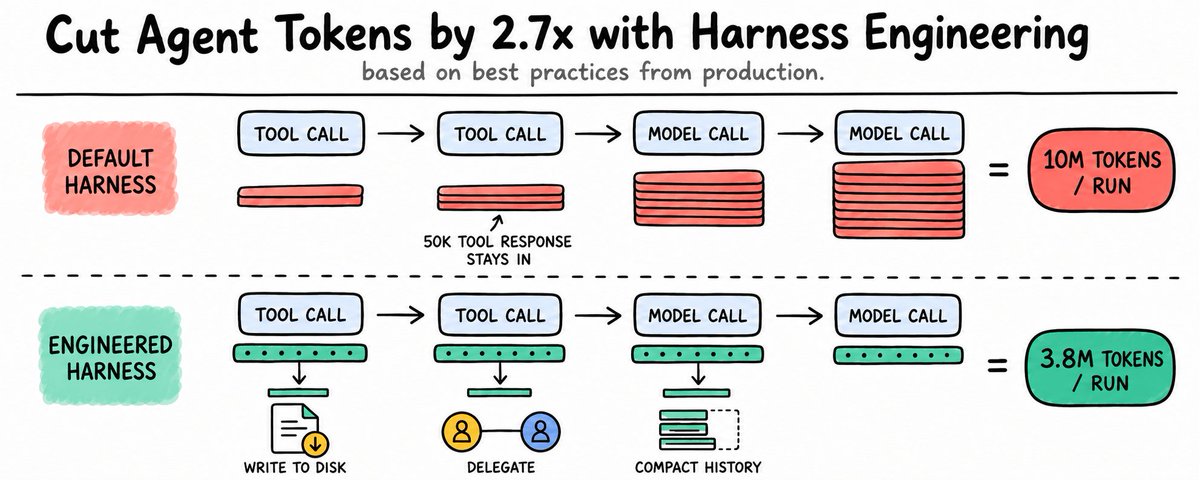
Two agents can run the same model on the same task and finish as expected. But one of them can spend nearly 3x the tokens to complete the task.
The extra usage originates from the code wrapped around them, which decides what reaches the model's context on each call and how many calls there are.
For instance, consider a tool that returned 50k tokens of JSON at some step. If it stays in the context, the model will continue to read that payload again at every subsequent step.
Tool definitions behave the same way.
A server can expose 50 tools, each with a name, a description, and an input and output schema.
By default, all of them will stay in the prompt from the first call, whether the agent uses them or not.
However, an optimally built harness can avoid that unnecessary cognitive load on the model.
More specifically, one core design principle of harness engineering is to push things out of the model at the right time:
- Memory holds the state that weights and context shouldn't carry.
- Skills hold procedural knowledge. These cover the operating procedures and heuristics that specialize a general model.
- Protocols hold the interaction contracts for users, other agents, and tools.
Do note that the context never disappears permanently.
It is always loaded when needed, and the harness decides how much is loaded and when.
For instance, to manage a 50k token payload, a harness can write it to a file and keep a preview and a path in context, hand the work to a subagent whose context is discarded afterwards, or summarize the older messages once the conversation passes a threshold.
If you want to see this in practice, TrueForge is an open-source harness that already implements these practices.
Tool schemas are deferred unless preloading is switched on, large responses go to a sandbox file, and generated code calls tools back through the harness, so the sandbox never holds the credentials.
The two agents I talked about at the top are from DevRev's Enterprise-Bench. TrueForge solved the same number of tasks as Claude Managed Agents on the same model, using a bit over a third of the tokens and around 40% fewer tool calls.
Here's the GitHub repo: github.com/truefoundry/truef…
(don't forget to star it ⭐ )
I also wrote a full breakdown of where agent tokens actually go inside a run, covering context accounting, the strategies above, and the benchmark in detail, and TrueForge worked with me to put this together.
Read it below.

Jithin Anchanattu (h/eng) retweeted

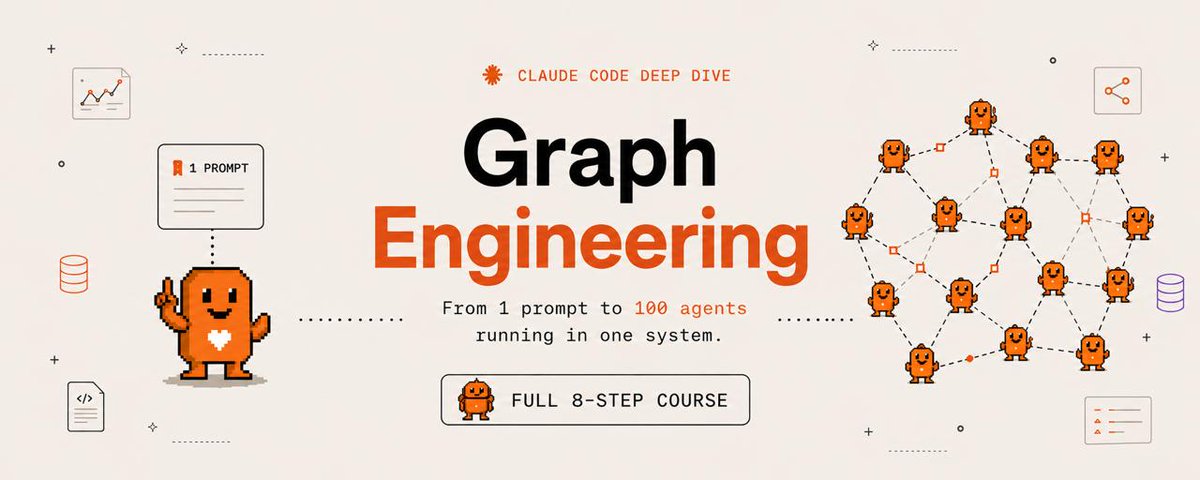
Loops vs. Graphs, clearly explained!
loops are great, but they have a ceiling:
a loop makes one unit of work better. it cannot decide which units exist.
so you end up with a very good agent running the wrong three steps, in the wrong order, one at a time.
Graph engineering fixes this by moving the decision up a layer: what runs, what runs at the same time, and what never runs at all.
you need both. here's how it works:
a graph splits your system into two kinds of decision.
↳ inside a unit: the loop. produce, check, correct, repeat until green
↳ between units: the graph. split, fan out, merge, gate, send back
Prompts → Context → Harness → Loops → Graphs
you get parallel work, isolated contexts, and steps that stop running when nothing needs them.
the trick is being selective about what becomes a node.
only spend a model where judgment lives. merging, ranking, deduping and schema checks are edges, and edges are code.
free, instant, and they cannot be argued out of a verdict. a graph where every edge is an agent pays rent on its own wiring.
one thing to know before you scale it.
a graph has two return paths, and almost everyone builds one.
↳ the correction edge is short. a gate rejects one unit back to the step that produced it, and it fixes the run you are in
↳ the learning edge is long. an accepted result goes back to the splitter as a constraint, and it fixes every run after
skip the second and you get a graph that is fast and never gets smarter. next week it starts from the same place with the same blind spots.
and a smaller one that eats whole nights: when a unit fails, return that unit, not the batch.
send back four slices because one failed and you have just rewritten three correct ones. do it twice in a run and the run never converges.
below i have quoted my full guide on graph engineering. it covers the three topologies, the verifier patterns, and where the gate should actually open.
save this and read it below ↓