

https://xitter.cf/t.co/C29dd0Anou Light is the original condition.
Joined January 2026
- Tweets783
- Following62
- Followers4.2K
- Likes1.7K





Pinned Tweet
Your skin absorbs around 90 J/cm² of red and NIR photons per hour in sunlight. Spend a day outside, some time in direct sun, some in shade... and you're looking at 400-600+ J/cm²


With the levels of autism we have on the Chroma team, theres zero chance you'll find our Sky Portal or Bulbs making a sound 😂🤷
Don't even get me started on flicker awareness...


CHROMA retweeted

The real tragedy, besides the human health cost, to creating a society that uses conventional LEDs 24/7 is the loss of ambiance
Places no longer have a character because the lighting has gone to shit
If you work on a computer, pay attention.
What if the light you work under had an impact on your body and mind?
We've thought a lot about fixing light exposure, UV to IR in any given situation.
Light is fundamental to being human.
Evidence keeps piling up.
How's your light?

A wavelength of light mostly missing from indoor lighting completely prevented experimental myopia.
Researchers put a very strong prescription lens in front of the eyes of young tree shrews to make their eyes grow longer than normal.
Under standard warm-white LEDs, the eyes became severely nearsighted (up to −11.6 D).
Adding indigo wavelenghts of light (419-446 nm) prevented the elongation and the eyes stayed around 0.4 D.
Sunlight contains more indigo light than indoor LEDs, which might be one of the reasons why spending time outdoors is protective against myopia.
DOI: 10.1016/j.xcrm.2026.102999


Thanks for the chat, Dr. Bradford, it was a pleasure!

00:00 Introduction and guest introduction
02:03 Meet Matt, CEO of Chroma and his background
04:04 Why modern LED lighting is mismatched with biology
05:02 The spectral shape of LED lights and health impacts
06:16 Nuance around blue light and circadian signaling
07:04 Shifting the spectrum for biological signaling
08:02 The importance of light intensity and spectrum
09:32 Flicker in LED lights and its effects
11:41 Detecting flicker and its health implications
14:03 The new light product: the bulb and its features
19:21 Designing optimal indoor light environments
23:53 The role of natural light and architecture
26:16 Practical tips for healthy lighting at home
28:51 Living in harmony with natural light and technology
TBH pretty close to the prototype of our Ironforge device back in the day. The time to overheat was on the order of a single minute 😄

Hypersonic heat 🔥 Sandia’s Thermal Test Complex features a 12-panel radiant heat array that mimics heat loads relevant to hypersonic flight. The array uses 480 custom halogen lamps mounted to water-cooled reflectors to create the heat.
➡️ bit.ly/4h65qWD

What would you accomplish if you had dramatically improved focus, motivation, and always got deep restful sleep?
Could a poor light environment be holding you back? 🤔


Ya'll scooped up The Bulb really quickly!
First batch is sold out. More already in production.
Get on our email list to know when pre-orders are open for the next batch.
Thanks for the love!
getchroma.co/products/the-bu…

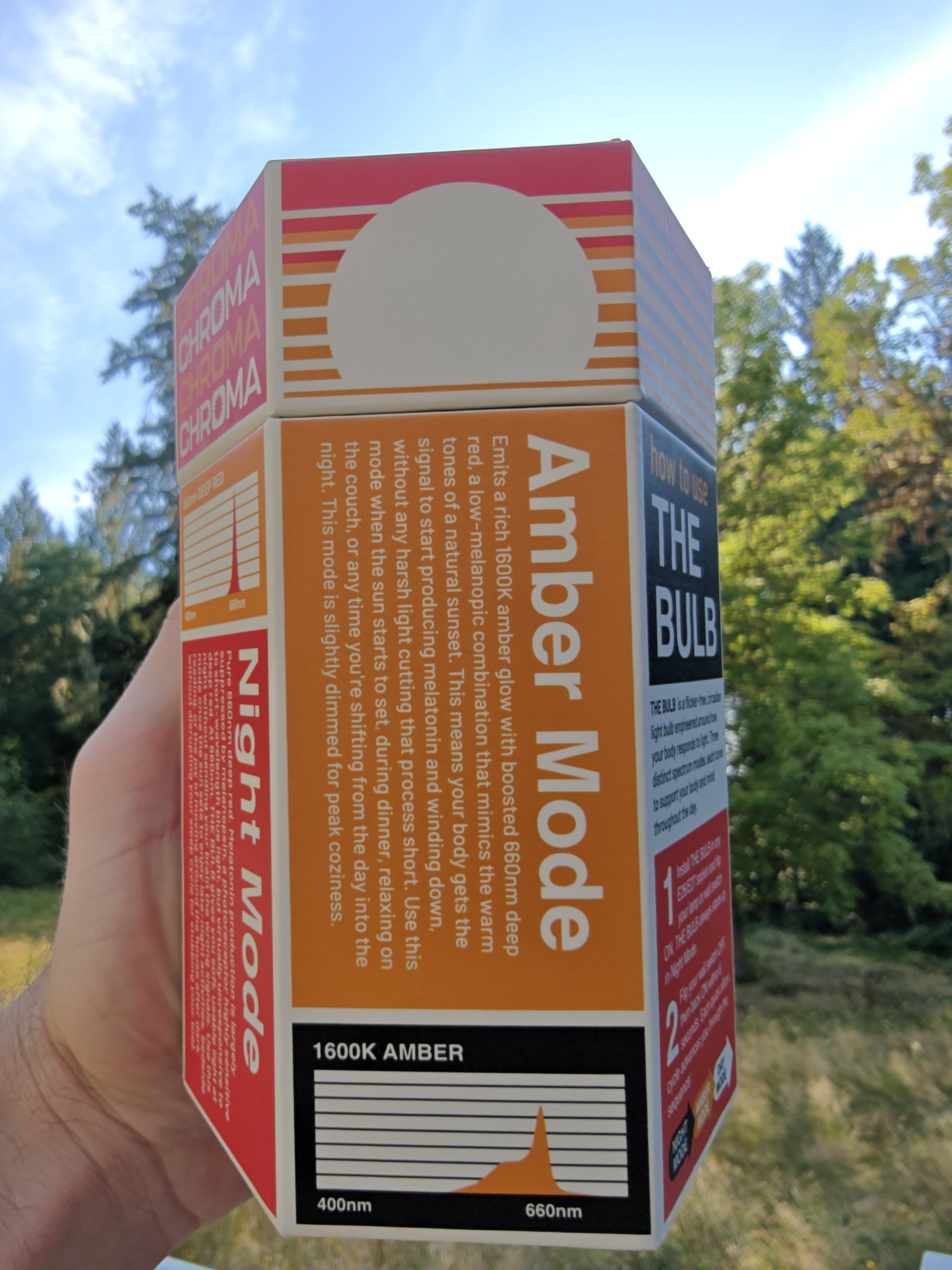
The biggest concern with standard lighting is overexposure to stimulating light in the evenings.
The Bulb solves that with...
Amber Mode : about half as stimulating as candlelight, at the same brightness.
&
Red Mode : almost invasible to the circadian system.


Neuroscientists warns that our reliance on LED light bulbs has created a 'asbestos-level' public health crisis.
It literally starves our cellular mitochondria of vital near-infrared wavelengths.
Modern light-emitting diodes (LEDs) have revolutionized energy efficiency, but researchers are warning that our constant exposure to them may come with a massive physiological cost. According to Dr. Glen Jeffery, a leading neuroscience professor at University College London, standard commercial LEDs lack the essential red and near-infrared wavelengths found in natural sunlight and older incandescent bulbs. This restricted spectrum, dominated by short-wave blue light, directly impacts mitochondria—the powerhouses of our cells. Because mitochondria are light-sensitive and rely on longer infrared wavelengths to optimize energy production, our indoor light environments may be keeping our cellular engines running on empty.
This 'infrared starvation' is linked to a cascade of systemic issues, including slowed metabolism, impaired vision, and poor blood sugar regulation. Dr. Jeffery has boldly compared the widespread adoption of narrow-spectrum LEDs to an asbestos-level health crisis, cautioning that the long-term impact on aging populations could overwhelm public health systems. While critics debate whether the asbestos comparison is too alarmist, the underlying science highlights a growing design flaw in modern lighting. Fortunately, researchers say the fix is incredibly simple and cost-effective: the lighting industry must evolve to incorporate broader spectral ranges, and individuals can counteract the deficit by spending more time in natural morning sunlight or opting for full-spectrum indoor bulbs.
source: Jeffery, G. (2026). LED lighting (350-650nm) undermines human visual performance unless supplemented by wider spectra (400-1500nm+) like daylight. Scientific Reports.

Violet is featured in our Sky Portal desk light.
(We also stripped out the peak of the blue light hazard zone)
The Bulb we just launched includes this range in the Day channel too 👀
A wavelength of light mostly missing from indoor lighting completely prevented experimental myopia.
Researchers put a very strong prescription lens in front of the eyes of young tree shrews to make their eyes grow longer than normal.
Under standard warm-white LEDs, the eyes became severely nearsighted (up to −11.6 D).
Adding indigo wavelenghts of light (419-446 nm) prevented the elongation and the eyes stayed around 0.4 D.
Sunlight contains more indigo light than indoor LEDs, which might be one of the reasons why spending time outdoors is protective against myopia.
DOI: 10.1016/j.xcrm.2026.102999