
Belgium 🇧🇪
België
Joined September 2012
- Tweets9.3K
- Following3.5K
- Followers1.1K
- Likes87.6K



Pinned Tweet
- "Financial sovereignty is the bloodstream that sustains the entire architecture of comprehensive national power."
- "Economic statecraft transforms financial strength into national strength, and financial sovereignty into strategic autonomy."
- "Financial sovereignty is not simply an economic asset; it is the strategic bloodstream that sustains industrial capability, technological advancement, military preparedness and enduring national power."
- "Financial sovereignty is seldom created through isolated reforms; it is patiently engineered through decades of productive capability, institutional continuity, disciplined governance and strategic economic execution."
- "Economic statecraft succeeds when finance, industry, trade, technology and national strategy cease to function independently and begin operating as one integrated architecture of national power."
- "Economic influence is the outward expression of financial sovereignty, just as military power is the outward expression of industrial capability. Nations that command both increasingly shape the strategic architecture of the twenty first century."
- "The balance of power in the twenty-first century will increasingly be determined not merely by military strength, but by financial sovereignty, economic resilience and the strategic architecture of national capability. The strongest economies are not those that merely accumulate wealth, but those that systematically convert wealth into enduring national capability."
- “Financial souvereignty is not the destination of economic growth; it is the enduring capability that empowers a nation to shape its own future with confidence, resilience and strategic autonomy."
- "The destiny of nations will increasingly be shaped not by the wealth they accumulate, but by the productive capabilities they create, the financial sovereignty they preserve, and the strategic wisdom with which they convert both into enduring national strength."
c3sindia.org/post/c3s-issue-…


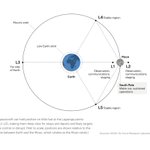
Yes, agreed, but I meant the Lagrange points.
Earth only has 5 Lagrange points (as does the moon). Do you foresee an ’astrostrategic’ competition to more or less ‘control’ these points in space ?


Honest question, Velina: what is your estimate, when will ‘space’ become the next chokepoint ?
When will geostrategy involve (or become) astrostrategy ?

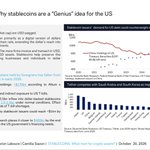
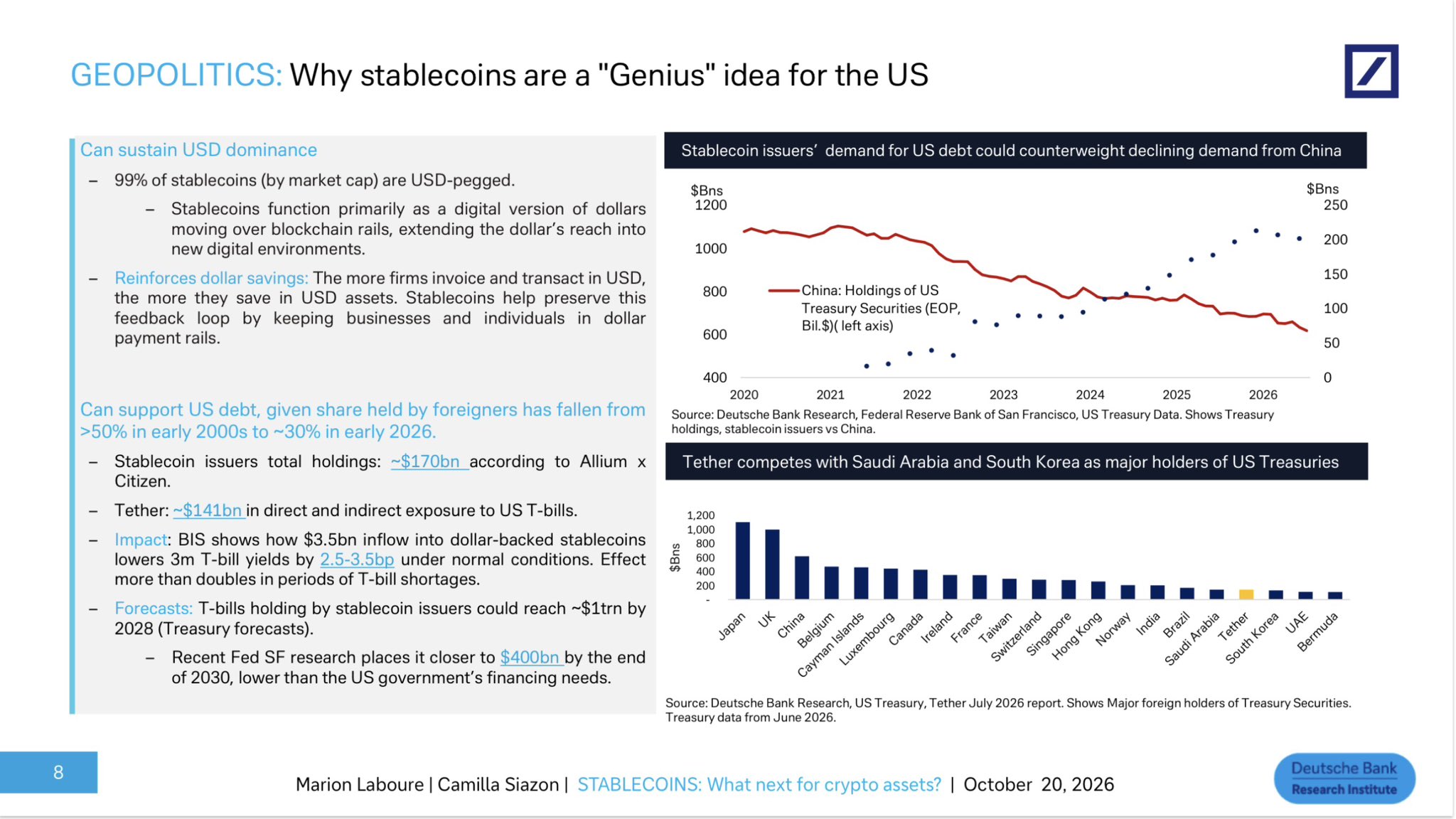
Deutsche Bank Research
Geopolitics: Why stablecoins are a “GENIUS” idea for the U.S.
dbresearch.com/PROD/IE-PROD/…


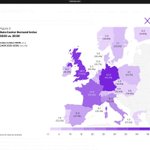
Memo to Sikorski/Applebaum: as long as Russia outproduces NATO in (certain) weapon systems, Russia’s GDP per capita is completely irrelevant.
At least Russia asks itself what its GDP is for. It’s about time we do the same.

This has been Putin's dream for years: That his country, with GDP per capita lower than Poland, unable to conquer Donbas since 2014, will be treated as an equal to the US and China.
wsj.com/world/russia/putin-f…


Must-read NATO-wisdom to run into a brick wall with your eyes wide open (on free trade and open markets from 2010)👇

Speech by NATO Secretary General Anders Fogh Rasmussen at the announcal conference of the Security and Defence Agenda in Brussels
21 June 2010
In my remarks today, I want to focus on three points. First, how a stable, free and open market economy enhances our security.
My first point is the importance of keeping the fundamentals of a free and open market economy.
Trade encourages countries to acquire wealth through production and exchange, instead of through conquest. It encourages cooperation. And it discourages conflict, as countries do not want to jeopardise the stability and prosperity that free trade brings.
Quite simply, nations that trade together don’t go to war against each other because the consequences are too severe. And we benefit from a virtuous cycle – with increased trade encouraging increased security which in turn leads to further trade and prosperity.
This virtuous cycle has been perfectly demonstrated here in Europe. After the end of World War Two, under the security umbrella provided by NATO, former enemies became friends. European nations were able to embark upon an ambitious economic and political integration project, which eventually became the European Union. And after the end of the Cold War, the European Union, together with NATO, were able to spread peace, progress and prosperity throughout our continent.
The ability for countries to trade, for companies to do their business, and for people to earn a living, is very much dependent on a stable and secure international environment. And it is especially dependent on free trade routes. Trade routes through the so called “global commons” – air, sea and land, and increasingly also through space and cyber space. We need to devote sufficient resources to maintaining these free routes if we want to maintain our economic prosperity.
But we need more. We must not only keep these routes open. We must also secure their full potential. And ensure that free trade flourishes.
Therefore we must avoid protectionism.
At times of financial crisis and economic recession, it is often tempting to adopt “buy local” policies, or put up trade barriers to protect national businesses or jobs. This is a temptation we must resist, because experience shows that such moves are counter-productive.
From an economic point of view, protectionist measures offer only a false sense of security to businesses and jobs that are no longer viable. But the consequences of protectionist measures are often felt most severely in those countries and regions that are already fragile.
And there they will only amplify some of the most serious security threats that we have already had to deal with in recent years – such as energy security, water security, food security, piracy, violent extremism and terrorism.
There is a lesson to be learned. If we move away from free market principles in response to the current economic crisis, then we are likely to find ourselves confronted by more fragile economies, vulnerable states and regional instability. If, on the other hand, we maintain a free and open market, we will not only create strong economies and improve economic wellbeing, but also improve security and stability.
nato.int/en/news-and-events/…
Taiwanese travel agencies flouting China travel ban
Some travel agencies are using labels such as “cultural visits” to advertise tours to China despite the government’s ban on organized group travel, sources from the tourism industry said on Sunday.
The number of Taiwanese traveling to China rose 19.63 percent year-on-year to 2.49 million in the first eight months of this year.
Taiwan has maintained the ban since February 2024, allowing only independent trips to China.
taipeitimes.com/News/taiwan/…

Press conference by NATO Secretary General Anders Fogh Rasmussen
09 November 2011
“It is an important agreement. Russian membership of the World Trade Organization will enhance free trade in line with our ambition to engage Russia in a constructive economic, political and security cooperation.”
nato.int/en/news-and-events/…
Apparently you have to adopt ‘free trade’ to get a ticket into NATO ?
NATO-Ukraine Action Plan
22 November 2005
In pursuit of its strategic goal of full integration into the Euro-Atlantic security structures, Ukraine is committed to adapting its internal legislation to Euro-Atlantic norms and practices.
Ukraine will continue to strive for sustainable economic growth and a substantial rise in general living standards.
A key element of Ukraine’s economic strategy is to ensure the economy's openness in conformity with World Trade Organisation’s (WTO) standards.
nato.int/en/about-us/officia…
Speech delivered by NATO General Secretary M. Paul-Henri Spaak
17 November 1958
SNIP:
I mean that we are in a position which seems to me difficult and inferior to that of the Russians. Gentlemen, I do not wish to plead the cause of liberalism nor yet of a planned economy. However, I feel I must say that, as far as aid to under-developed countries is concerned, the Russian planned economy is a considerable advantage to them - a trump card, in fact, for it enables them to act quickly and on a better ground than the one we have chosen.
I am convinced that the future of Western economic policy towards the under-developed countries does not lie in gifts or presents, or in a certain form of assistance which, whatever precautions are taken, always has a slightly superior and paternal character. Our future economic policy towards the under-developed countries must be, like that of the Russians, a policy based essentially on trade relations, but the free world is not, at present, equipped to undertake these negotiations or this policy in an efficient and effective manner. We have a great many economic organisations and it is quite unjust to deny the efforts which have been made so far; it is both unjust and stupid. These economic bodies, however, are too perfect, their economic concepts are too absolute and, I fear, they are not sufficiently inspired by political thinking. What we in the West lack, at the present moment, is a body which would consider all economic problems from both the political and economic angle, as the Russians are able to do.
@TheMichaelEvery
nato.int/en/news-and-events/…
This👇
VW boss Schäfer: “We’re starting now to export to the global south and countries that have easier access from China than Europe, such as Australia and the Middle East.”
@Brad_Setser @SanderTordoir
Volkswagen 'getting ready' to add selected Chinese EVs in Europe
Asked about that plan at the Paris motor show, Volkswagen boss Thomas Schäfer told Autocar: “The big thing about our strength in China is that we have done an exercise to bring down cost in in the vehicle – both material and engineering cost – over the last two years.
"We’ve radically rethought the vehicles and worked with partners here [in Europe] and there [in China]. We’ve set up vehicles that are completely cost-competitive in the Chinese market.
“We've been working with our colleagues in China, hand in hand. So [technical chief] Kai Grünitz and his team have been synergetically working with them. We know exactly every step and we have been working in parallel in our cars. We have not used more of it in terms of export or technology yet.
“We’re starting now to export to the global south and countries that have easier access from China than Europe, such as Australia and the Middle East.
“For the future, we’re getting ready for bringing one or more vehicles in from China.
autocar.co.uk/car-news/new-c…
GLOBALIZATION EUROPE : Has Europe given up on free trade?
SNIPS:
Abraham Newman: Well, I mean, I think politics has changed all over the world. You know, the support for free trade in the United States. I don't think that there's a really a coalition on the left or the right. You don't see the Democrats saying, you know, when we take back power, we're going back to the WTO system. You know, that's not what's happening.
Hosuk Lee-Makiyama: Well, one can say like this Europe is built for a time that is based on predictable, rule based free trade. Sure. And I don't think come back to the previous topic, I don't think Europe hasn't necessarily abandoned free trade, but I think free trade has perhaps abandoned Europe. The, the institutions have built and they perfected over the last half century just doesn't work anymore.
Hosuk Lee-Makiyama: If you want to expand, you need to look at the market shares that will come in the future. In other words, the market as our growing where the markets are now taken and we live now and then the economy, according to the IMF, where half of world growth, 50% is produced by two countries, United States and China. Europe accounts for slightly south of 10%.
Hosuk Lee-Makiyama: And the Russia angle is a really interesting question, because it is true. Russia is weak, but what do you say about 27 countries who can't even win against Russia? Russia has basically one claim in global governance. It has no relevance in the global system except for one, which is that it can create very expensive problems for Europe very cheaply.
dw.com/en/has-europe-given-u…


Trump’s foreign policy: Unconventional in method, traditional in US strategy
What if Donald Trump’s foreign policy is not as chaotic as it looks?
Last year, I argued that beneath the spectacle, contradictions and unpredictability, Trump’s foreign policy had an internal logic. But I stopped short of calling it strategy.
Today, I am more convinced that there is one — grand strategy in fact.
Consider the pieces.
Greenland. Panama. Canada. Venezuela. Iran and Hormuz. Tariffs. Critical minerals. Reindustrialisation. Pressure on allies to carry more of their defence burden. And, increasingly, China.
Viewed separately, these can look like disconnected episodes. Put them on the same map and a pattern begins to emerge.
No conspiracy is required. Nor a secret master plan. Elements of it are set out in the Trump administration’s 2025 National Security Strategy. The question is whether interests, opportunities and events are increasingly converging. They are.
Once seen, the pattern is difficult to unsee.
But this did not begin with Trump.
In 1948, George F. Kennan, one of the architects of America’s Cold War strategy, observed with unusual candour that the United States possessed about half the world’s wealth with only 6.3 per cent of its population. The task of America, he emphasised, was to devise relationships that would allow it to maintain this “position of disparity” without jeopardising its security.
The world has changed profoundly since then. So has American policy. The methods changed. The purpose changed much less: American preponderance remains the strategic constant. And preponderance has never been merely military. It is economic, technological, commercial, financial and diplomatic.
en.philenews.com/op-eds/trum…
