
Rare token hunter. VP growth @labelbox past: Co-founder @upcraftai, CMO @BookCameo, @remoteyear founder
San Francisco, CA
Joined January 2011
- Tweets7.4K
- Following2.4K
- Followers8.2K
- Likes13.9K





My muse is polite but subtly judgmental about how I manage my email…
Making me nervous about the long term risk of this vulnerability with super intelligence
Huge milestone for Labelbox
Crazy it’s been almost a year since Upcraft jumped on board this rocketship 🚀
Great data continues to become increasingly important for models to chase the frontier and we are proud to serve most of the leading labs training the most advanced models in the world.
This capital will enable us to triple down our investment in the most advanced RL capabilities to support our customers.

Today we’re announcing our Series E.
We’ve raised $100M+ led by Infinitum Partners. We believe every company will soon run on agents that learn from their own work.
- For frontier labs, Horizon provides RL environments that teach frontier models to do real work.
- For enterprises, Recursion brings managed agents into the apps your teams already use, improving with every run.
labelbox.com/blog/labelbox-s…


I think token limits are accidentally one of the best growth hacks in AI.
At first you are not really using it in deep ways. It is more like quick questions, small tasks, surface level stuff.
Then you start realizing it actually helps you think, so you bring it into more and more of what you do. Not just tasks, but ideas, planning, problem solving.
Then you hit the limit right in the middle of something and it is genuinely frustrating, like your thinking just gets cut off.
So the next token window that opens, you do not hold back anymore. You use it earlier, you use it more, and you end up going way deeper than you planned.
You feel a deep need to use every token you get.
Greg Caplan retweeted

Manu (@manuaero) joined Jason Calacanis on This Week in AI alongside @sarahookr (Adaption Labs) and @spirosx (Resolve AI) to break down the rapidly shifting AI landscape.
From the Token Price Wars and Demis Hassabis’ recent call for an AI oversight board, to the Uber vs. Waymo robotaxi battle, and a reality check on whether orbital data centers are science fiction or closer than we think (Manu’s aerospace engineering background came in handy) 🚀
A few key insights from Manu:
- Proprietary intelligence is the new edge: As base model costs decline, the real winners will be defined by what they own: proprietary data, customized RL environments, deep domain expertise, and continuous feedback loops.
- From models to moats: The narrative is shifting. The biggest opportunity is not building another general frontier model, but architecting intelligence systems around an enterprise’s unique workflows and expertise.
- Owning the enterprise intelligence stack: General purpose AI will continue to raise the baseline for everyday productivity, but true industry differentiation, whether in banking, pharmaceuticals, or manufacturing and beyond, will come from owning the proprietary knowledge layer that compounds over time.

X feed is so much better now that we can hang out together again.
Content was so impersonal and empty without the connections
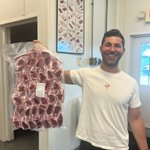
Four lambs’ worth of lollipops, straight from the farm. 🐑🔥
This weekend I grilled for three families at the lake house, and the star was fresh, never frozen lamb from Pinn-Oak Ridge Farms in Delavan, WI.
The Pinnow family raises their flock on a special grain-finishing diet and processes everything right on the farm, so the meat you pick up was walking the pasture just days earlier. Their butchers cut these racks to order into lollipops.
You can taste the difference immediately: mild, sweet, unbelievably tender. No gaminess at all. Just salt, pepper, and oregano, a hot fire, and a few minutes per side. That’s it.
If you’re anywhere near southeast Wisconsin, take the drive. This is the same lamb top Milwaukee and Chicago restaurants source, sold at the farm door.
📍 Pinn-Oak Ridge Farms, N5784 Johnson Rd, Delavan, WI


If the frontier labs start losing that much market share to open source models due to pricing, won’t they just lower their margins and get the market share back with more valuable tokens that are slightly more expensive rather than much more expensive?

The mega bull case for AI infrastructure would be *if* market share shifted away from certain frontier labs with 90%+ inference margins toward cheaper models, whether open-source or closed.
It would increase the ROI on AI spend for end customers by increasing intelligence per dollar, which would drive incremental token demand. Margin dollars would effectively get redistributed from the frontier labs to AI infrastructure providers. The infra winners would be those with the lowest per token cost and the winners at the model layer would be those with the highest token efficiency.
There are many reasons Jensen is so focused on open source, but this is likely the most important one as I think he is probably less worried about a monopsony these days. Lower margin % at the model layer = more margin $ at the infra layer all else equal.
With SpaceX and Meta being vertically integrated and possessing the #3 and #4 models respectively it is more possible than ever. Note that Grok 4.5 is ahead of Fable for some useful tasks at a much lower cost, so ranking them #3 is conservative.
This is not happening yet. Cheap, mostly open source tokens are likely the majority of volume today but the majority of economic value is still accruing to the most intelligent models. Might change though.
We will see.
The agent manager era is dead.
In the last cycle, models could hold context for four-hour horizons. You needed humans babysitting agents, checking in at every checkpoint, course-correcting. It was management theater.
The new class of models? They run indefinitely. They reason across hours, days, task chains you couldn’t dream of before. The bottleneck isn’t human oversight anymore. It’s tokens.
We’re moving from a world of agent managers to a world of resource allocators. You don’t manage agents. You architect them. You decide how much compute goes where. You federate fleets across problems. You let test-time compute run until it solves it.
The tools we built for the old paradigm are obsolete. We need resource allocation systems that understand trade-offs between tokens spent, quality achieved, and problems solved.
But here’s what nobody’s talking about: the teams that figure this out will spend compute like we’ve never seen. The demand curve flips. Suddenly you’re not optimizing to conserve tokens. You’re allocating them like capital. Billions of tokens on single problems if it moves the needle.
That reshapes everything. GPU demand, chip manufacturing, inference infrastructure. We’re not just entering a new era of AI use. We’re about to see demand that makes current infrastructure look quaint.
The gatekeepers are gone and almost nobody has noticed.
Your hero posts at 11pm. Your dream mentor answers DMs. The person whose work changed your life is sitting there refreshing their feed.
Stop waiting for permission and shoot your shot.
Everyone’s talking about routing to cheaper models, but they’re optimizing for the wrong metric. Yes, a smaller model costs less per token. But here’s the thing: it needs way more tokens to reach the same quality output. You end up spending more in aggregate.
There’s a Pareto frontier emerging in model economics. On one side, expensive models that solve problems with fewer, higher-quality tokens. On the other, cheaper models that need more attempts, context, and retries to get there.
But it goes deeper. Capable models can handle complex, meta-level tasks in a single pass. Cheaper models force you to break everything into smaller subtasks and route each one separately. Each routing multiplies tokens. You’re not just paying more per task, you’re paying for decomposition overhead that smarter models sidestep entirely.
The real arbitrage isn’t token price. It’s capability per dollar on total task execution. Route to the model that solves your problem cleanly, completely, in one pass. That’s where the economics actually work.
Getting a client to finally say "add me on Slack" is the same courtship millennials ran to earn a crush's AIM screen name in 8th grade. You don't just get the handle. You earn your way to it.
Then the green dot owns you forever...
There is going to be a cohort of Americans that spike on wealth tied to being born when these massive gifts happen this year

SpaceX President and COO Gwynne Shotwell and her husband have announced that they are donating ~$325 million of SpaceX stock to Trump Accounts for more than two million children across the U.S.
Every one of those kids will now have a direct stake in a company whose mission is the most ambitious in human history: to make life multi-plantary 🚀


This is a step function change in capabilities and will trigger the whole community to rethink how we use these tools.
Engineers can send fable off on much more complex missions than opus and trust it will come back with valuable results when it’s done.