


Pinned Tweet
If I started Bookipi today, I'd hire differently.
AI is making traditional job titles less relevant. I still value deep expertise, but I'd bet on people who can learn, adapt and build beyond their roles.
4
7
550
I don’t think small business owners want to manage a team of AI agents.
If someone calls a plumber to request a quote, the plumber shouldn’t have to work out how to connect their AI receptionist to their CRM, quoting software and calendar.
The software should already understand how those things work together.
We spent years giving small businesses more tools to run their businesses. In some cases, we also gave them more work.
I’d hate to see us repeat that with AI.
A business owner should be able to focus on the job they’re getting paid to do.
Would I still learn to code if I were starting Bookipi today?
I taught myself how to code using YouTube while working as a tiler. If I had access to today’s AI tools back then, I probably would have built my first app a lot faster.
I’d still want to understand how software works, though.
Learning to code helped me understand what was possible, what was difficult and how to turn a business problem into a product.
I think AI will bring a lot more people from outside the tech industry into software.
Some of the best opportunities might come from people who have spent 10 years working in an industry and have never written a line of code.
AI is getting cheaper. That doesn't mean AI companies are getting more profitable.
We're seeing an incredible amount of money poured into models and infrastructure while the cost of intelligence keeps falling.
As someone building AI products, I think the economics are becoming more interesting than the technology itself.
I've become less interested in which model wins the latest benchmark and more interested how often does a human need to step in
An agent completing 10,000 tasks sounds impressive. But if half need human intervention and the costs exceed the value created, what have we achieved?
As models become cheaper and more capable, the opportunity for companies like Bookipi is enormous.
Workflows that were too expensive to automate could finally become affordable for millions of small businesses.
I wrote about this for Forbes and why I think AI business models need to catch up with the technology.
forbes.com/councils/forbeste…

3
7
110
Would customers still want your product if you switched off the AI?
I’ve been thinking about this as we plan what to build next year.
There’s a temptation to put AI everywhere because it’s “exciting”, but if the underlying product isn’t useful, adding AI probably won’t fix it.
I want us to build products that are already good at solving a problem, then use AI to make the experience much better.
I think that’s a more sustainable way to build an AI company.
4
75
Some of the best product improvements come from people who don’t write code.
Support knows what customers keep struggling with. Sales hears why people don’t buy. Designers see things engineers might overlook.
AI is making it possible for more of these people to contribute directly to the product.
I think that’s a good thing.
It doesn’t mean everyone suddenly becomes an engineer. We still need people who understand architecture, security and quality.
But I’d rather have a company where talented people can solve problems than one where every improvement has to wait for the right department.
1
59
Anthropic’s IPO shows just how much money and attention AI is attracting.
But there’s still a huge disconnect between the AI industry and everyday small businesses.
At Bookipi, we surveyed over 2,100 small business owners. Only 16% said they were using AI for finance, compared with 36% for marketing.
While the industry is racing to build more powerful models and autonomous agents, most small business owners are still trying to manage invoices, get paid on time and keep their finances organised.
The technology is advancing incredibly fast, but adoption in the businesses that make up much of our economy is still at an early stage.
I think the next big opportunity is closing that gap.
Making AI simple, reliable and affordable enough that a plumber, cleaner or shop owner can benefit from it without needing to understand how any of it works.
3
3
167
AI is making some of our old ways of working look pretty ridiculous.
You can generate a working prototype in 10 minutes, then spend three days getting people to review it.
We’ve spent years creating processes to manage how work moves between people.
A lot of those processes made sense when building things was slow and expensive.
Now I’m questioning how many we actually need.
I think companies that simply add AI to their existing processes are going to be disappointed with the results.
The bigger opportunity is changing how the company operates.
37
If everyone agrees with me in a meeting, I get a bit worried.
As a founder, it’s easy to end up surrounded by people who assume you’ve already thought everything through.
I definitely haven’t.
I want people who question my decisions and tell me when they think there’s a better way.
Sometimes the discussion gets uncomfortable, but I’d rather have that than a team quietly working on something they don’t believe in.
Being the CEO shouldn’t mean having the best idea in the room.
1
3
40
I've started paying much more attention to how we review work at Bookipi.
AI makes it easy to produce something that looks finished. A design can be impressive or the code can run and the person who created it can feel they've done a great job.
But, someone still needs to look at the whole experience.
Does it make sense to the customer? Is it simple enough? Would we be happy putting our name on it?
I think the companies that get the most out of AI will also be the ones that become much stricter about quality.
The cost of creating something is falling. That doesn't mean our standards should.
1
38
This is only going to accelerate.
AI companies are moving from providing the intelligence to building the products themselves.
If you’re building software that AI can easily replicate, you need a stronger moat. Network effects, distribution, proprietary data and deep customer relationships will matter more than ever.
The cost of building software is collapsing. So are the barriers to competing with it.

Introducing Claude Meetings: add Claude to your team’s video call and it builds docs, whiteboards, and other artifacts with you while you’re still talking.
Starting to roll out in beta on Team and Enterprise plans.
1
42
One of the biggest mistakes a founder can make is becoming too important to their own business.
In the early days, you do everything. You make every decision, solve every problem and know every detail. That’s often how you survive.
But as the company grows, those same habits can start holding it back.
I’ve come to believe that a founder’s job is increasingly about building the people, systems and culture that allow the company to succeed without their constant involvement.
That means hiring talented people, trusting their judgement, giving them ownership and accepting that they won’t always do things exactly as you would.
AI is making this transition even more interesting. Small teams can now take on responsibilities that once required entire departments.
The real challenge for founders is learning when to step in and when to get out of the way.
A successful business shouldn’t depend on how much its founder can carry.
I used to think being a good founder meant having the answers.
Now I think a big part of the job is finding people who see things you don’t.
The hard part is actually listening when they tell you you’re wrong.
It’s hard to be a founder!
1
1
30
AI can get you 98% of the way to a finished product.
The problem is that 98% can look pretty convincing.
The design looks good. The code works. Everything seems ready to ship.
Then someone with good judgement looks at it and asks why we built it that way.
That's becoming one of the most valuable things people can contribute.
I don't want our teams to get better at accepting AI output. I want them to get better at questioning it.
1
28
We built our first payroll software in about two months.
There were two of us. Neither had a background in payroll or accounting.
I'd heard about a regulatory change that would affect businesses across Australia, and we decided to build for it.
Around 1000 customers signed up in the first month.
I'd spent years trying to figure out how to get people to use my products. This time, customers already had a problem they urgently needed to solve.
It changed how I thought about finding product-market fit.
2
4
53
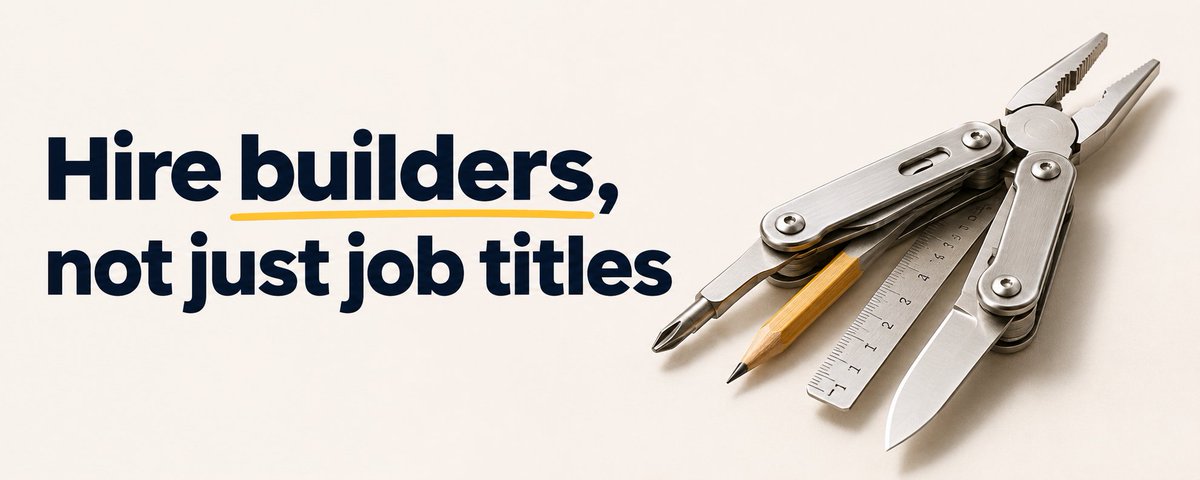
If I started Bookipi today, I’d probably ignore half the job titles we hired for.
For years, we’ve built software teams around specialists. Product managers write requirements, designers create screens, developers build, and testers check the work. It made sense when each role required a different set of skills.
AI is changing that.
If I were starting again, I’d focus much more on finding talented people who are curious, adaptable and good at solving problems, rather than hiring for a specific set of skills.
The skills we need today might be completely different in two years. I’d rather hire someone who can learn and evolve than someone who’s excellent at one thing but struggles when that thing changes.
I also think the best people want this. They want to learn, challenge ideas, take ownership and see the impact of their work.
We’re moving in this direction at Bookipi. It’s not about having fewer people. It’s about giving talented people the tools and freedom to do much more.
I’d bet on adaptable people over fixed job descriptions any day.
2
3
112
Canva's restructuring caught my attention. They're moving away from highly specialised roles towards smaller teams where people can do more across different disciplines.
AI is changing what it means to build software. Product managers can prototype, designers can code, and engineers can get much closer to customers. The traditional boundaries between roles are becoming less relevant.
I've been encouraging our teams to think of themselves as builders rather than specialists. People who can take a problem, work out what needs to happen and use AI to get it done.
I also think we're going to value human judgement much more. When almost anyone can build something, knowing what to build and whether it's actually good becomes far more important.
The way we organise software teams will look very different in a few years.
techcrunch.com/2026/11/04/ca…

2
49
The upgrades that are easy today get a lot harder once you're past a few thousand customers. Worth remembering while the number's still small.
1
39
Tim retweeted

I recently joined Melissa Bill on The Business Roundup to discuss how we’re using AI to rethink marketing and operations at Bookipi.
AI is making it possible for smaller teams to take on work that would have required entire departments just a few years ago.
But there’s quite a gap between using AI tools and actually changing how a business operates.
At Bookipi, we’ve been experimenting with how AI agents can take on meaningful work across marketing and operations. Some experiments have worked remarkably well. Others have reminded us that automating a poorly designed process just makes it inefficient at a much faster pace.
The biggest challenge hasn’t necessarily been the technology. It’s been rethinking how work gets done, helping teams adapt and figuring out where human judgement still adds the most value.
We’re still figuring plenty of things out, but that’s part of what makes this transition so interesting.
Thanks to Melissa for having me on.
Listen here:
open.spotify.com/episode/6Rg…
