
Speech, TTS & Gemini @google. Ex chemical Engineer (fuel cells, batteries, oil & gas). Now speech Synthesis, ASR, RL, NLP.
Brooklyn, NY
Joined May 2014
- Tweets1.1K
- Following392
- Followers341
- Likes4.7K





Pinned Tweet
Some fun TTS samples for the current US political climate: soundcloud.com/gary-wang-23/…

Gary Wang retweeted

Introducing REKI, a 2.4B vision-language-action model pretrained on public data only. With a simple design, it rivals larger models trained on in-house data with complex multi-stage pipelines, setting a new Pareto frontier between performance and size. kyutai.org/reki

Gary Wang retweeted

There’s a new fairness issue I am seeing in public AI leaderboards.
Leaderboards that rank AI systems/models based on evaluations have become so high-profile that systems ranking near the top attract significant attention (and sometimes funding). This has led to silly games like benchmaxxing.
To counter this, modern leaderboards rank systems using a combination of public and private datasets, or entirely private datasets.
However, this shifts the power to leaderboard maintainers.
You could submit a system that’s better than the current top-k systems, but you’re now at the mercy of the leaderboard maintainers to actually evaluate your system and add it to the rankings.
If leaderboard maintainers have incentives to favor the companies behind the current top-k systems, they can simply take their sweet time evaluating your submission, keeping the top-k rankings unchanged in the meantime.
This means you may never get a fair chance to compete on the leaderboard, regardless of how good your system is.
I’m writing this from actual experience. I don’t want to name and shame the leaderboard maintainers involved because doing so would likely make things worse for me.
Gary Wang retweeted

Ummm guys, I took @googlegemma Embedding 2 model and train it on 3,000hrs of Vietnamese audio. IT REACHED SOTA. All it took is 2 hours on 8xH100

Gary Wang retweeted

Can diffusion models generate high-quality images without CFG?
Yes! We introduce ✨Correction Training for Diffusion Models✨, which significantly improves sample quality without relying on classifier-free guidance.
Project page: sunovivid.github.io/correcti…
🧵 (1/n)
Gary Wang retweeted

DAMN… I tested Gemini 4 Argon on my CrusaderBench and it ranked 1st, beating Opus 5.5 by a margin.
Argon liked the benchmark too: “This is one of the best-designed game benchmarks I have encountered” ☺️
the benchmark tests how well models can grow an economy in the strategic game Stronghold Crusader. it involves strategic reasoning, planning, computer use, and tool use.
other models need more reruns to filter out noise but so far:
> Opus is a very good strategic player
> Sonnet and Haiku were surprisingly lazy and uncompetitive, often sitting idle too soon before the time reached the end
> GPT models have been consistently good
> Kimi knew well how to utilize different buildings, but the strategy was often poor
> GLM 5.3 flash performed much better than I expected from it, much more competitive than Haiku
> Muse Wonder has been a very good player, though it performed worse than the do-nothing score in one of the maps, which tanked its overall score
> Argon on the other hand, pulled off some of the surprising tricks only pro players usually do, such as increasing the working population by building wells, or relying on bread to grow the economy.
the benchmark doesn’t tell the agents about any tricks, just the game rules. it’s completely up to the creativity of the models, and inferring from the game rules and resource prices to come up with a strategy.
the game is paused while models are thinking, so it’s purely a measure of strategy rather than model speed.
congrats to the @GoogleDeepMind @OfficialLoganK team for the model release.
all the game runs, logs, even screen recording of their playings, harness and benchmark code, prompts, etc are public on the website:
the next plan is to run models on more games, so the scores might change.
it’s in beta so things might go wrong ;)
crusbench.com/


Gary Wang retweeted

Gemini 4 Argon is the first model where It felt like an image, video and language model all at once.
Everything in this thread is made with code. @GoogleAIStudio
More examples + the full code for all 534 paintings below ⬇️
Gary Wang retweeted

Argon has this amazing natural understanding of the world. It can do so many things from first principles.
Here's a pelican riding a bike, using fourier epicycles.
Video made by Argon.
Time-synced Lyria 3.5 music prompted by Argon.

Gemini 4 Argon is live.
blog.google/innovation-and-a…
There's a lot to show you.

Gary Wang retweeted

Gemini 4 Argon is now globally available.
Built to solve your hardest problems from start to finish, the model brings frontier capabilities across coding, enterprise workflows, and cyber defense.
Gary Wang retweeted

Introducing GameGym: The ultimate gaming benchmark for AI agents 🎮
Today we're releasing parts of our internal evaluation environments to track frontier model performance on video games.
It measures two main KPIs: completion rate and speed. Similar to speedrunning, while completion rates may eventually saturate, speed is designed to be an evergreen metric for continuously measuring improvements.
Games are amongst the hardest challenges for AI to master: 3D, real-time, long-horizon, non-deterministic and massively diverse environments.
We believe it is the perfect benchmark built for the endgame.
Check out early results here:
evals.nunu.ai/benchmarks/gam…
Gary Wang retweeted

🔁 𝐖𝐡𝐚𝐭 𝐢𝐟 𝐥𝐨𝐨𝐩𝐞𝐝 𝐋𝐌𝐬 𝐜𝐨𝐮𝐥𝐝 𝐮𝐬𝐞 𝟑× 𝐟𝐞𝐰𝐞𝐫 𝐩𝐚𝐫𝐚𝐦𝐞𝐭𝐞𝐫𝐬 𝐚𝐧𝐝 𝐚 𝟑× 𝐬𝐦𝐚𝐥𝐥𝐞𝐫 𝐊𝐕 𝐜𝐚𝐜𝐡𝐞 𝐚𝐧𝐝 𝐬𝐭𝐢𝐥𝐥 𝐛𝐞 𝐜𝐨𝐦𝐩𝐚𝐫𝐚𝐛𝐥𝐞 𝐭𝐨 𝐚 𝐬𝐭𝐚𝐧𝐝𝐚𝐫𝐝 𝐓𝐫𝐚𝐧𝐬𝐟𝐨𝐫𝐦𝐞𝐫?
Introducing 𝐑𝐞𝐭𝐡𝐢𝐧𝐤𝐢𝐧𝐠 𝐚𝐭 𝐅𝐢𝐱𝐞𝐝 𝐏𝐨𝐢𝐧𝐭𝐬. We argue that looped LMs don't have to pay for every loop. They can scale by adding FLOPs at constant memory.
The key is the fixed point of the loop. We introduce:
– 𝐅𝐢𝐱𝐞𝐝-𝐏𝐨𝐢𝐧𝐭 𝐒𝐡𝐨𝐫𝐭𝐜𝐮𝐭𝐬: what fixed points buy a looped model in training (pre-training, post-training) and inference (prefill, decoding)
– A 𝐥𝐞𝐚𝐫𝐧𝐞𝐝 𝐝𝐞𝐩𝐭𝐡 𝐩𝐫𝐢𝐨𝐫 and 𝐨𝐫𝐭𝐡𝐨𝐠𝐨𝐧𝐚𝐥 𝐢𝐧𝐣𝐞𝐜𝐭𝐢𝐨𝐧: two ways to shape those fixed points
🧵 Long thread ahead (0/n).

Gary Wang retweeted

Backprop has been the only credit assignment algorithm capable of training large neural nets.
Introducing Dust, the first zeroth-order method to pretrain transformers to approach and sometimes even *exceed* backprop with large amounts of computation (bitter lesson!)
- Dust is on the order of 1,000 to 10,000x more compute efficient than EGGROLL, the state-of-the-art ES method, for training transformers.
- We chose pretraining transformers because it's arguably the hardest task possible for zeroth-order optimization.
- Search in high dimensions is really misunderstood: zeroth-order usually gets better with overparameterization, not worse, i.e. at a fixed population size, larger models (up to 120x) reach a lower loss than smaller ones.
- Backprop-like gradients emerge from a large population of activation perturbations, and the alignment holds up at every scale we tested, up to 1B tokens, which is critical for scaling.
The core idea is a *virtual population*, which helps scale to large populations in transformers by perturbing activations in parallel.
w/ @bishmdl76, @cs_serdar, @akshayvegesna
Gary Wang retweeted

The most profound paper of my PhD so far. We truly did something special to make LMs play/explain chess, needing both architectural & algorithmic innovation (natural-language analogue of the Alphazero algorithm) + applicable to many other domains. Please read on and share!
1/10

Gary Wang retweeted

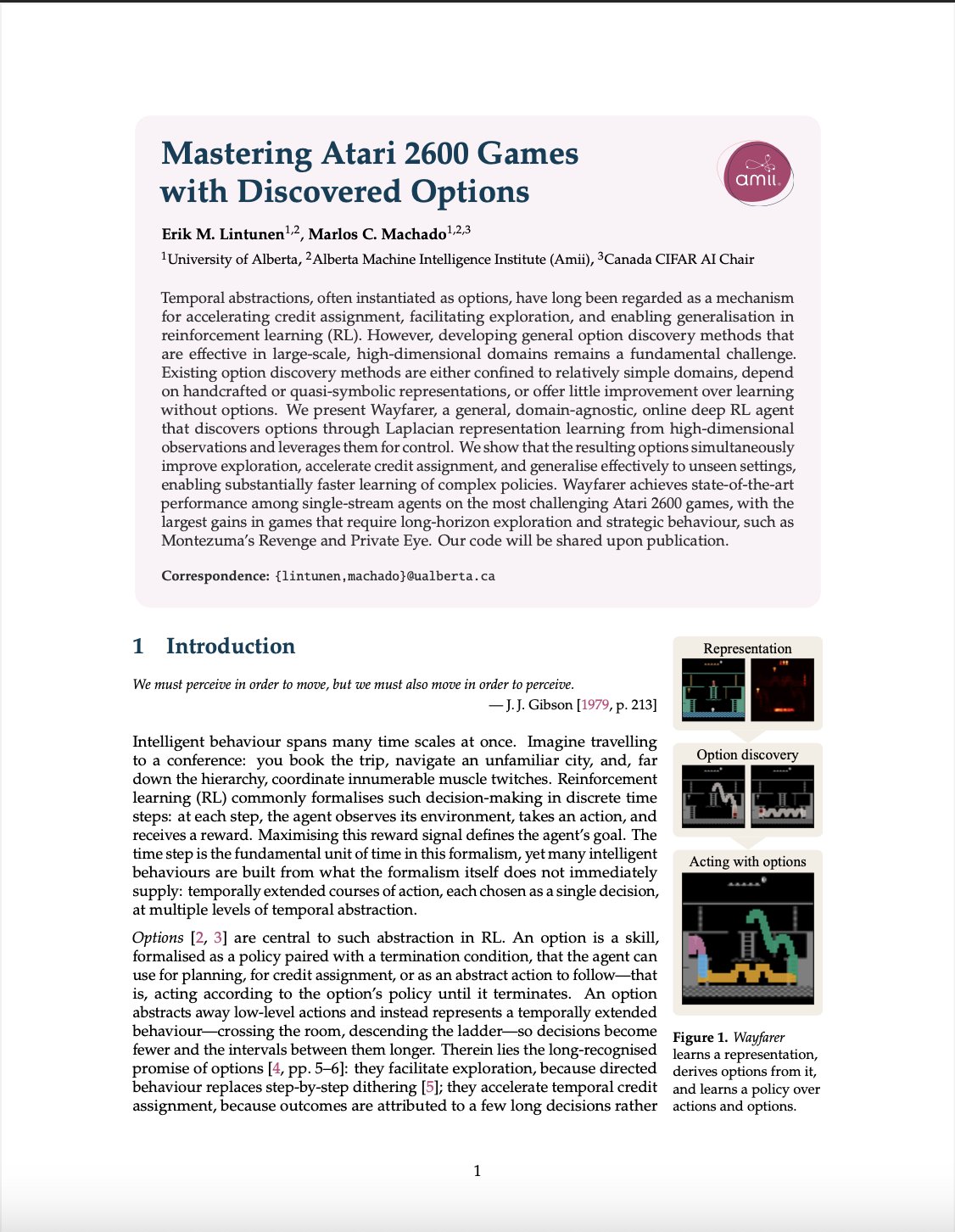
I'm excited to share Erik's work!
Mastering Atari 2600 Games with Discovered Options
We have a general-purpose option-discovery method that works w/ high-dimensional observations, tabula rasa, using a single stream of experience! It outperforms DreamerV3, Rainbow, and IQN! 1/9
Gary Wang retweeted

[Hiring a Research Scientist to Build Frontier AI Models at Google DeepMind Tokyo]
The Google DeepMind Frontier AI Tokyo team is hiring a new Research Scientist! We are looking for talented researchers to join us in building the next generation of Gemini, following today’s Gemini 4 announcement 🇯🇵
As I shared at our recent media roundtable, GDM is the only global frontier AI lab with an R&D site in Japan that works directly on developing frontier AI models themselves. Working closely with our global teams, our Tokyo site drives core R&D that elevates overall model intelligence, including Gemini Audio, the speech and audio foundation of Gemini 🎙️
In this role, you will contribute directly to the development of our frontier AI models. If you are excited to solve and globally scale challenges in multimodal AI and the diverse linguistic and cultural nuances of the APAC region—shaping the future of Gemini for billions of users worldwide from Tokyo—we would love to hear from you 🚀
google.com/about/careers/app…

🎙️ Yet another position in Google DeepMind Tokyo 🇯🇵
Want to build the future of Gemini Audio with us? 🚀
🔥 Beyond the Paper: Research that scales to billions.
👀 The Focus: Solving multilingual & APAC AI nuances.
Build the future at GDM Tokyo: google.com/about/careers/app…


Gary Wang retweeted

Very happy to announce that our team @GoogleDeepmind has pushed the boundaries of generative biology, achieving the successful synthesis of AI-designed proteins that are both functional and watermarked.
This proof-of-concept watermarking of the building blocks of life is enabled by SynthID Bio, our new protein watermarking method. It is designed to safeguard the new era of AI-powered generative biology and strengthen global biosecurity.
You can read my thoughts here on why watermarking AI-designed proteins is an important research breakthrough: xitter.cf/pushmeet/status/210531…


Gary Wang retweeted
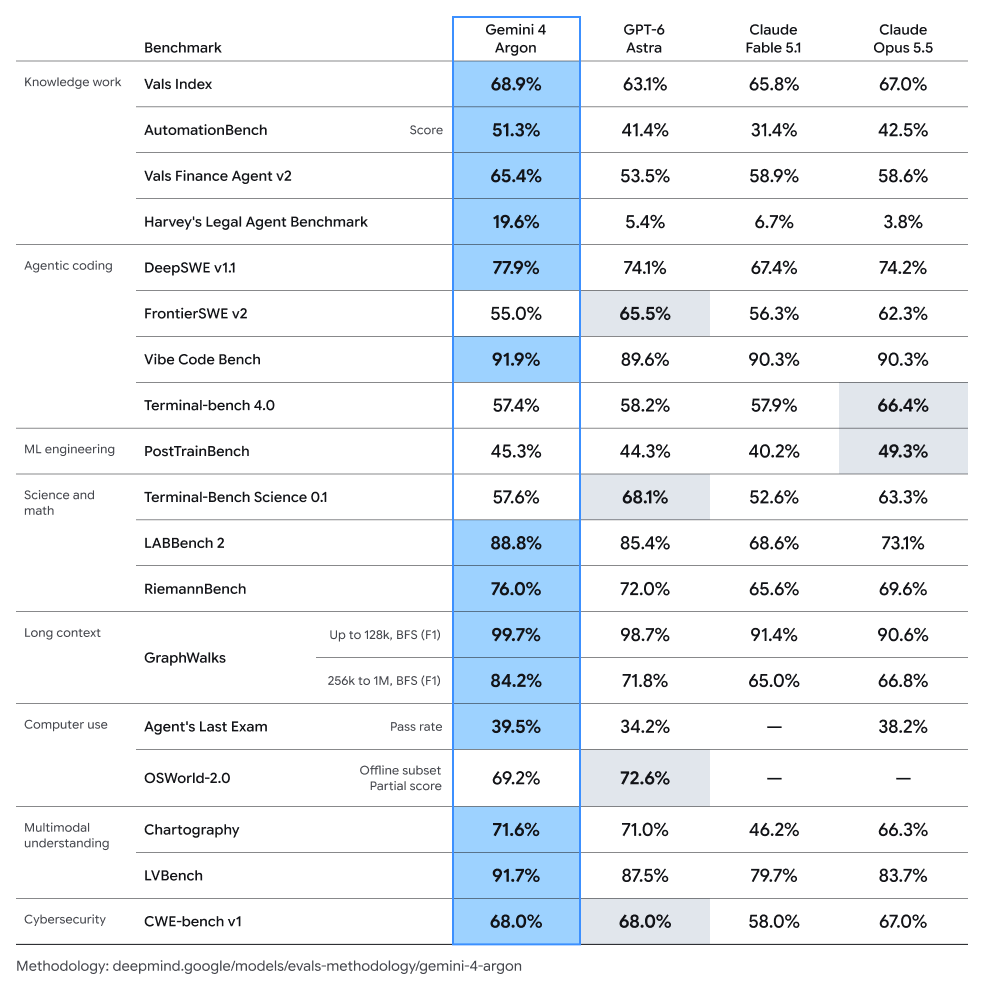
Introducing Gemini 4 Argon – our new frontier model.
It’s built for complex workflows across coding, enterprise knowledge work, and cybersecurity defense – rolling out today to a set of trusted testers through our Fairwind Program.

Gary Wang retweeted

While I'm at Interspeech, another paper is coming out: arxiv.org/abs/2609.30784
It presents a way to turn a text LLM into an audio language model without any fine-tuning, just by manipulating its memory and letting it behave like an audio LM.

Gary Wang retweeted

Who wants more speech training data?
YODAS v3 is now available @huggingface
It’s 1.1M hours - the biggest audio dataset ever. And the first at this scale with stereo audio at 48kHz, with timestamped transcripts and translations. 100+ langs
hf.co/blog/espnet/yodasv3
CC-BY-3.0
