








Normal People Saturday: Beautiful fall weather, apple picking, touching grass.
Crypto Twitter Saturday: Locked in. Desperately trying to be the first to lose millions.
Greg Di Prisco retweeted

Over the next month I will be in:
* Singapore for @token2049
* Tokyo
* SF
* Vegas for @money2020
* NY
* Sao Paulo
While most of the discourse of 2026 around stables was about institutions embedding tokenized money in their workflows, I remain convinced that stablecoins are the most powerful monetary layer for new financial products and financial applications, born globally and (often) permissionlessly.
I want to talk with as many builders as possible of digital and accessible financial experiences. If you need to embed stablecoins, liquidity for your products, yield streaming from reserves assets, compliance, programmability features, and more, I want to talk to you.
@m0 inteds to become the most comprehensive, seamless, and easy to use monetary stack for the next generation of financial experiences. Those have no boundaries, and if you live in one of the cities I will visit in the next month, you should write me.

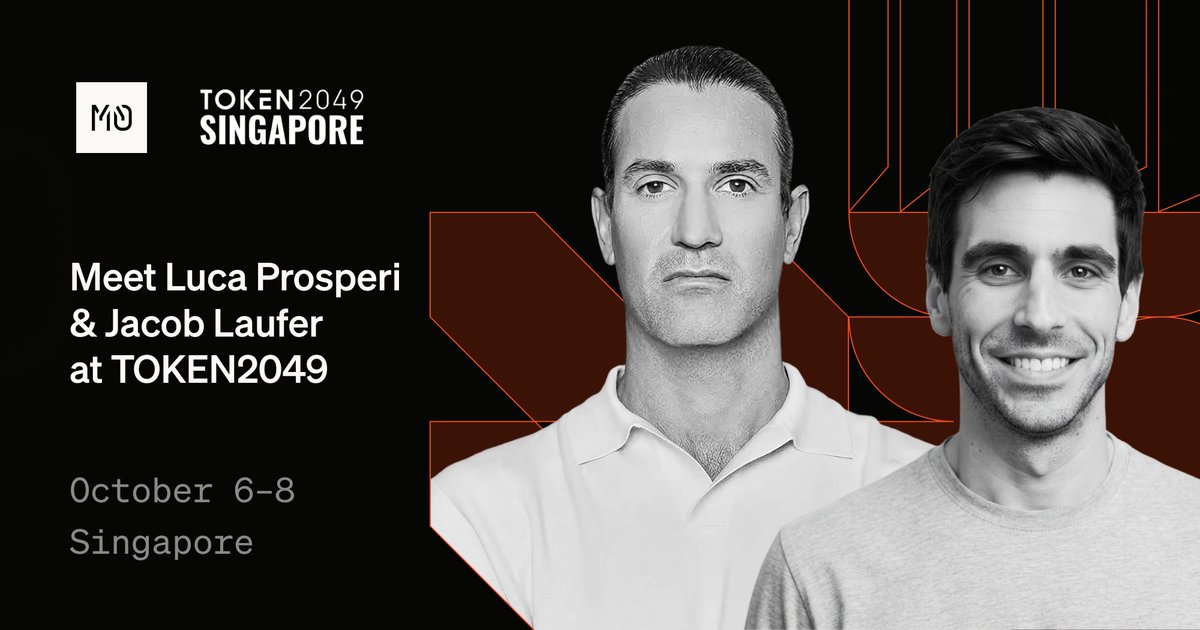
The M0 team is heading to @token2049 Singapore.
Catch us on stage at the main conference, @stblcnsummit, @PanteraCapital's Thought Leaders Summit, @DeFinition_evt and more, talking onchain finance and where stablecoins go next.
See you there.


Greg Di Prisco retweeted
.@dawninternet is opening up access to financing for the next generation of AI infrastructure so institutions and retail can access its cash flows as on-chain yield.
USD.infra is built on M0.

DAWN started with connectivity.
This gives the USD.infra Vault a strong foundation for deploying networks across digital infrastructure powering AI, compute, data delivery, and edge systems.
DAWN’s CEO, @neilc_dawn, walks you through what this looks like in practice 🎥
Greg Di Prisco retweeted

We just created a new metric for exchanges: realized perp slippage
1. We take a snapshot of the orderbook right before market orders execute
2. Calculate the slippage at which it should fill ($0.94 on Binance)
3. Compare against actual slippage on the fill (actually $1.63)


Which exchanges have your tokens? Which work in your country? What are the fees?
New on DefiLlama: Find My Exchange
50+ exchanges compared on costs, slippage, liquidity & volume. Advanced filters, token finder, and detailed per-exchange pages.
defillama.com/exchanges
Greg Di Prisco retweeted

Perp City is working with @meconemarkets to bring more real-world indices onchain.
AI usage, compute demand, inflation baskets, and other live signals shouldn’t just be charts people argue about.
They should be tradeable.
Greg Di Prisco retweeted
We can't wait to see what builders ship with PYUSDx.
M0 built the developer platform behind it: modular infrastructure that gives builders contract-level control over how their onchain products behave.




Sure, there’s a 99.999% chance Cramer just bottomed the bond market. But if even he can’t jinx our way out of this, get ready for the black swan of all black swans.
Greg Di Prisco retweeted
Money is programmable, so fragmentation across stablecoins is inevitable, and that's fine. What's missing is the technology making a dollar a dollar everywhere, instead of trading one stablecoin for another like they're different currencies, which is what we do today.
W/ @reginatto @TheCryptoMavs

Greg Di Prisco retweeted
Citrea USD (ctUSD), built on M0 and issued by @moonpay, brings seamless stablecoin liquidity to Bitcoin's growing lending, rewards, and vault ecosystem.
Excited to support ctUSD's growth.

🟣 @moonpay on-ramps for ctUSD are live!
ctUSD is officially live for direct on-ramps and off-ramps in the US (excluding New York, Colorado and the U.S. Virgin Islands) & across 120+ countries worldwide.
Bitcoin capital markets at scale!
Start now: app.citrea.xyz 🧵
Greg Di Prisco retweeted

Tokenization is coming for every asset class. It's changing how assets move, interact, and are verified across markets.
Nik Kunkel @nomos_paradox and @g_dip from @m0 on the latest Unwrapped.

Doo is the man. A biz dev machine.
The extent of my "mentorship" was giving Doo the platform and freedom to close HUNDREDS of deals in Asia.
He was an employee with a founder mindset. Rare.

I think I’ve written more than 30 references or recommendation letters this year for people applying to various roles, especially partnerships and BD positions.
The market is still very skewed, in my opinion. People with deep experience in a particular field, whether DeFi, institutional business, or a specific region such as Asia, are still highly sought after. Generalist BD roles, however, are a different story.
Here are a few notes:
1. In BD, you are literally paid for your connections. Keep those relationships warm. When you work with an important partner, or simply someone you enjoyed working with, stay in touch.
2. There’s nothing more short-sighted than focusing only on people who currently work in a particular industry, because people move around frequently. That’s another reason why it’s important to stay in touch with the people you enjoyed working with.
3. Have a mentor, and be a mentor too. I was fortunate to have Greg @g_dip as a mentor. He helped me navigate business dealings and supported me in MakerDAO. He also supported me and co-founder Gustav operating StableLab for many years. I’m also happy that I’ve been able to mentor people such as Mike @mikemu_eth , who has been spearheading various DeFi initiatives across Asia.
4. Have a higher purpose. BD involves a lot of rejection, and no one enjoys hearing “no” repeatedly. It can be a grind, but it becomes easier when the work is tied to a larger purpose. For some, that purpose may be innovation. for others, it may be revival, impact, or ambition.
Greg Di Prisco retweeted
Many reached out asking for my thoughts on @openstandard announcement. I decided to share my personal reading, and, more importantly, put it in context with my vision of the world.
First, the announcement. @stripe / @Stablecoin is not new to extremely powerful announcements—nor to announcements where evidence didn’t necessarily follow. Some will remember October 2025's Open Issuance, Bridge's open issuance platform that was meant to be a technology letting companies issue their own stablecoins, overall with limited adoption—albeit in a challenging market.
Open USD is an iteration of the same vision with the opposite architecture: no longer a modular platform, but a single purpose-built entity (called Open Standard) issuing one single token, OUSD, with governance and economics shared among participants. The emphasis has shifted from technology to shared reserve economics, free mint / redeem, aggregated liquidity, and a governance promise that remains without specifics.
The partner list is impressive on paper (140+ of the most powerful names), but its quality is harder to assess given its heterogeneity, as far as we know: (i) some partners have communicated strong commitments to embedding OUSD in their flows, (ii) others have signaled a lukewarm desire to support on X, (iii) others still (who shall remain unnamed) have expressed disappointment through various channels at being listed as implied supporters. This is, for all practical purposes, a list of signed Letters of Intent to collaborate. My honest read is that this will not be a 140-company consortium: it is most probably a @stripe + @Visa + @Mastercard initiative with an aggressive economic rebate attached, and everyone else is in that announcement for a different reason. We should be intellectually honest: OUSD might, in the long run, be a powerful force and a genuinely compelling alternative to @circle's USDC for specific use cases. This is Stripe indexing on convenience, and there is a real market for convenience. Today, however, convenience still points to USDC.
A tokenized, fragmented future. At @m0 we underwrote, years ago, a vision of the world that has been materializing, albeit more slowly than expected: most money will migrate to tokenized form (whether stablecoins or bank deposits) and it will not sit on one balance sheet. Regulation, competitive dynamics in payments and banking, and the economics of self-issuance all point to a monetary base fragmented across many issuers and many balance sheets. Open USD is, ironically, the strongest confirmation of this thesis to date. Whether liquidity and acceptance are dominated by one company willing to give away economics when required (like Circle today) or by a handful of consortia, the incentive to deviate remains. It is our conviction that fragmentation will increase, not decrease: more proprietary dollars, more counter-consortia, more balance sheets. In such a world, value creation does not reside in rent-seeking NIM retention (issuance itself is a race to the bottom) but in the layer that connects the liability claim (the money) to what it can do: inter-issuer settlement, global sophisticated payments, stablecoin-centric financial experiences, crypto, agentic commerce, geographical distribution, and more.
@m0 is building, alongside a handful of others—including many of the signatories of the Open USD initiative, to thrive on fragmentation, by unifying and settling this growing plurality of instruments rather than competing with any of them. Our conviction remains that this productive connective tissue won't be built on announcements and paper alliances, but on technology.
The future. 2026 has so far been a lateral, weird, market, in stablecoin-land: an enormous amount of positioning has been signaled (including by @m0) while very little new volume has actually materialized. Lateral markets are where narratives get sold.
The Open USD announcement is reminding us that most of the largest financial infrastructure companies in the world are heavily investing in what is the deepest paradigmatic shift in finance we will observe in our lifetimes. While this makes the journey more challenging from a mindshare perspective, it confirms that the main asset of companies like @m0, through which we will continue to grow relevance, attract resources, and increase our financial value, will remain the technology we build ahead of everyone else.
Onwards.