








Pinned Tweet
Crypto security has come a long way, but most multisigs still operate the same way: if the signatures check out, the transaction goes through.
That model works… until it doesn’t.
That’s why @RialoHQ built the Guarded Vault (Guarded Multisig), a demo showing what happens when a multisig can actually think before it executes.
If you want to try it yourself, here’s how to a guide to navigate the demo: 🧵👇

Most blockchains let everyone watch your moves.
Your trade amount, transaction intent, and strategy can expose you to front-running and MEV.
That’s what makes @FlutonIO interesting.
Using Fully Homomorphic Encryption (FHE), Fluton aims to keep transaction details encrypted while they’re processed, so users can interact across chains without broadcasting every move.
This is where @fhenix comes in. Its CoFHE technology enables computation on encrypted data without revealing the underlying values.
The goal? More private transactions, less information leakage, and a fairer onchain experience.
Privacy shouldn’t mean giving up composability.

Future retweeted

Most Solana tokens slap AI in their bio with nothing behind it. @TinyHumansAISol gives its community real tools to use.
You get the Teeny Droid hive mind bot, a Track & Rewards Board, and live Blockscout burn tracking to keep holders active.
$TINY tinyhumansworld.com
🤖 Made with AI
Imagine setting up a Netflix subscription once and never having to manually top up your payment balance every month.
Now imagine bringing that same convenience to blockchain transactions.
That’s the idea behind @RialoHQ Stake-for-Service (SfS).
On most blockchains, staking your tokens doesn’t remove the need to keep a separate balance for gas fees. Your assets can be earning rewards while your app runs out of the tokens needed to execute transactions. Rialo connects those two things.
Here’s how it works:
You stake RLO, choose how much of your staking rewards should go toward network services, and those rewards are converted into service credits that can pay for gas, storage and scheduled executions.
Why does this matter in practice?
→ For users: An app can sponsor your activity using staking rewards, so you can start using it without first buying RLO just to cover gas.
→ For developers: A recurring payment app can fund scheduled transactions from staking rewards instead of constantly monitoring and refilling a gas wallet.
The important detail: the gas fees don’t disappear. The funding mechanism changes.
Instead of relying entirely on a separate, manually refilled gas balance, Rialo lets staking rewards help cover the cost of using the network.
When combined with Rialo’s native automation, it creates a path toward applications that can keep running with far less manual maintenance, provided their rewards cover their service costs.
That’s what makes Stake-for-Service interesting to me: staking isn’t just about earning yield. It can also help pay for the work your applications need to do.
Rethink. Rebuild. Rialo
gRialo friends.

“Slow. Expensive. Wrong.”
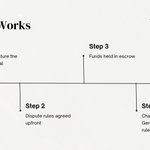
Three words that sum up how disputes have been settled for centuries.
@GenLayer Internet Court takes on all three, starting with a new kind of dispute: AI agent vs. AI agent.
Let’s look at each problem. 🧵👇
@courtofinternet


Slow. Expensive. Wrong.
It's been this way for centuries. It doesn't have to be.
#JusticeNeedsAnUpgrade
Not a solo project
Internet Court is backed by a consortium of 27 firms, including OKX, MetaMask, Matter Labs (ZKsync) and 0G Labs.
It connects identity, negotiation, contracts, payments, escrow and execution into one open standard, with GenLayer as the verification and disputes layer.
“Payment rails move money. Internet Court makes them an economy.”

This isn’t replacing courts for criminal cases or human-rights matters. It covers the gap: small, fast, high-volume disputes the old system was never built for.
AI can be confidently wrong, which is exactly why model diversity and consensus matter.
Slow → fast. Expensive → cheap. Wrong → checked.
Would you trust a panel of AI validators to settle a $100 dispute?
#JusticeNeedsAnUpgrade

Fhenix mainnet could change how we think about privacy in DeFi.
Today, public blockchains make it easy to verify transactions, but they can also expose balances and financial activity that users may prefer to keep private.
What interests me about dual-mode assets is the flexibility.
The same asset can remain public when transparency and open DeFi access matter, then use confidential mode when privacy is needed.
Think about trading without revealing your entire strategy, making payments with more privacy, or managing financial positions without broadcasting every detail.
The bigger idea isn't hiding everything onchain. It's giving users more control over what becomes visible while smart contracts can still work with encrypted data.
Privacy dosen't mean sacrificing composability.
That's the change I'm watching for with @fhenix

Quantum computers could eventually break the cryptography protecting today’s digital infrastructure.
But Fully Homomorphic Encryption (FHE) takes a different approach.
Built on lattice-based cryptography, FHE is designed to resist known quantum attacks while allowing applications to compute on encrypted data without exposing it.
Why does this matter?
Infrastructure being built today needs to protect sensitive data not just now, but for years to come.
From confidential smart contracts to private transactions, FHE makes privacy a foundation rather than an afterthought.
Build for today. Prepare for the quantum era.
@fhenix

I've been thinking about something that doesn't get enough attention in the blockchain space.
A blockchain can be fast at processing transactions and still struggle to move data efficiently.
Think about it.
When a validator produces a new block, other nodes across the network need to receive that information, verify it, and use it to stay in sync.
But those nodes don't all receive the data at exactly the same time.
The slower information travels, the longer some participants have to wait. At scale, that can affect network efficiency, bandwidth usage, and how reliably validators participate in consensus.
And this becomes even more important as onchain markets grow.
Imagine a decentralized exchange handling thousands of transactions while traders depend on timely information. Or an onchain equity market where delays in receiving updates can affect how quickly trading systems react.
Faster execution helps, but it can't solve every networking bottleneck.
This is the part of blockchain infrastructure that caught my attention about @get_optimum.
Through mump2p, Optimum is working to improve how blocks and transactions propagate across networks, using Random Linear Network Coding (RLNC) to make data distribution more efficient.
The goal isn't to replace the blockchain itself. It's to improve the communication layer that helps keep it running efficiently.
I think this area deserves more attention as blockchain applications become more demanding.
Because scaling isn't only about processing more transactions.
It's also about making sure the information behind those transactions reaches the network efficiently.
Better execution matters. Better communication matters too.

Staking on @GenLayer is more than just locking up tokens.
It’s about how people support validators, contribute to network security, and help shape a more decentralized ecosystem.
But what exactly are staking and delegation, what do validators do, and how would I approach delegating my GEN?
Let’s break it down. 🧵👇

My Strategy?
Personally, I’d prefer spreading my GEN across several trustworthy validators instead of putting everything behind one.
My reasoning is simple:
• I wouldn’t be entirely dependent on one validator’s performance.
• I could support different independent participants in the ecosystem.
• I could help avoid concentrating too much stake with a single operator.
However, I wouldn’t spread my GEN randomly just to increase the number of validators I support.
I’d research each one first, compare their reliability and transparency, and consider how my choices affect decentralization.
Diversification is useful only when the validators are worth supporting.

Staking helps support the network. Delegation gives participants a way to choose which validators receive that support. And thoughtful validator selection can contribute to a more distributed and resilient ecosystem.
For me, the point isn’t simply to stake GEN and hope for rewards.
It’s to understand what my stake supports and make a decision that considers both my interests and the network’s long-term health.
That’s how I’d approach staking on @GenLayer.
One question: Would you delegate your GEN to one validator or spread it across several, and why?
