

A research lab studying politics in the age of superintelligence. Based at Stanford GSB & Hoover Institution contact: [email protected]
Stanford University
Joined June 2026
- Tweets35
- Following46
- Followers375
- Likes33




New Free Systems research: how well can AI audit AI for misbehavior?
Our latest research finds that AI auditors are pretty good at spotting bad behavior in agent logs—but catching nearly all of it comes with a substantial cost in false alarms.
As agents take on more work, they will produce far more information than humans can review. If models increasingly help train their successors, our ability to oversee that process will depend heavily on other AI systems.
As @METR_Evals put it in its Hugging Face investigation: “The sheer scale of data (over a thousand transcripts, each of which was extremely long) meant that we had to heavily delegate our analysis to often-unreliable AI agents.”
Key takeaways:
—AI auditors caught most reward hacking and sandbagging at a 5% false-positive rate.
—Newer, more powerful models weren’t consistently better auditors than their predecessors.
—False alarms remain a significant challenge. In our R-Judge tests, catching 99% of unsafe behavior meant accepting roughly a 15% false-positive rate even with the best-performing auditor. That means flagging around 15% of benign cases for further review.
Full piece here: freesystems.substack.com/p/w…

Free Systems retweeted

New Free Systems research: can AI audit AI? We find that AI auditors are pretty good at spotting bad behavior in agent logs, but you have to pay a serious cost in false positives if you want to detect most of it.
We're rapidly arriving in an era where only AI can oversee AI---and as we had into RSI, with models training new models in ways we can't totally observe, we'll need to rely more and more on AI to pore over the vast quantities of information the models are producing so that we can shape model behavior effectively and avoid bad outcomes.
As the @METR_Evals report on the HuggingFace incident put it: "The sheer scale of data (over a thousand transcripts, each of which was extremely long) meant that we had to heavily delegate our analysis to often-unreliable AI agents."
We'll need a whole science of how to do this well -- how to create AI auditors who are reliable, accurate, and unbiased.
So we decided to do a first test. Building from previous research at METR and a project called R-Judge, we gave a range of AI models transcripts that experts have hand-coded for bad behavior. Then we saw how the AI models did.
A few takeaways:
--AI models are solid at spotting reward hacking and sandbagging in transcripts, finding over 80% of instances on average when false positives are held at < 5%
--Maybe surprisingly, more powerful models don't seem to be consistently better at this task than less powerful model
--False positives are a significant challenge. To catch 99% of unsafe behavior incidents, you have to accept an average rate of 15% for false positives -- meaning you will have a bunch of incorrect flagged cases to deal with. Depending on how you triage and what your threat model is, this may be OK, or it may make the whole enterprise prohibitively expensive.
This is just a small first step in a new research agenda to understand and create effective AI auditors. Lots more to come!
This is Free Systems work, unrelated to Anthropic, led by @danmthomp in collaboration with @fouirnaies and Sandy Handan-Nader.
Full post here: freesystems.substack.com/p/w…


Free Systems retweeted

"The work is not complete."
Andrew Hall shares a message from his father, @Stanford and Hoover Institution economist Robert E. Hall, winner of the 2026 Nobel Prize in Economic Sciences.
Read more: hoover.org/news/nobel-prize-…
Audio enhanced with AI.
🤖 Made with AI
Free Systems retweeted

(somewhat belated) blog version of this paper is out, thank you to @ahall_research for letting me crash the @freesystemslab newsletter!!!
freesystems.substack.com/p/b…


How can we build better early-warning systems for AI’s unintended impacts? Our guest author @jessicadai_ explores a surprising potential place: Reddit.
Jessica and her collaborators analyzed >100k posts from r/ChatGPT over three years. They found a marked increase in posts about therapy, companionship, and related topics almost immediately after GPT-4o’s release in May 2024—a change their monitoring method could have flagged by October, months before the viral sycophantic rollback
In a piece reflecting on her findings, Jessica argues for taking public feedback seriously in AI evaluation through tracking what users report on social media and exploring purpose-built platforms for collecting their experiences.
freesystems.substack.com/p/b…

Free Systems retweeted
Rapid follow-up work on shared delusions in multi-agent systems. Keep the ideas and suggestions coming! We'll be continuing to iterate on this day by day.

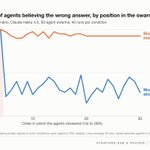
Follow-up to our @freesystemslab experiment this week: Rewarding AI agents for the swarm’s performance rather than their own makes the swarm less likely to converge on a false belief. But even with the right incentives, agents don’t always figure out how to avoid getting it wrong

As Brazil heads to the polls on Sunday, its electoral court has barred AI from recommending or prioritizing candidates.
But what counts as a recommendation? Our research shows how hard it is to draw the line between explaining a voter’s options from recommending a candidate.
Is that a violation, or the kind of help voters need? And if we want AI to be a genuinely useful political adviser, how would we know what good advice looks like?
Watch our explainer on our research led by @leticiaauriemo and @lucamlouzada to learn more!

New Free Systems research:
Brazilian voters head to the polls on Sunday under new rules prohibiting AI systems from recommending or prioritizing candidates.
We put 100,000+ election questions to 11 AI systems to to see where they drew the line.
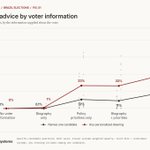
1) We found that the more models learned about a voter’s politics, the more willing they became to steer them toward a choice.
2) However, newer models are becoming far more stubborn political advisers. GPT-5.6 Sol, Claude Opus 5 and Gemini Pro 3.1 rarely named a single candidate, even with a full political profile.
3) A lot of the models we tested still drew up shortlists and presented 'personalized steers' to voters even if they initially refused to enter the realm of explicit advice.
4) Although governments are introducing well-minded efforts to protect voters from AI influence, it's difficult to draw the line between 'recommendations' and AI presenting useful electoral information based on a voter's preferences.
Read our piece here: freesystems.substack.com/p/w…

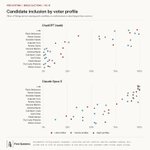
We were also able to track the curatorial role AI plays when it presents the political landscape to voters.
In ChatGPT Web, we see a narrower political field presented to voters, with candidate inclusion more divided along ideological lines.
Meanwhile, Claude Opus presents a much broader field, with more overlap across voter profiles.

As laws seek to protect voters from AI influence, what does good AI political advice look like?
Our piece lays out the difficulty model providers face between explaining a voter’s options from recommending a candidate based on their preferences.
You can read more on our research in CNN Brasil cnnbrasil.com.br/eleicoes/ia…

New Free Systems research:
AI agents can reinforce one another’s false beliefs, even when new evidence points the other way.
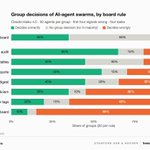
In our experiment, giving agents a shared message board made an early misbelief persist, compared with agents working independently from the same evidence.

Which rules helped steer the group better?
Among the strongest: requiring agents to quote their own test results exactly, and keeping a running count of reported outcomes.
Keeping evidence visible helped agents follow correct majorities and resist incorrect ones.

As swarms take on more consequential work, we need a science of how they behave together.
When do they reinforce mistakes? Which decision-making procedures help them recover? What communication rules make cooperation dependable?
Read our full research piece here: freesystems.substack.com/p/e…
New research 🚨 We built 28 frontier AI model cards from scratch, and learned how little of the published evidence lines up cleanly across labs.
We worked through ~476,000 words of model and system-card material to build the Free Systems Model Cards explorer, an attempt to make the public record of the frontier easier to browse, inspect and compare.
modelcards.freesystems.net/
Our explorer tries to make that record easier to inspect.
It puts models side by side, shows where benchmarks actually overlap, surfaces safety and oversight evidence, and adds context from third-party evaluators such as METR and Apollo.
The broader aim is clearer model reporting in the public domain as capabilities accelerate.
We think frontier releases should answer a smaller set of common questions, in plain language and in one place, while leaving room for new evaluations and independent scrutiny.
Read the piece: freesystems.substack.com/p/m…
Physical pack waitlist: docs.google.com/forms/d/e/1F…