







Does a long-term #warehouse commitment always mean lower costs? Not necessarily. #Flexe data shows spot rates were lower than asking rents in 17 of 33 months since late 2023. Flexe Spot Warehousing Index was mentioned in Gartner's guide: ow.ly/vUYL50ZXlOH

Buyers have leverage on warehouse space. Not on price. September spot rates dipped, but inflation and shrinking low-cost options could push prices higher. How long will buyers keep the upper hand? See the Sept. Market Pulse data across 21 regional markets: ow.ly/gMbg50ZWqzw

Finding #warehouse space shouldn’t take weeks of outreach and spreadsheets. #Flexe Search lets you explore 3,000+ warehouses across North America from one interface, then narrow by market and capabilities like climate control, food grade or rail access: ow.ly/znH950ZVuUl

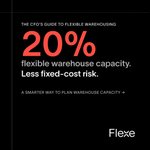
The problem with fixed #warehouse costs? Demand isn’t fixed.
The 20% Rule: keep ~80% of core capacity fixed and 20% flexible to adjust as demand changes.
Our CFO’s Guide breaks down the financial case and the math behind it: ow.ly/8M0x50ZSloq

Vacancy is up. Long-term #warehouse rates haven’t followed.
Why? Warehousing is still built around long-term commitments.
The Flexe Spot Warehousing Index brings market intelligence to short-term capacity, and right now, it’s a buyer’s market: ow.ly/wn8050ZLZkg
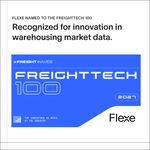
We made the #FreightTech100 list!
The #Flexe Spot Warehousing Index turned a decade of proprietary transaction data into warehousing's first published benchmark. Today, @FreightWaves recognized it as one of the industry's top technologies: ow.ly/fBZl50ZPfve

#Warehousing pressure looked like it was easing. August data says otherwise.
Demand remains roughly flat, while rising input and energy costs add pressure.
This month's #Flexe Market Pulse breaks down where the pressure's actually landing: ow.ly/Oj5Y50ZOh66

When you run the numbers on a 10%–25% #tariff increase, the tradeoff becomes clear: pulling inventory forward can cost less than paying higher duties later.
The companies doing the math early stay ahead.
See how: ow.ly/lve350YVygf

Speed matters more than ever in network design. #Flexiblewarehousing helps companies add #capacity where and when it’s needed without fixed infrastructure. #Flexe customers have seen a 50%+ reduction in ramp time. Explore real-time capacity: discover.flexe.com/?utm_sour…

Product launches drive 26% of revenue, but most #logistics networks can’t scale in time. One global gaming company launched 600K units using a flexible #warehouse network, hitting strict street dates with precise ship timing. See how: ow.ly/xxUm50YAU7u
#FlexibleWarehousing
Better #supplychain decisions start with better visibility.
Real-time insight into inventory and operations is now foundational for supply chain teams. The next step is visibility into capacity itself.
Explore real-time #warehousing capacity: ow.ly/Fshh50YzUZf

Supply chain #innovation isn’t about chasing new #technology, it’s about removing constraints that limit agility. See how future-ready #supplychains turn disruption into advantage: flexe.com/articles/innovatio…

Last-mile transportation can account for more than half of D2C shipping costs.
Network design is now a key cost lever. More #warehousing access gives #supplychain teams flexibility to position inventory and respond to demand.
Explore real-time capacity: ow.ly/CuyL50YzUGq

Capacity planning shouldn’t require long-term commitments. With the Spot Warehousing Index, teams can instantly search warehouse space & compare dynamic pricing across locations, aligning storage costs with real demand & adapting faster when markets shift: ow.ly/u9wn50Yp7Gy

Pandemic-era warehouse vacancy hit 3.3%. Today it’s 8.3% yet rents are ~50% higher than pre-pandemic. The challenge isn’t just capacity, it’s transparency. See how we give teams visibility into capacity & pricing across 800+ operators and 3,000+ locations: ow.ly/7LyR50YpFYH

Warehousing has long lacked the transparency of spot freight markets. Our new Spot #Warehousing Index delivers real-time visibility into capacity, vacancy rates, and site-level costs so teams can make decisions based on current market conditions. See how: ow.ly/XMWC50Yp6kW

Fast, affordable #delivery wins eCommerce, but expanding fulfillment networks has long been slow & complex. Flexe Discover changes that, giving companies real-time visibility into flexible warehouse capacity so they can launch new fulfillment nodes faster: ow.ly/e6p050YpEqq

When demand spikes, fixed #distribution can become a bottleneck. A top 5 food & beverage manufacturer expanded capacity to move 350+ extra truckloads each week, driving millions in added sales. See how aligning distribution to demand unlocked #peak growth: ow.ly/4ucy50Y4lY3

For #supplychain leaders, the real test of a #logistics partner isn’t just today’s performance, it’s adaptability. Fixed logistics models struggle with change, while flexible approaches help organizations respond to uncertainty, scale with demand and evolve as requirements shift.

Modern #distribution depends on the systems behind it. Managing multiple contracts and systems slows teams down. See how a single integration for a distributed #warehousing network helps teams gain visibility, reduce complexity, and respond faster: ow.ly/PVnY50Y4jBV
